25 March 2017

With Bike-Friendly Cities Like These, Who Needs Enemies?

You know you're an adult when you make the same mistakes as your parents made. 

Sometimes it seems that policy-makers define "progress" in a similar way.  Your city is becoming as big, important and hip as the "big boys" when it emulates their policy and legislative blunders.

At least, it seems that way whenever a city wants to tout itself as "bicycle friendly".  Hardly a day goes by without my learning that some municipality or another tries to show that its affinity for bicycles and cyclists.  The other day Houston was making its declaration of love.  So was Durham, North Carolina.

The enlightened leaders of both metropoli seem to think an alliance with cyclists seems  to involve the same things.  One is "encouraging ridership", whatever that means.  Another is building more bike lanes.

Photo by Marlo Stimpson

The latter always seems to be accepted as the ultimate sign that someone's fair city really and truly wants to make the world--or, at least, its world--safe for cycling.  Surely, they believe, riding in a designated bike lane is better than riding in traffic.  Even if that lane is poorly maintained. Even if there's nothing to stop cars and trucks from parking in it. Even if it leads into a turn more dangerous than anything a cyclist would have to navigate from the main roadway.  Even if it ends, without warning, in the middle of a block.

Or even if that lane is a "contraflow" lane:  a one-way street turned into a roadway shared with bicycle traffic running in the opposite direction from the motor vehicle traffic.

Welcome, Durham, to the Pantheon of Bicycle-Friendly Cities in the United States.  With friends like you, we don't need enemies!

24 March 2017

No Matter What He Says, The Earth Isn't Flat!

Is she opining?  Or is she just whining?

That's a fair question to ask, sometimes. I am sure that I blurred, or even crossed, whatever line separates reasoned evaluation from mere complaint.

That line exists somewhere between recalling what was and lamenting that they aren't what they used to be.  I will attempt to straddle the line but will probably cross it with what I'm about to say.

Time was when being a celebrity meant being a kind of model for the public.  People--especially kids--listened to what they said and tried to emulate them; public figures acted accordingly.  Most of the time, anyway.  Today, though, it seems that being a celebrity is just a license to wear your silliness or stupidity--or display your vitriol--on your sleeve.  Or, as the folks in psychology might say, it gives you permission to live by your id.


During an election season that led to the coronation of hominem qui calumniatur, all some people could talk about was someone who got famous for being famous getting robbed of more than some developing countries own.  It is no wonder, then, that a celebrity who, not so long ago, would have been considered a world-class buffoon is considered to be a harmless side-show, or a cartoon cariacture, for embracing a notion that not even illiterates have espoused in half a millenium.

That notion is that the earth is flat.  And the celebrity who declared it to be a truth is none other than Shaquille O'Neal.

Now, just as El Presidente and Mrs. Kanye West (and, for that matter, Kanye West himself) have stayed in the public eye by being stupid, vulgar or, at times, simply gross, Shaquille's schtick, if you will, is his goofiness.  Even so, his declaration that our blue and green orb is shaped like a flapjack was even more ridiculous than anything else he's done.


From The Human Cyclist


To be fair, today "Shaq" walked back his absurd pronouncement.  Also, in the interests of fairness, I should point out that he is not the only one "who should have known better" but nonetheless made such a crazy declaration. There is, after all, a worldwide organization for those who still believe the notion that The Tall One embraced for three days.

Now, of course, as cyclists, we didn't need Columbus getting lost or photographs from space to prove to us the Earth isn't flat.  Some days, it seems as if we're always pedaling uphill!

23 March 2017

"Uber For Bicycles" Coming To Your Town?

As happy as I am to see bike-sharing programs, I have to admit that I haven't used one myself.  When I'm home in New York, I have my own bikes.  The Florida city where my parents live doesn't have a program and I have a bike (such as it is) there.  And, when I've traveled during the past few years I've rented bikes, even in cities (Paris and Montreal) that have share programs.

I rent bikes mainly for a few reasons.  One is that rental bikes are generally better than share bikes. Also, I figure that renting a bike is actually less expensive, given how much I ride, than using a share bike.  Finally, I would rather use my credit or debit card just once, when I pay the rental shop or agent, than to insert or swipe my card in a docking station every time I use a share bike. I'm no expert on cyber-security, but I reckon that the less often I have to use my card, the less vulnerable I am to theft.

But the main reason why I prefer to rent than to use a share system is that I like having the freedom to ride where I want, for as long as I want, without having to worry about finding a docking station.

Cyclists ride bike-share machines around Hangzhou's West Lake. 


During the past year a number of Chinese start-up companies, led by Mobike, have tried to solve the problem. Users of their services download an app that tells them where to find a bicycle, which they unlock by scanning the bike's code into their phones or using a combination they are sent. Then they can ride wherever they want or need to go, and leave their bikes wherever their trip ends.

Three years ago, Beijing's bike share program was deemed a bust.  Increasing affluence brought more cars, seen as symbols of prosperity, into the city and people started to see bicycles as primitive.  Now business is booming for the "Uber of bicycles", as the dockless bike program is called, in the capital as well as in other Chinese cities.

Share bikes piled up near entrance of Xiashan Park in Shenzhen.


In fact, some residents as well as officials complain that they can't park their own bikes when they ride to work, school or wherever because bikes from the dockless share program are parked, often haphazardly, in spaces designated for residents' bikes as well as in other areas--including, at times, the streets.  

Still, the proprietors of those startup companies want to export their service and expand the prosperity they have enjoyed.  They are looking at other Chinese cities, as well as municipalities in Europe and the US.  (Interestingly, of the world's fifteen largest bike share programs, thirteen are in China.  The other two are the ones in Paris, which comes in at number five, and London, which is twelfth.

While some would welcome an "Uber for bicycles", as the service is often called, others fear that they will suffer from the same problems of parking and congestion that are now seen in Chinese cities--especially since some of those places, like Hangzhou and Shanghai, have compact centers that contain historic districts with narrow streets.

N.B.:  Photos are from The Guardian.

22 March 2017

The Idaho Stop: A Women's Issue (Or: Does Obeying The Law Kill Us?)

I learn some interesting things from my students.

From one of them--a criminal justice major--I learned that the vast majority of crime is committed by males between the ages of 15 and 25.  After that age, the crime rate plummets, and there is an even more significant difference between the lawlessness of males and that of females.


Or, to put it another way, females are more law-abiding than males.  Of course, that usually works to our advantage, but there are instances in which it doesn't.


One of those areas in which it doesn't is in traffic law, as applied to cyclists.  In most municipalities, the law requires cyclists to stop for red lights, just as motorists do.  Of course, such laws are not evenly enforced:  A state highway cop in a rural or suburban area is more likely to give a summons for running a red light than an urban police officer, and in cities, Black or Hispanic cyclists are more likely to get tickets (or worse) than a White or Asian person on two wheels.


But, according to studies, women are, proportionally, far more likely than men to be run down by heavy transport vehicles while cycling in urban areas.  As an example, in 2009, ten of the thirteen people killed in cycling accidents in London were female.  Of those ten, eight were killed by "heavy goods vehicles", i.e., lorries or trucks.  That year, about three times as many men as women cycled in the British capital.


That stark reality reflected conditions described in a report leaked by The Guardian's "Transport" section.  According to that report, 86 percent of the female cyclists killed in London from 1999 through 2004 collided with a lorry.  In contrast, 47 percent of male cyclists killed on London streets met their fates with a truck.


In unusually blunt language for such a study, the researchers concluded, "Women may be over-represented (in collisions with goods vehicles) because they are less likely than men to disobey red lights." (Italics are mine.)  They, therefore, confirmed what many of us already know:  We are safer, particularly in areas of dense traffic or in the presence of heavy vehicles, if we get out in front of the traffic in our lane rather than wait for the green light--and run the risk of getting smacked by a right-turning vehicle.


A DePaul University study of Chicago cycling and traffic patterns made use of the British study and came to a similar conclusion.  More broadly, the DePaul researchers concluded that it would be more practical and safer to mandate the "Idaho stop" for cyclists.  


In essence, the "Idaho stop" means that cyclists treat red lights like "Stop" signs and "Stop" signs like "Yield" signs.  It allows cyclists to ride through a red light if there is no cross-traffic in the intersection.  


Believe it or not, Idaho enacted that law all the way back in 1982.  Since then, no other state has adopted it, although a few Colorado municipalities have enacted stop-as-yield policies since 2011.  Interestingly, a 2012 decree allows cyclists in Paris to turn right at--or, if there is no street to the right, to proceed straight through-- a red light as long as they excercise prudence extreme and watch for pedestrians. Three years later, that policy was modified to allow cyclists to treat certain stop lights (designated by signage) as "yield" signs as long as they are making right turns or going straight through "T" junctions.


The funny thing is that you don't hear or read the kinds of flat-earth rants about cyclists in the City of Light that we regularly find in American discourse.  And, it has seemed to me, cycling is generally safer than it is in New York or just about anyplace else in the US I've ridden.


Now, back to my original point:  Allowing the "Idaho Stop", or even the policies of Paris or those Colorado municipalities, is not only a cycling or transportation issue.  It's a women's issue!


21 March 2017

Happy Spring Equinox!

According to the calendar, today is the first full day of Spring in the Northern Hemisphere.

The day is more or less springlike, at least weather-wise.  We had warmer weather a couple of weeks ago and last week, while the storm wasn't as intense as the forecasters predicted, snow fell and the temperature dropped, leaving sheets of ice on sidewalks and streets.

Tomorrow is supposed to be almost wintry, and there might be a warm-up next week.

I have noticed a few trees and flowers budding.  Soon we'll see more.  Now, if I move out of this country--as so many of us said we would if you-know-who was elected--I could go to the Netherlands, just to have a morning commute like this:


Then again, in a few weeks, I'll find vistas like this not so far from my apartment:

From The Province 


Crocuses, lilies, irises cherry blossoms:  They're all wonderful.  Best of all is biking by them.


Even if her "bike" has a 1200cc engine, I like the way the "Steel Cowgirl" welcomed the season last year:


Happy Spring Equinox, everybody!

By Michael Titherington.  From the Working Bikes Cooperative of Chicago

20 March 2017

A Menage A Trois Of Wolves?

Every culture has its odd and interesting ways of describing natural phenomena.  One of my favorites is the "mariage du loup".  The first time I heard it, I wondered what a wolf's wedding had to do with the weather I'd just experienced.  For that matter, I wondered whether wolves indeed had weddings:  Was there something I missed?

I was cycling near Chenonceau, which alone made me a very privileged individual at that moment. (Really, there are very few better places to ride!)  The weather that day created the sort of picture that every agence du tourisme likes to post on its websites or brochures:  a sea of sunflowers softly undulating a reflection of the sunlight that filled the clear blue sky.  

At least, that's what I saw until the early afternoon.  Then, I felt a couple of drops plip onto my arms.  For a moment, I thought it was sweat, as the air had warmed up.  But then I felt a few more drops on my legs, and on top of my head.  Those drops were falling from the sky--but the sun shone as brightly as it had earlier in the day!

That night, I described my ride to a hostel-keeper.  "Une mariage du loup," he said.  

Most of you,  I am sure, have experienced a "sunshower", perhaps during a ride.  Although I've experienced them here in New York, I think they're more common in more open areas, like the countryside I was touring when I experienced the "mariage du loup".

I encountered it again, sort of, yesterday afternoon:


My first ride since last week's snow took me to Randall's Island, where rain fell on me as the sun shone.  Well, actually, it wasn't rain:  The snow was melting from the railroad viaduct over my head.  

Now, if a train had rumbled overhead, I would have had a sun-thunder shower.  Would that be a menage a trois des loups?

19 March 2017

How Many Bikes Do You Have?

How do you explain this?


Is it the team van for a very low-budget operation?

Or is the driver (or a passenger) shopping for a bike and can't decide on one?

Or could there be another explanation?

Whatever it is, I hope the driver (and/or passnger(s)) are not part of a bike-theft ring!

18 March 2017

Bicycling While Black In The Windy City

Two decades ago, I was living on Bergen Street, on the northern side of Park Slope, Brooklyn.  I was midway between Fifth Avenue, then one of the area's main shopping strips, and Flatbush Avenue, one of Brooklyn's main throughfares. 

The latter street was often called, in a grim joke,  "The Mason-Dixon Line."  The difference between the two sides of the Aveune was literally black and white.  I ended up on the white side.  Some time after I moved there, I realized that all of the apartments the agent with whom I'd dealt showed me were on the side of Flatbush where I lived.  

The local precinct house was just on the other side.  I often heard stories about how differently each side was policed.   It was during that time I heard an expression that may be familiar to you: Driving While Black, or DWB for short.

Of course, the phenomenon was not limited to that neighoborhood--or, for that matter, to any particular American city, or to the US.  It's also not surprising to realize that there's a two-wheeled equivalent:  BWB, or Biking While Black.


biking_while_black_is_a_crime.9286566.87.jpg
From phmelody.com


Yesterday, an article by Chicago Tribune reporter Mary Wisniewski revealed that of the ten community areas with the most bike tickets from 2008 to September 2016, not a single one has a white majority of residents.  Seven of those neighborhoods have an African-American majority, while Latinos are the majority in the other three.

What must be most galling, particularly to Black and Hispanic cyclists in the Windy City, is that the neighborhoods with the greatest numbers of cyclists are mainly-white enclaves such as West Town and Lincoln Park, whose cyclists didn't come anywhere to getting as many summonses as those in such communities as Austin and North Lawndale.


But African-American cyclists are bearing the greatest burden of constabular harassment, according to Wisniewski.
"As Chicago police ramp up their ticketing of cyclists," she writes,  "more than twice as many citations are being written in African-American communities than in white or Latino areas."

Some law enforcement officers and commanders repeat an argument I have heard before and is condescending or simply insulting, depending on your point of view.  In essence, they say people in low income (which usually means African or Hispanic) communities are less educated and therefore more ignorant of the rules of the road.  But others, including cycling advocates, point out there are simply more cops on the streets because of their higher crime rates, so there are more opportunities to stop cyclists in such neighborhoods.

Whatever the explanation, such tactics can only worsen relations between the police and non-white residents in a city where, by many accounts, such relations are worse than in most other cities.

And don't get me started on relations between cops and cyclists--or trans women!

17 March 2017

Shay Elliott and The Roches On St. Patrick's Day

Today is St. Patrick's Day.  Here is a message for the President whose name I dare not say:


Actually, it might be even more appropriate for the guy he appointed to direct the Environmental Protection Agency!


Yes, "Go Green" on St. Patrick's Day!  And every other day of the year.  That might just be a good all-around political philosophy.  Forget the Democrats and Republicans. Go Green!


Today is as good a day as any to think about the great Irish cyclists.  I am one of the many people who regard Stephen Roche as the greatest of all.  He remains, to date, the only Irishman to win the Tour de France and one of the few from any nation to achieve a "Triple Crown" with victories in the Tour de France, Giro d'Italia and Vuelta a Espana in 1987.  In addition, he won or placed highly in a number of "classics" and proved himself in a wide variety of courses, from mountains to time trials.  


The reason why he will never have the status of Jacques Anquetil, Eddy Mercx, Bernard Hinault and Miguel Indurain--whom I, like many other fans, see as the "Big Four"--is that his career was cut short by a chronic knee problem.  But the reason why he's beloved is that probably no other racer's form was as graceful as his.  He really was, to use a cliche, poetry in motion.


Roche, Sean Kelly and every other Irish rider owes a debt to Shay Elliott.  In 1963, he became the first Irishman to win the maillot jaune, which he wore for three days during that year's Tour.  


Unfortunately for him, his career spiraled downward because of financial and marital problems.  Worse, he became a pariah in the peloton when he sold a story to a newspaper about drug-taking in the sport.  Two weeks after his father died, he was found dead in the living quarters above the family business premises.  The cause of his death, at age 36, was a gunshot wound.

The Route de Chill Mhantain, a race held every May, was named for Elliott after his death.  It's considered the most prestigious race in Ireland besides the national championships.


About the Irish Road Race and Time Trial Championships:  Last year, they were won by a fellow named Nicolas Roche.  Yes, he's Stephen's son.

16 March 2017

Collecting 200 Years Of Bikes

There are all sorts of great reasons to visit the Bourgogne region of France.  There are the food and wine, of course.  If you're interested in art, history or architecture, the place is a treasure-trove.  And the cycling is great.  I know:  three of my bike tours included excursions to the area.

Speaking of which:  In 2010, la Musee du Velo opened in the town of Tournus, which is also home to l'Eglise de Saint Philbert, one of the oldest and best surviving examples of Romanesque architecture.  Earlier, the Musee had been in nearby Cormatin, where it closed due to financial reasons in 2007.  

I saw the museum in its earlier location.  France is known for such monumental museums as the Louvre and Orsay, but small, quirky places like the Musee du Velo are found all over the country.  (If you're in Saumur, you simply must check out the Musee du Champignon. Really!)  

One of the things that makes the Musee du Velo so interesting is its collection.  It includes a version of the hobby-horse Karl van Drais created 200 years ago and is considered, by some, to be the first bicycle.  


Another fascinating artifact is this brake on an 1869 bike:


I hear someone's still trying to break that saddle in!

There are also a number of penny-farthing (high-wheel) machines and one of the first Tour de France bikes to use a derailleur in 1937, when such mechanisms were first permitted in the Tour.

I got a kick out of this 1938 triplet


with its drop bars in front and two moustache bars (No, Grant Petersen didn't invent them!) for the "stokers".  If you want to turn your kids into tandem riders, there is this:


If their legs tire out, let one of them ride this 1950 machine


which can be propelled by pumping the handlebars from side to side!

In addition to these and other bikes, the museum has a fantastic collection of Tour de France memorabilia, items from chinaware to match boxes with images of bicycles and cyclists, and what might be the most beautiful collection of bicycle bells in the world.


The museum's collection might be said to have begun with this:


which was used by a fellow named Michel Grezaud.  He was a butcher in the area during the 1950s who used that trike to make deliveries.


He is also the one who amassed the museum's collection and, with his wife Josette, founded the original museum.  Sadly, he did not live to see it in its new location.

15 March 2017

Thinking About The Bicycle

Go to any residential college or university--or even to some commuter schools--and you will see racks full of bikes.  Where racks are lacking, bikes will be locked to lamp posts, fences and any other stationary object.

It's likely that the majority of those bikes belong to students.  Administrators don't seem to ride much, but more than a few faculty members (including yours truly) pedal from their homes to their campuses. 

Given how many bikes and riders are on American post-secondary campuses, it's astounding that so little academic attention is paid to them.  I don't recall any course about any aspect of bicycles or bicycling--or even any class that mentions them in any way--offered in any of the schools in which I've studied or taught.

Among that rare breed of academic offerings is something with an unlikely title.  At least, the first part is unlikely--for a college class, anyway:  Cars Are Coffins:  Ideologies of Transportation, offered at Adrian College in Michigan.

The emphasis is, of course, on the second part of the title.  The course in question "draws attention to how decisions we make concerning mobility and the design of our public environments have profound implications for how we understand community and identity," according to Scott Elliot, one of the course's instructors.  A study of such matters is important, he says, because it provides an "opportunity to discuss matters of justice, ethics and quality of life."

What makes that course unique (to my knowledge, anyway) is that it includes work in a bicycle shop.  The students dismantle, repair and reassemble bicycles, in part to make them intimately familiar (if they aren't already) with the mode of transportation they're studying.  Another reason for this work is that it brings students into contact with people and communities they might not otherwise encounter.  You see, the shop in which they work isn't selling carbon fiber machines with five-figure price tags to investment bankers.  Rather, it's ReBicycle, located in the same town as the college.

Adrian College senior Scott Campbell works on a donated bicycle under the guidance of  Scott Dedenbach, a professional mechanic who volunteers at ReBicycle.  Photo by Mark Haney of the Daily Telegram.


Like similar shops in other locales (such as Recycle-A-Bicycle, which I've mentioned in this blog), ReBicycle refurbishes used bikes donated to them.  Some of those bikes are sold; others are earned by people--including some students--who take their classes and volunteer in the shop.  Places like ReBicycle and RAB, as a result of such work, serve a wider cross-section of a community--from people who see bikes strictly as a form of transportation to those who cycle for fun, and a few as a religion--than bike boutiques.  

Elliott and fellow Adrian professor Tony Coumondourous taught a smaller but similar course for two years.  That effort helped to bring about Bruiser's Cruisers, the campus bike sharing program.  The increasing demand for the service and what the class was teaching were among the factors that motivated Elliott to continue and expand the course this year.

Another thing that spurred him on was an experience he had last July: "I was nearly killed when I was hit by a drunk driver while riding my bicycle".  If such an experience doesn't highlight how auto-centric transportation planning and infrastructure are (at least here in the US), I don't know what does.  

Interestingly, neither Elliott nor Coumondouros has any formal education or training in urban planning or engineering.  They are both professors of Philosophy and Religion:  Elliott is a Bible scholar and literary theorist, while Coumondouros is a specialist in ancient and political philosophy, the history of philosophy--and ethics.  So, not surprisingly, students in the bicycle course come from a wide variety of majors and backgrounds.

Talk to any scholar and educator, and he or she will probably tell you the purpose of research and education is not to "know stuff".  Rather, it is helping people to learn ways of thinking about a number of topics, including some students may not have previously considered.  From what I can see, Coumondouros and Elliott are doing that for their students, precisely because they had to do it for themselves.

14 March 2017

So You Think You Need A Fat Bike?

This is what the Iditabike race looked like in 1988:


Mark Forman's video was originally broadcast on The Discovery Channel.  

13 March 2017

Blown Off, Literally

The Blizzard is imminent.

That's what the weather forecasters have been telling us since Friday.  We're going to get hit with a nor'easter that will bury us in snow, leaving us for future archaeologists to unearth as they did in Pompeii.  And the wind will whip the snow around, leaving whirls and swirls and bubbles like frosty cappuccino foam.


Well, now I believe that the storm is coming.  The college in which I teach, and its university, will be closed tomorrow.  After all, whose wisdom is more infinite than that of our school's administrators?  Certainly not that of the National Weather Service!


All right, I'm being snarky.  At least, that's what I want to believe:  Otherwise, I'd have to accept the fact that I'm being silly.  But, whatever our storm brings, I don't think anyone will run a bike race through it.  And if there were one, I'm not even sure that my old, crazy, self would have participated.


I mean, look what happened to some riders who rode in blizzard-like conditions.


So they didn't have any snow.  They did, however, experience the sort of wind we are supposed to have tomorrow morning.  


The race in which no one could stay on his bike is the 40th edition of the Cape Town Cycle Tour.  At least, it was supposed to be.  The race was finally halted "due to safety concerns."


Given that the race is in South Africa, it's no surprise that wind wasn't the only obstacle.  Protesters, upset that pegs used as placeholders for shacks were removed, burned tires and tossed rubble on the roadway before the race. 

12 March 2017

Fixer Cat

Were you one of those kids who always wanted to help his or her mother or father when they were cooking, cleaning, fixing or making things?

Do you have a kid like that?  Or does your kid like to "supervise"?  Maybe you were that kind of kid.

What about your pets?  How do they behave when you're maintaining, repairing or building your bikes?

Marlee and Max, my feline housemates, like to poke their noses in whatever I'm doing.  I've tried to teach them how to do basic stuff, like fixing flats, oiling chains, chopping garlic and grading students' papers. But they always have the same excuse:  "We don't have opposable thumbs!"

That's all right.  I am convinced that they are good luck.


I think this one would agree!

11 March 2017

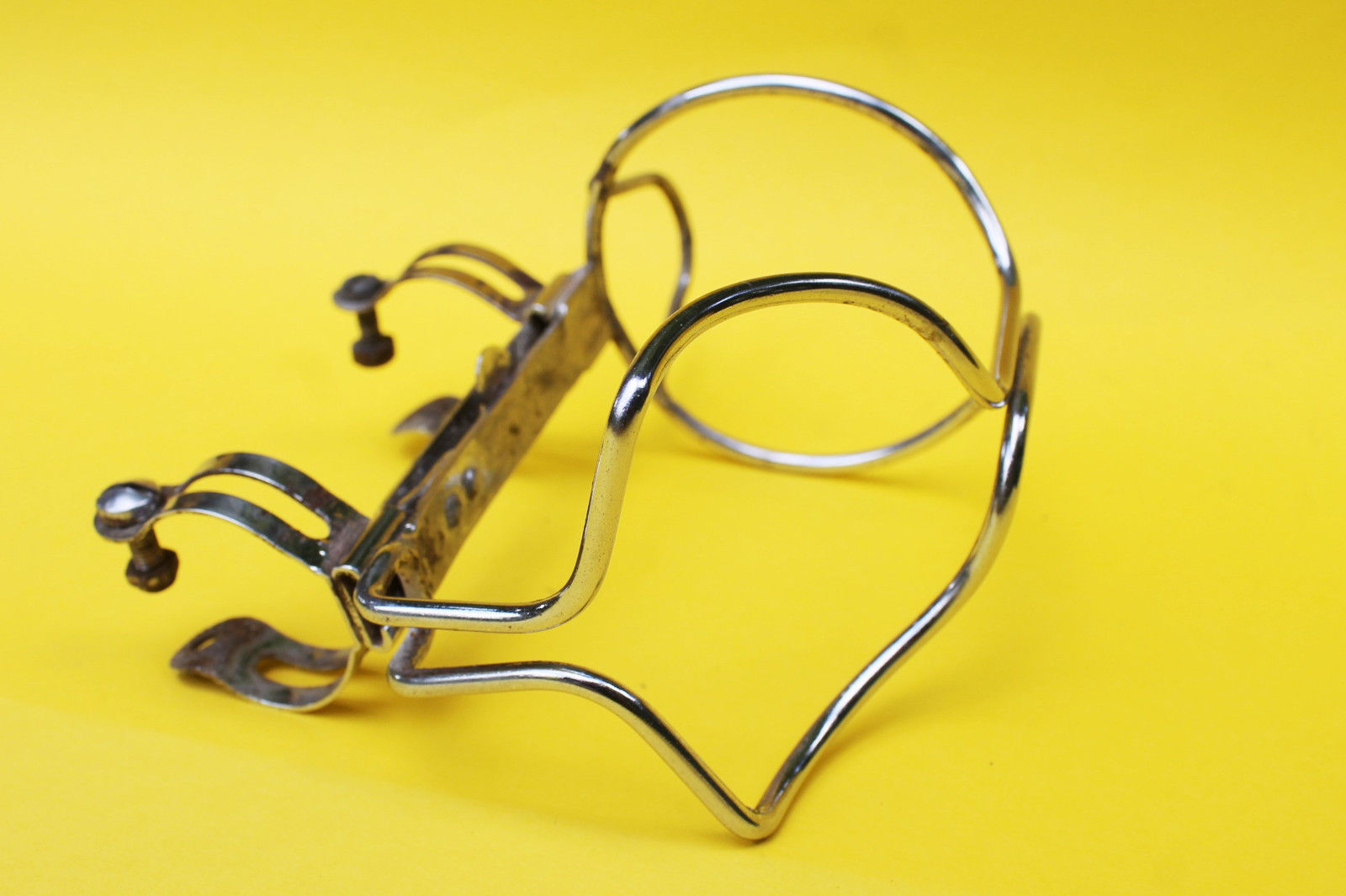
A Water Bottle Cage Decaleur? From Specialites TA?

I know I'm working on a project--or doing my usual late-winter/early- spring maintenance and overhauls--when I'm spending way too much time on eBay.

That's when I start to find all sorts of weird and interesting stuff. To wit:


The seller, in Austria, says it's a French-made, possibly by Specialites TA. I couldn't find any reference to it in TA brochures or catalogues I've located on-line. Given that the cage is French, and looks interesting and well-made, it's easy to understand why the seller might think it's from TA.


The shape of it is echoed, at least somewhat, in the beautiful Nitto R cage.  But the Nitto cage is not made to be used with clamps. Perhaps the cage I saw on eBay isn't, either. That leads me to wonder whether whoever made the cage also made the mechanism that attaches it to the clamps--and, according to the seller, allows it to be easily removed from the clamps.  Or was it made by whoever bought the cage and installed it on his or her bike?


Hmm...Were water-bottle cages being lifted from parked bikes?  I can't think of another reason for a mechanism like that. A decaleur for water bottle cages?  What a concept!

10 March 2017

Just Bring Her Bike Back

Stealing a bike from anybody is bad enough.  But stealing it from an 11-year-old girl takes a particular kind of depravity.

Whenever I hear about someone stealing, I want to believe--or at least hope--that the thief was desperate.  There is,  however, no room for such hope when the thief steals a bike that is way too small for him, or any other person over the age of 14, to ride:  Small-wheeled bikes for young children have very little, if any, resale value.  

Still, those bikes mean everything to the kids who ride them.  "I learned how to ride a bike on it,"  Brianna Jiminez recalled, as tears streamed down her face.  She has "lots of memories" on it, she said.


At least there is some chance the the thief will be caught:  His image was captured on a surveillance video from her family's front porch, where he took her bike.  The bike burglar also took wallets, purses, jewelry and other items from the Jiminez's neighbors in Houston.

Her father, Pablo isn't "looking for trouble".  All he wants is for the thief to "get the items back."  He won't press charges and has this message for the crook:  "If you need somebody in your life, let me help out."

09 March 2017

As I Was Saying...

If you've been reading this blog, you know that I am, in general, not a big fan of bike lanes.  At least, I don't like bike lanes as they're (mis)conceived, designed, constructed, regulated and maintained here in New York, and in too many other US locales.

And I have another peeve about bike lanes--again, mainly about the ones here in the Big Apple.  One of my posts from a few days ago began with it:

One of the reasons I don't like to use bike lanes, at least here in New York, is that motor vehicles frequently pull in and out, and sometimes park, in them.

Well, wouldn't you know it...This is what I encountered while riding to work this morning:


A few weeks ago, a new bike lane opened on the north side of Hoyt Avenue, the wide boulevard that straddles the entrance to the RFK Memorial Bridge.  Traffic is westbound, one-way on the north side, above which the bridge's pedestrian-bike lane arcs.  (Traffic is eastbound one-way on the south side.)  The lane runs eastbound--in the direction opposite the traffic.  There are two rationales for that, I guess:  1.) The lane is intended, at least in part, to provide access to the bridge's pedestrian/bike lane; and 2.) The lane is "protected", meaning that there are pylons separating it from the motorized traffic.

Although the lane hasn't been open for very long, this wasn't the first time I've seen a vehicle parked in it.  Worse, I've seen a truck or van in the lane, and another motorized vehicle on the sidewalk: There are maintenance and storage facilities in the real estate around the bridge pillars. 

Woe betide the cyclist who unwittingly turns on to the lane: If both the lane and the sidewalk are blocked, there is no choice but to ride in the traffic lane--against traffic--or to make a U-turn back on to 26th Street, which is one-way. If the sidewalk is free, a cyclist can use it as long as some highway cop with too much time on his hands isn't looking to meet his ticket quota for the month.

For the time being, I think I will take the route I had been taking most days before the lane opened:  I will ride up 23rd Street to the south side of Hoyt Avenue, turn at 27th Street, cross under the bridge overpass and access the bridge's pedestrian/bike lane from there.

I must say, though, that in spite of the obstacle, I had a pleasant commute.  As you can see in the photo--which I hastily took with my cell phone--it was a beautiful morning.  And, when I stopped to take the photo a nice young lady named Rachel--who probably thought I was looking at a GPS or some other app-- asked whether I was trying to find something.  I explained what I was doing and told her about this blog.  And she told me about some rides that might start soon on Randall's Island, where she works--and through which I ride during my commute!

08 March 2017

Why Else Would We Ride?

Today is International Women's Day.

I won't sully this post, or blog--or, for that matter, the digital world--by recounting what Trumplethinskin (a.k.a. TrumplerasPUTIN) tweeted.  I will only say that his missives are the very epitome of condescension or pure-and-simple insincerity, depending on your point of view.   


Instead, I'll repeat something I've included in previous posts.  It comes from the far-more-esteem-able personage of Susan B. Anthony:


Let me tell you what I think of cycling.  It has done more to emancipate women than anything else in the world.  It gives women a feeling of freedom and self-reliance.

Surely she would have been happy to see these young women helping another learn how to ride:


Also, she would have been happy to see their outfits:  They were free of the whalebone corsets and voluminous dresses and skirts "proper" ladies were expected to wear.  Instead, they were attired in the far more practical "bloomers", patterned after the pants worn by fashionable ladies in Istanbul--and named for their designer, Anthony's fellow suffragist Amelia Bloomer.


Another fitting quote for this day, in my opinion, comes from Queens homegirl Cyndi Lauper:  


Girls Just Want To Have Fun:  Is there a better reason for us to ride bikes?