20 October 2017

In Cuba: Away From Bikes, And Back

It happened in the US after World War I.  It happened, perhaps to a lesser degree, first in England, then in Continental European countries, after World War II.  And it happened in China and Cuba during the early years of this century.

The "it" is this:  Greater prosperity led people to forsake the bicycles they had used for transportation and recreation in favor of automobiles.  When it happened in the US, surviving bike manufacturers sold the public on the idea that a bicycle is a toy--or, that if it is indeed useful as transportation, it is suitable only for those who aren't old enough to drive.  On the other hand, in England and the rest of Europe, adult cycling survived mainly as a recreational activity practiced by a slowly but steadily declining portion of the population.  

In the US, England and continental Europe, those who switched from cycling to driving seemed, as often as not, to see the bicycle as a symbol of privation--or of those things which they had "grown past" or "grown beyond".  This was particularly true for poor or working-class people who acquired the means to own a car:  They simply would not dream of "going back".  I believe that this is one reason why we see more bicycle disdainers among people who are, say, over 50 than among the young.  


Similar phenomena have taken place in China and Cuba.  In both countries, especially China, the bicycle was a, if not the, primary means of transportation-- particularly in cities.  The leaders most identified with those two nations--Mao Tse-Tung and Fidel Castro--had much to do with turning people into cyclists.  Both rulers saw the bicycle as a "people's" way of transportation, and the "Communist"* parties they led promoted it as such. 

But while the numbers of bicycles and cyclists in China grew steadily from the time of the Revolution (1949) until the end of the century, Cuba experienced a surge in cycling during the 1990s.  The Soviet Union, the island's chief benefactor, had just collapsed.  In its wake, the supply of cheap petrol that had flowed to the Pearl of the Antilles dried up.  So did the cash subsidies from Moscow, which meant that less was spent on public transportation and other infrastructure improvement.  

And so did the supply of bicycles from the Soviet Bloc.  Some people bought bikes from foreign tourists or other sources.  It was at that time that the first bicycles were manufactured in Cuba:  one model, called the Minerva.  It left most people wishing for imports and black- or gray- market bikes:  The Minerva was of "poor quality," according to Lazaro Pereira, a bicycle repair specialist in the city of Cardenas.  "The forks split, and when this happened, passers-by would mock people falling off their bikes," he recalls.

I imagine that alone would have stopped some people from cycling.  But in the early 2000s, the island began to recover from the loss of Soviet subsidies and cycles, and people abandoned two wheels in favor of four.  Bicycles developed a "negative connotation...associated with the poverty that characterized this period," according to Naybis Diaz Labaut, the owner of VeloCuba, a repair and rental enterprise in Havana.  She has seen "significant movement in the world of bicycles in Cuba" during the past five years or so, which has allowed her to open two shops.

All of the bikes she rents, or that her guides use on tours, were purchased from foreigners.  Even with the increased interest in cycling, the bikes sold in Cuba are "Chinese models made of iron" and "of poor quality," she says.   She believes that cycling "has a big future in Havana" even though it has yet to achieve the popularity it's regained in the provinces.

Still, one of the biggest challenges to the growth of cycling in Cuba, she says, is motorists--and not only because many of them won't get out of their cars and bike on their bikes.  There is a "lack of motorist education," she explains:  A generation of people has grown up without cycling, while some older motorists have been away from cycling for a long time.


That sounds like a problem we still have in the US and it won't change tomorrow, as several post-World War I generations didn't ride bikes as adults, or at all.  At least the Cubans have lost only a decade or so rather than a generation.

19 October 2017

Cycling: Socially Profitable--And Good For Business

As an undergraduate, I took an economics class.  The thing I remember most is the professor intoning, "Marginal Revenue equals Marginal Cost", then pounding the podium  and shouting "Always!"  I don't recall, exactly, what that means, but I do understand--more or less--by two other phrases he seemed to use in every class:  "supply and demand" and "benefit cost analysis."

That last phrase might be one of the few things I actually understood in that class, which may be the reason why it's probably the only thing I took from that class and used in my daily life.  Well, sometimes, anyway.  I guess most of us perform some version of a "benefit cost analysis" when we're making important decisions.  

Of course, the "benefits" and "costs" are not always monetarily measurable, or even quantifiable in any other way.   For example, we might give up some free time in order to volunteer for something, or simply to help someone.  The "cost" of the free time can't be measured; nor can the "benefit" of serving meals at a soup kitchen.  

Sometimes the costs and benefits of something are both quantitative and qualitative or, if you like, empirical and subjective.  An example is a city's efforts to encourage cycling.  

What's interesting is that the authors of a study from the Spanish research group Applied Economics and Management, which is based at the University of Seville, set out to discover whether building cycling infrastructure in their city--and generally--is a net gain.  One thing that sets their study apart from others like it, however, is that the economists involved didn't try to calculate only business profitability.  Instead, they tried to measure what is commonly called "social profitability":  Does the investment make the city a better place to live?

Now, if you ask cyclists--or people who want to make their cities "bicycle friendly"--that question in reference to bicycle infrastructure, their reflexive answer would be "Yes!"  And, on the whole, the authors of the study agree, but with some caveats.


Those researchers seem to share some of my skepticism about bike lanes.  Indeed, they conclude that it's not enough that Seville has constructed 140 kilometers (about 87 miles) of bike lanes or 260 bike-share share stations.  They are just two elements of a scheme that would actually entice more people to ride bikes to work, school, shop or play.  The authors, therefore, advise that other  "complementary services", such as places to safely and securely park bicycles at the beginnings and ends of routes, are necessary.  Absent such measures, they say, cycling for transportation in Seville "will probably enter a period of stagnation, not to say decline."

Yes, they understand that "bicycle infrastructure" isn't just bike share programs and bike lanes and that they alone don't make cities "bike friendly."  (If anything, the poorly-conceived, designed, constructed and maintained bike lanes I've encountered probably keep people from cycling and discourage those who've just started.)  Moreover, they also acknowledge that public projects often end up costing a lot more than anyone anticipated, especially in a country like Spain, notorious for its corruption and the over-spending that results from it.

Even weighing in such factors, the researchers found a remarkably high social profitability to the bike lanes and stations that have been constructed. That, even as University of Seville Economics Professor Jose Ignacio Castillo Manzano, the chief author of the study, says that his team used a "conservative approach" that didn't take into account such factors as the reduction of traffic and noise levels or the national and international recognition the city has earned for its use of the bicycle.

So, the short answer is, yes, building bicycle infrastructure--the right kind, anyway is socially profitable--and good for business!

18 October 2017

Can't Stop Thinking About Him

I took the day off from work yesterday.  I'm going in today and I hope to have time afterward for a ride (besides my regular commute), however short.  I think it's the best way to deal with my feelings about Max.


He's not the first cat I've lost.  But he has experienced so much with me.  To be more exact, he was a sweet, loving presence through both the joys and the trials of the past ten and a half years.  


Max was at the door when I came home from a couple thousand days of work, a few hundred bike rides, trips to see my parents in Florida, trips to see my friends in France and other trips to Italy and the Czech Republic--and to Colorado, for my surgery.  He was with me during some difficult times, when people who said they would "always be there" for me changed their minds, and when a beau revealed his true, abusive, colors--and nearly destroyed my life.   


Most important of all--at least to me--he was with me as I was re-defining myself as a person, and a cyclist.  He didn't care whether I raced or if a 150 kilometer ride took half an hour, then an hour, longer than it did when I was in my twenties, thirties or even early 40s.  He didn't even care when I had a "bad hair day": something that was never a concern of mine when I was younger.


I had long heard that orange cats were the friendliest.  Max certainly lived up to that.  He was all love, all the time.  And when he wasn't basking in someone's affection, he was doing the other thing he did best:


A friend of mine, Michiko, called him "The Zen Cat."  Now you know why.  Maybe I should remember his calm affection today, as I ride to work and, hopefully, somewhere--even if it's just a park near work--afterward.

17 October 2017

R.I.P. Max

I've just lost a friend.

You've seen him on these pages.  He's one of the most loving and friendly beings I've ever known. 


Sometimes he would climb on me while I was sleeping.  I didn't mind: When I woke to him, I felt the sun rising.  He looked like a sunrise.


I am talking about Max, the orange cat who's lived with me for ten and a half years.


He came into my life on 9 April 2007.  My friend Millie rescued him from a street near us.  She told me that when she saw him, she walked right up to him.  He did the same for me the first time I saw him.


What that meant, of course, was that he is anything but a feral  cat.  "He must have had a home before," Millie observed.  When I saw him, I couldn't not give him one.


The vet said he was between five and seven years old when I brought him home.  So, that means he lived about sixteen or seventeen years--a pretty good lifespan for a cat.


Even if he'd been in my life for only a day, he could have given me a lifetime of happiness:  That is what he carried with him, and couldn't help but to give.  He greeted everyone who came to my apartment--including Marlee, the day I brought her home--like an old friend and playmate.


He died late Sunday night, after I'd come back from a nice ride, had a sumptuous dinner and talked to my mother.  I wrote yesterday's post about the ride I took Sunday, the day before, because it was just too difficult to talk about Max.


He won't be waiting for me at the end of my next ride.  Not physically, anyway.  I believe, though, that I'll see him at the end of many rides for a long time to come.


Note:  In a sad irony, I lost another cat--the first one I had who was named Charlie--on 16 October in 2005.

16 October 2017

Seasonal Indecision

Yesterday was one of those days that couldn't seem to decide whether it was very late summer or not-quite-early fall.  


My ride started in a cool mist on Tosca, my Mercian fixed gear.  It was actually pleasant:  I felt every pore and orifice of my body opening in a very pleasant way.


I headed for the Rockaways.  The cool mist clung to silent streets, still homes and closed stores--and to me--as I spun through the western Queens neighborhoods near my apartment.  


But, after I crossed under the "el" (elevated tracks, or viaduct for those of you who don't live in New York), the warm mist turned into a mild steam bath on my way across Jamaica Bay to Beach Channel.  Then, as I crossed the Veteran's Memorial Bridge into the Rockaways--and from the waves and clouds of Jamaica Bay to the tides and sky of the Atlantic--I experienced something I normally experience in early spring:  the temperature seemed to drop 20 degrees (F).  That is normal in April, when the air temperature on the mainland might be in the 70s (F), but the ocean is only in the 40s.  Yesterday, however, the air and water temperature were probably not very far apart:  somewhere near 70F, though it felt cooler along the Rockaway Boardwalk.


It's one of those odd coastal days that I truly enjoy:  The sky is overcast, though still only slightly less blue than the sea on the horizon, and that cool mist swirling about me.  I rode under that sky, by that sea and in that mist all the way to Point Lookout.  


Then the clouds broke and the sun peeked through--at least as I looked eastward from the Point.  Behind me, conditions were the same as the ones through which I'd ridden from the Rockaways.


And that is what I rode in all the way home.  I didn't mind:  Such conditions are actually welcome, at least for me, during the last few kilometers of a 125 kilo fixed gear ride!


15 October 2017

Comment Moderation

As of yesterday, I began to moderate comments.  So, if you don't see your comments right away, please don't panic.

I have started this practice because, lately, I've received quite a few "spam" comments.  Mind you, none were mean or offensive; most were non-sequitirs or were merely trying to sell us something.  But I don't want spammers to take up space on this blog, which should be for me and those of you who are interested.

I guess I should count myself lucky:  Until a month or so ago, not much "spam" found its way to this blog.  Hmm...Could attracting spammers be the price of fame? (As if I have gotten so much of that from this blog! ;-) )

I hope you all understand.

A Curious Vehicle

You know you're getting old when you mention a name that was on everybody's lips when you were young--which doesn't seem all that long ago--and a young person has no idea of  who you're talking about.

That happens from time to time when I teach:  I might utter the name of a song, band, TV show, movie or anything that was part of the culture or news when I was young and my students look at me as if I'd started to speak Basque.  

Something similar could happen if I say "John Howard" to a cyclist who's, say, a couple of decades younger than I am.  Actually, the young 'unz might think he was part of the British Invasion or some white-bread politician. 

But if you're my age, or not much younger, you remember that he was part of that generation of cyclists that put the USA on the bicycle world's map. His star rose as American racing--and cycling--rose from its "Dark Ages" during the 1970s.  

It's hard not to wonder what he would have been like had he been born, say, a decade or two later than he was.  Greg LeMond was no doubt a talented rider, but coming along nearly a generation after Howard gave him the advantage of having faced better-trained competition than Howard had at home before he went to race in Europe.  But Howard did well in a greater variety of events, including the early Ironman triathlons.  Moreover, Howard held a land speed record that stood for a full decade--a geological age in the world of sports records.

He also was something of a philosopher:


14 October 2017

She's Back. And She's Like I Remember Her, Only Better!


She's ready.


In late June, I sent Vera, my Mercian mixte, back to England for some rejuvenation.  She was riding just fine as she was, but I wanted to fix a couple of things.  One was the seat lug:  I think someone tried to jam a 27.2 seat post in it when the bike really takes a 27.0.  As a result, I had to use a shim to keep the seat post from slipping.


Vera no longer has that problem.  The folks at Mercian replaced the seat lug.  They also took the old cable guides off the down tube and replaced them with bosses that can be used for shift levers--like the ones that are on the bike now--or the cable stops that are used with Ergo/STI shifters, which I would need if I ever change to bar-end shifters.


I also wanted to clean up the bottom bracket, headset and other threads.  Not surprisingly, they did a good job at Mercian--Hal, at Bicycle Habitat, told me everything went together easily.


So why, if I have worked as a bike mechanic, did I let him put the bike together?  Well, he's the one who introduced me to Mercians.  Also, Vera was getting special treatment, so I figured it was only appropriate to give the job to someone who's been working with bikes for far longer than I did.  Plus, he enjoys working on Mercians.


Finally, though, I wanted to allow Vera to be the pretty bike she is.  That's why I had her re-finished.  I liked the old finish (British Racing Green with gold transfers and lug lining) well enough, but I thought Vera should get a chance to kick up her heels.

I decided that I don't want all of my bikes to be the same color, but I want to keep them in a "family", if you will, of colors I like.  As I've mentioned, the Vincitore Special I ordered is going to be painted Lilac Polychromatic (#17) with Deep Plum Pearl (#56) head tube and seat tube panels, topped off with white transfers and lug lining.

Because of the slope of the twin top tubes, it's difficult to put panels on a mixte frame without distorting the proportions of the frame.  At least, that's how I feel.  So, I opted for a single color:  Mauve Pearl (#53), with white transfers and lug linings.

And I simply could not resist the '50's style headbadge.


I was pleasantly surprised to see a seat-tube transfer that matches the headbadge.


And, perhaps, one of the more esoteric decals of all:


I knew that Reynolds made "respray" decals, but I hadn't seen many of them.  


You may have noticed something else about Vera's new look.  Hal convinced me not to use metal fenders again:  He believes I broke a couple of pairs of aluminum fenders on this bike because the aluminum is thin and because I "squeezed" them into the frame.  He also convinced me that this bike would look better with black fenders than with shiny (or matte-finished) silver ones.


The SKS/Bluemels fenders Vera now wears have piping on their sides.  They reminded me, somewhat, of the "ribbing" on some of the classic English and French fenders--and the Velo Orange Facettes I had on this bike before the "makeover."

The piping, though, serves a non-decorative function:  They're reflective. 


The bags were made by Ely Rodriguez of RuthWorks.  I will most likely keep the seat bag on the bike, but I may use one of the other bags Ely made for me on the front, where I have a Nitto M12 rack.


This "makeover" didn't change Vera's ride.  Then again, I didn't want it to:  It's nimble and comfortable.  And, yes, stylish:  Isn't style the point of having a twin-tube mixte?


As much as I love Vera, getting her back now makes me even more eager for the Vincitore Special I ordered.  Just five more months, if all goes as planned! 


13 October 2017

Escaping Another Kind Of Slavery--With Bicycles

Had bicycles been available, it's not hard to imagine that slaves would have used them to escape from their enslavers.

Perhaps Brandale Randolph had that in mind when he named his new business the "1854 Cycling Company".  In the year for which the company is named, US President Franklin Pierce began to fulfill a campaign promise that helped him win election to the office:  To enforce the Fugitive Slave Act, he pressured officials in the "free" northern states to arrest former slaves and return them to their former owners.

One such former slave, 19-year-old Anthony Burns, was arrested in Boston, Massachusetts and sent back to Virginia.  This led to a protest in nearby Framingham led by abolitionists Sojourner Truth, Henry David Thoreau and William Lloyd Garrison.  There, Garrison held a match to a copy of the Constitution, calling it "a covenant with death, an agreement with Hell."

The 1854 Cycling Company's flagship model is called the "Garrison" in his honor.  And a pair of road bikes are named for Ellen and William Craft, who escaped slavery in 1848 to become authors and lecturers.  Knowing that, I have to wonder whether Randolph will name another model "Douglass".


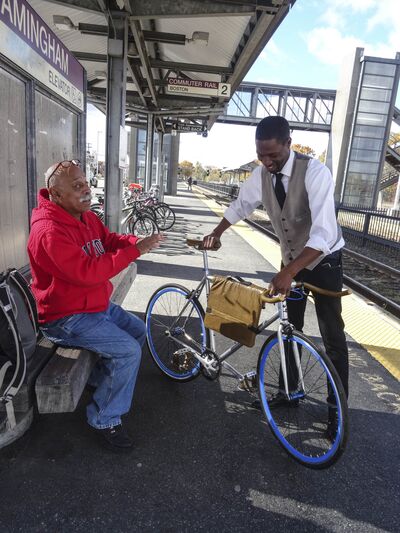
Brandale Randolph shows one of his early "1854" bicycles to a Framingham resident.

And, yes, the bikes--built around classically-designed steel frames with modern touches--are being built in Framingham.  But most important of all to Randolph is the homage he is paying to the 13th Amendment of the US Constitution.

That amendment, passed after the end of the Civil War, outlawed slavery nationwide.  Many people--including yours truly--argue that the prison-industrial complex is today's version of slavery.  So, apparently, does Randolph:  He is employing recently-released prisoners and starting a training program that will help bring all of the manufacturing in-house--and teach the parolees valuable skills they can use, whether they continue to work for him or elsewhere. And he will pay them "living wages," he said.

He started making bikes only this year and is looking for financing to move his company forward.  His plans, as idealistic as they are, have basis in his knowledge and experience:  A former hedge fund manager, he graduated from the streets of South Central Los Angeles to the prestigious Thacher School (by way of A Better Chance, a program for inner-city kids) and earned a degree from the Wharton School of the University of Pennsylvania. (Irony of ironies:   A certain Wharton alum is now in the White House!)

His business instincts tell him that the bicycle market will grow "exponentially" in the next ten years, as more and more people, particularly in cities, give up their cars.  His vision is not to become a major manufacturer like Specialized or Giant, or one of the"niches brand, like in craft beers", that "only have to sell a couple" of their bikes every year.  He wants to fit "somewhere between the two", he explains.

That might be just the right spot for him--and those whose escape from modern slavery he is trying to aid.

12 October 2017

Borne--And Born--Out Of The Fire

Sometimes natural--or human-caused--disasters can make it impossible to drive a car or truck.  Roads might be impassable, gasoline supplies could be low or non-existent or wind, rain or other conditions might reduce visibility or eliminate it altogether.

During such crises, some people ride bicycles to stores that might still be open,  to check up on relatives, friends or neighbors or even to rescue or transport victims.  Last month, after Hurricane Harvey struck the Gulf Coast of Texas, Jeff Whitehead pedaled 300 miles from his home in Laguna Park, a town near the center of the Lone Star state, to the coastal community of Rockport "just to do whatever I could to help," he explained.  He could not have made that trip in his car due to the destruction wrought by the storm.

Other times, however, it's not the disaster itself that makes driving impossible:  it's, ironically, other drivers.  A mass exodus from a storm, wildfire or other catastrophe can lead to huge traffic jams on roads leading out of the afflicted area.  That is what happened to Charity Ruiz when she evacuated her Santa Rosa, California home in the wake of wildfires that have singed their way through the northern California wine country.

The traffic tie-up stopped her in the middle of a street on fire.  She feared, not only for her own life, but for those of her two daughters--and yet-unborn baby son.


Yes, she is pregnant.  In fact, she is due to have a C-section next week. (That is on hold, because the fires closed the hospital in which she was scheduled for the procedure.) That makes what she did to get herself and her children out of harm's way all the more heroic.

She ran back to her house and grabbed her bicycle, which is equipped with a toddler trailer.   With her two girls in the trailer, she pedaled through the fire.  


Her greatest worry, she said, was tipping over and falling.  "I just kept yelling at the girls, 'Tell me if you're OK'," she recalled.

After riding for a while, a Good Samaritan in a Jeep drove them to a friend's house, where they were reunited with Charity's husband Mike.

The family is now staying with relatives in San Jose.  And one day, Charity Ruiz will be able to tell her son of all that she did to bring him into this world!


11 October 2017

Just Ahead Of The Dawn

This semester, I teach early classes on Monday and Wednesday. Yes, I volunteered for that as part of a deal, sort of. But that's another story.

Anyway, today I decided to ride to work a little earlier than usual so I could do a bit of work before classes.  Also, I sensed I would have an even more pleasant commute than usual.


I pedaled across the Queens span of the RFK Memorial Bridge just in time to see the sun rising over the North Shore of Queens and Long Island--just beyond Rikers Island, and just ahead of a southbound Amtrak train that would pass over the Hell Gate Bridge.


And I was pedaling just ahead of the sunrise.  One of my students said I brought light into the room today.  I wonder whether she saw me riding across the river, in front of Hell Gate.  

10 October 2017

Are We 19 Percent More Lawless Than We Were Last Year?

Are New York City cyclists committing 19 percent more traffic violations than they were last year?

As of 1 October, the New York Police Department handed out 23,452 summonses to cyclists in 2017.  During the same nine-month period in 2016, cyclists in the Big Apple were issued 18,991 summonses.

"Ticket blitzes" are a common topic of conversations I have with other cyclists in this town.  Of course, the NYPD--like just about every other police department--denies that its members engage in such practices, or are under pressure to meet quotas.  It does, however, seem that we are ticketed en masse over certain hours, days or weeks.

It also seems that we are ticketed disproportionately compared to drivers.  I take that back:  There is evidence of this.  Officers often say that, under the law, we are operating vehicles and are therefore subject to the same regulations.  They are mostly correct about that. However, I have witnessed many drivers running red lights or talking on their phones while driving.  I have never seen any pulled over and ticketed.  Drivers routinely "gun it" through yellow signals in the intersection nearest my apartment,  and none ever seem to be penalized for it.  


cyclists, nyc, biking nyc, bike tickets
Photo by Billie Grace Ward

And their actions can have far more serious consequences--but not to themselves, usually.  The metal surrounding them offers protection--to them, but not the cyclists, pedestrians (some of whom are residents of a senior center on the corner) or anyone else who happens to be on the outside.

Also, many cyclists feel "targeted" by the police.  I know I did when I was summonsed last year in Harrison:  The cop, on a motorcycle, followed me for about a kilometer to the intersection where I was charged with pedaling through a red light. The fact that it was near the end of the month and the officer told me to plead "not guilty" and just happened to be at the front desk when I appeared in court leads me to think that as a cyclist, I was simply an easy mark.  And, I am sure, other cyclists in New York City and other places are ticketed for that reason alone.

Or it could just be that the NYPD is under some mandate to raise 19 percent more revenue than it raised last year?  Who knows?

09 October 2017

What If He'd Had A GPS?

Today Columbus Day is being celebrated in the US.  When I was growing up, it was always observed on 12 October.  But, some time during the '70's, many traditional holidays were moved to Mondays because folks in the government realized it was cheaper to close offices for three days in a row rather than to interrupt the work week.  Of course, not too many people complain about the three-day weekend.

This morning, I was talking with my friend Mildred.  She is not a terribly political person, and she doesn't normally involve herself with what much of the alt-right derisively calls "identity politics".  Today, though, was different.  The first thing out of her mouth was, "They should take down his statue! They should re-name that circle at 59th Street!"

From her daughter, she recently learned that he was a "murderer" and "rapist".  I assured her that there was much I didn't know for a very long time, so she shouldn't flagellate herself.

I tried to make light of the situation.  "And on top of everything, he got lost."  She laughed.

She shares an Italian-American heritage with me.  So she practically applauded when I said, "We have Michelangelo, Galileo, Dante and Armani.  Why do we celebrate a guy who got lost?"


Image result for Columbus Day sale bicycle
Add caption

That got me to thinking about another feature of this holiday: sales.  All of the big department stores are running them.  So are many smaller retailers.  Interestingly, bike shops don't seem to follow their example.   I guess there's no particular reason for them to have a sale today.  What could they offer?  GPS devices?  What would history have been like if Chris had a Garmin Edge?  

I think I'd get lost even if I used one.  I may have descended from the same line of people as Columbus.  Sometimes, though, I think that all I inherited was his sense of direction!

08 October 2017

07 October 2017

If Marcel Duchamp Had Done It....

Last week, I gave the students in one of my classes a very short piece of writing. Some said it looked like a haiku and, perhaps, it bears a passing resemblance to one.  I asked the students why that particular piece of writing--which doesn't rhyme, at least not in the way of, say, a ballad or sonnet--was published in a poetry magazine.

At first, there was the silence of students afraid of seeming ignorant.  But I reassured them that I wasn't looking for a right answer: I just wanted to know what they thought, and why.

Then, a student pointed out the imagery and figurative language.  Another student said the piece of writing didn't rhyme but had "echoes"--internal rhymes.  Finally, another student mused, "Well, the writer said it's a poem and the people at the magazine thought it was a poem.  So I guess it must be a poem."


I still don't know what to make of that answer.  I told him--and the rest of the class--to take a look at Marcel Duchamp's "Bicycle Wheel"--which, in fact, is a bicycle wheel in a bicycle fork mounted upside-down in a stool--and ask themselves whether or not it's a work of art.

Funny I should give that assignment and, soon afterward, come across this:


Police in Springfield, Missouri are investigating what they are calling a "property situation" at a house that's been vacant for some time.  In addition to the bicycle wheel hanging from a tree, there are bicycles and parts strewn about the property.  Bicycle tires had been thrown through windows.  A large trampoline hung from the chimney and a smaller one, with a bicycle on it, topped the house.


When police officers asked a man at the house next door whether he knew what happened, this was his reply:  "Bicycles."  Other neighbors wouldn't talk to the cops.  An employee at a nearby Domino's pizza said she noticed the bike parts, but not the trampolines, a couple of days earlier.


Since no one seems to know how or those bikes and parts ended up on the property, some folks--including a writer for a local newspaper--wonder whether it was an act of vandalism or an art installation.

Hmm...If Marcel Duchamp had done it...


06 October 2017

I Am Happy To Pass My Wrench To Them

Yesterday I "outed" myself in the Women's Studies class I teach.

Now, I am guessing that a couple of students knew that I'm transgender because they're on the "rainbow" themselves.  And, I suspect one or two others might've known because they Googled my name and found that I indeed published and did all sorts of other things under my old name and identity.  And, perhaps, one or two might've guessed just because, well, they've seen enough different kinds of people: They're in New York, after all.

I told the students about my history because this week's readings, discussions and writing assignment were about the different kinds of feminism.  I joked that the class was going to be the Baskin Robbins of the women's movement, as we read about Black, Lesbian separatist, Asian and other kinds of feminism, as well as the ways in which feminism intersects with other areas such as the Civil Rights movement and Disability studies.

Oh, and they read a bit about  transgenders and feminism.  That, of course, was my "segue" into "outing" myself.

I will soon find out what sort of an effect that has on the class dynamic, and the students themselves.  But I told them, toward the end of class, that because I am transgender and started to live as a woman in my mid-40s, I have a different perspective on feminism--and on being a woman--from what others might have.

After that class, I couldn't help but to think about some aspects of my life as a male:  my education, my work history, the ways I related (or didn't) to family members and peers and, of course my cycling.  Though I knew a few active female cyclists--I dated one and rode with others, some of whom were members of clubs or groups with whom I rode--I wondered how much of a cyclist I'd have been, or would be now, had I lived as female all of those years.

And, of course, I wonder whether I would have worked as a bike mechanic.  In the years I did that work--on and off from the mid-1970s until the early 1990s--I never saw a female mechanic.  Oh, I saw women who worked in shops, but they always did sales or customer service.  One of those women was a partner (in a strictly business sense) in one of the shops in which I worked; another owned, along with her husband, another shop for which I fixed bikes.  In fact, it wasn't until my brief stint of fixing Citibikes four years ago, just after the share program started, that I actually worked alongside another female bike mechanic.  They, and I, were Recycle-A-Bicycle volunteers recruited for the task.

Those other female mechanics are considerably younger than I am.  I couldn't help but to wonder whether they would have learned how to fix bikes had they not volunteered for RAB--or whether they would have even been in RAB had they been part of my generation.  And, of course, I wonder whether I would have ever learned how to fix bicycles, let alone work in a shop, had I lived my teens and twenties as male.

At that time, there almost certainly wouldn't have been anything like the scholarships Quality Bicycle Products (QBP) is offering, along with other sponsors, for women to attend the two-week Professional Repair and Shop Operations class at the United Bicycle Institute.  "It's no secret that women have been historically underrepresented in cycling," says Kaitlin Johnson, QBP's Director of the Women's Mechanic Scholarship Program.  "Scholarship recipients gain a wealth of knowledge that helps them serve their communities better and helps them create a more inclusive environment," she added.

Previous scholarship recipients


In 2018, this scholarship is being offered for the fifth year.  Recipients must be able to attend the 29 January-9 February or 15-26 October classes in 2018.  Their scholarships will pay for the full tuition as well as lodging at UBI's Ashland, Oregon campus.  Recipients will also receive a small stipend upon completion of the class to help offset meal and travel expenses.

Oh, and scholarship applicants must be "women, trans, non-binary, gender non-conforming or intersex U.S. residents who are currently employed at a bike shop in the U.S.," according to QBP.  That sounds like something that would help Ms. Johnson's stated objective of "inclusion".  

Most important, it gives people like me--or, at least, younger versions of me who "might have been"--opportunities that I might not have had.  I am glad for that.