04 February 2019

The Morning After--A Game And A Guy Losing His Shirt

While out riding yesterday, I stopped in Recycle-a-Bicycle's Brooklyn shop.  I left a few things with them that I know I'll never use but they might need some time.  They were happy for it.

Then I told them the real reason why I stopped there:  I figured it's one place where I might find people who care less about the Super Bowl than I do.

Turns out, I was right. Two of the fellows working there didn't even know which teams were playing.  And I was so proud of myself for knowing only that the game pitted the New England Patriots--who, it seems, everyone outside of New England hates--and the Los Angeles Rams, who used to play in St. Louis and before that in Los Angeles.


Today I'm hearing about how "boring" the game was and that some guy took off his shirt during the halftime--and why it was or wasn't OK for him to do that fifteen years after Janet Jackson's "wardrobe malfunction".  Interestingly, I've heard nothing about the advertisements during halftime, which are usually among the most creative, or simply oddest, to be seen on TV.

Bicycle commuting


Me?  I didn't watch, didn't listen. And I rode to work this morning, refreshed, on my bike.  I hope not sound smug, but I thought it ironic that I was getting healthy exercise on my way to the college on the morning after a game when a few dozen guys pounded at each other's bodies for millions of spectators who ate and drank the most unhealthy things imaginable.

03 February 2019

Fitness And Birth Control In One?

If you peruse the listings on eBay, Craigslist or other selling sites, you'll find bikes for sale from sellers who have no interest in cycling or no idea of what they're selling.  Those bikes might be part of an estate sale, or they might have been left behind when someone moved.  

Most of the time, the ads read something like "I don't know anything about bikes, but I know this is a good (or expensive) bike."  The bikes usually are misrepresented, though not deliberately, and are often overpriced because, as an example, the seller knows the bike is a Peugeot but doesn't know a PX-10 from a U-08 and tries to sell the latter for the price of the former.  

Then there are those ads in which the seller tries, unsuccessfully, to describe what he or she is selling.  Parts are misnamed; brands are confused with other brands, and wheels and frames are mis-measured.  

Rarely, though, does one find so much disdain expressed for a bicycle and for cyclists as I found in this Irish ad:


Description

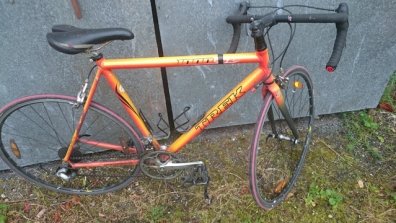
Do you want to spend several hours of your day staring at a man's spandex clad buttocks? Do you want to preplex co-workers and family with details of how you spend most your weekend in uncomfortable, sweaty, silence? Or do you just want an excuse to escape from your significant other for large periods of time? Then look no further, for I have a racing bike for sale!

It has a carbon fibre fork but the rest of the frame is aluminium. It has those pedals that clip your feet in, this is apparently good for cycling but it sucks if you need to stop suddenly because you'll probably fall over, to much pain and embarrassment. It also has a saddle that goes up ridiculously high. This is also good for cycling, I'm told, but I think it really goes up that high so you can present your posterior to other, similarly engaged cyclists as a form of mating ritual. 

The seat is also designed with racing in mind, by which I mean it's light, by which I also mean that it's not padded a huge amount. It can't imagine it does much good to your reproductive health, but maybe that's the point. Fitness and birth control in one.

It has many toothy wheel things, which I am reliably informed are called 'gears'. My brother says it has 20 but I count 12, but I never was any good at maths. There is no combination of switches you can press on this thing to make climbing hills any more pleasant, unfortunately.

It's got twirly handles, I haven't got much to say about those. Probably aerodynamic or summat. It also has kevlar tyres, which I assume makes them bulletproof. Now, I'm not the biggest fan of cyclists but I would draw the line at shooting at them.

Comes with a free helmet to protect your brain when some braindead Irish driver inevitably knocks you into a ditch, despite the fact that your colour scheme is so fluorescent that you could be radioactive.

(In all seriousness, my brother gave this to me as he spent god knows how much on a new carbon-fibre bike, and I have no interest in it. Here's more details on the bike:

http://www.roadbikereview.com/cat/latest-bikes/road-bike/trek/1000/prd_290760_5668crx.aspx )
Shipping: To be arranged
Payment: Cash

02 February 2019

Justice Pursues And Is Pursued On A Steelman

What do you do when you realize you can't achieve some youthful dream of yours?

Well, if it involved the creative or performing arts, you can teach them and, perhaps, practice them on a smaller scale or stage--say, in local theatre or gallery exhibits.  You can also teach if you wanted to be the Great American Novelist or a poet--or you can do some other kind of writing like, say, blogs (not that this one makes any money!)

Now, if your dream was an athletic pursuit, you might find a career as a coach or in one of the industries that serves the sport to which you'd devoted yourself.  Or you can keep yourself in shape and become a trainer, or go (back) to school and become a nutritionist or some other professional who helps athletes maximize their potential.

Of course, many people who don't realize dreams with long odds enter careers very different and far from the ones they'd envisioned for themselves:  They might become everything from insurance salespeople to social workers to engineers.  If nothing else, those occupations can provide long-term stability that is lacking in  most of the things we envision when we're young.


Then there are those who simply don't get over not having "made it" and drift from one thing into another--or try their hands at metiers that are dangerous, foolish or even criminal.

When he was still pursuing his dream


One would-be Olympic sprinter made a list of occupations that, he hoped, would offer him thrills or at least satisfaction for the instant gratification he got from pumping his pedals on the velodrome.  He compiled that list after--get this--washing out of the French Foreign Legion.  On the list were jobs that were dangerous, foolish (for him) or criminal.  He tried to enter a couple of them before finally settling on the last one--which was dangerous, foolish and criminal.

As for the foolish (for him), he applied to a Catholic seminary. From what I read about him, he's about as religious as I am, but it seemed, as he said, like a "fresh start."  The admissions officer, however, knew better and advised him to do some "soul searching."

As for the dangerous (and possibly foolish), he talked his way into an informational interview with the Drug Enforcement Agency.  The interviewer, like the seminary's admissions officer, quickly sussed him out: "You don't seem like the kind of guy who's going to kick down doors fighting the war on drugs."

Finally, he got involved with something illegal--ironically enough, dealing cocaine.  To finance it, he would embark on a career that was dangerous, foolish and criminal:  bank robbery.

Not surprisingly, to make his heists, he used one of the skills he honed while trying to achieve a dream of his youth.  You guessed it:  He escaped on his bicycle.  Because he could mount and take off with a burst of speed, he could ride just far enough into some alley or parking garage where the cops couldn't follow him and peel off the neat shirt,tie and slacks he'd worn into the bank. Then, in his billboard jersey and spandex shorts, and with is messenger bag slung over his shoulder, he looked like any bike messenger.  

He actually spent three years robbing and dealing before he was finally caught.  And, as was the case with many serial criminals, he was stopped because someone noticed a detail others might not have seen.


That someone was a police officer whom the rider-turned-robber eluded.  And the detail he noticed was the bicycle itself.

Officer Sean Dexter of Walnut Creek, California might not have been a bike aficionado.  But he knew that the bike--which the thief abandoned when he fled across a creek--wasn't some commuter's Schwinn.  "This bike is special to somebody," he observed.  "We gotta find out who."

It's no surprise that an Olympic aspirant and local champion would ride a bike better than the ones sold in Wal-Mart.  But the bike stood out even on the club training rides our rider-turned-robber did to keep himself in shape. It wasn't only the frame's bright orange color, or the matching deep-V rims that distinguished the machine.  It was the frame's pedigree:  custom-built by Brent Steelman.  

The getaway vehicle


Since he only built about 50 frames a year, it was relatively easy to trace the bike--even though the bank robber who was using it as his getaway vehicle bought it second hand. Dexter and other investigators followed a trail from Steelman to the shop that sold the bike to the person who ordered it and ultimately sold it to the pedaling pilferer.

Now, if it isn't ironic enough that someone was pulling bank heists on a bike built by Steel-man, the name of the racer-turned-robber seems like even more of a cosmic joke:  Tom Justice.

Maybe he should have gone to law school.  I imagine that winning a case can be quite a thrill--and lucrative.

01 February 2019

What Did Dr. Graves and Mr. Rhodes Have In Common?

I recall reading that people were always astonished to see Dr. Clifford L. Graves, a renowned surgeon, arriving on his bicycle.  Doctors of any sort were expected to show up for surgery or visits with patients in a Cadillac--the luxury car of choice at that time--or something like it.  

Consternation at seeing him on two wheels instead of four was not alleviated by the fact that he wasn't riding just any old bike:  He rode custom bikes, including a Rene Herse. Of course, most Americans at that time didn't know the Cadillac of bicycles, if you will, from the VW Beetles of the two-wheeled world.


Then again, in those days, almost any adult riding a bicycle in the US would raise eyebrows.  A few, like Dr. Graves, pedaled by choice.  But more often than not, an adult rode a bicycle because he or she couldn't drive a car, for whatever reasons.  And that was (and still is ) a source of shame in America.


Whether the cyclist was a doctor or drifter, the adult cyclist in the States was seen as, if nothing else, an eccentric.  As often as not, they were:  Dr. Graves had a number of interests that ranged far from cycling or surgery.  As an example, he was an accomplished classical pianist and founding President of the La Jolla Symphony Association.


Floyd Rhodes, a.k.a. Bicycle Charlie


Floyd Rhodes' musical tastes, on the other hand, ran more toward country and blues.  And he played guitar, mainly for people who knew him.  As for a career, he wasn't a surgeon or doctor of any sort.  Rather, he supported himself through odd jobs and collecting leftover food from Safeway and W.T. Grant's Bradford Room restaurant.  


He moved to Waynesboro, Virginia with his family in 1916, when he was five years old. Previously, they'd lived in Covington, about 85 miles away.  While the work and bicycle tours of Dr. Graves, born five years before Rhodes, took him all over the world, Rhodes never seems to have ventured much beyond Waynesboro, where he lived in a trailer by the river.


Still, in his own way, he seemed to have garnered respect, and even affection, from his community. When they called him "Bicycle Charlie," it wasn't a taunt or joke:  While they didn't understand his lifestyle, they admired him for his sense of himself.  He was also said to be gentle and generous with everyone.


These two men who lived by their bicycles could hardly have died in different ways.  On the night of 24 July 1981, Rhodes attended a concert near Waynesboro.  After it ended, he rode along Route 250.  A teenager driving along that road struck what he thought was a mailbox.  He continued home and told his father about the accident.  They went to the scene and found, not a mailbox, but a crumpled bicycle.  Not long after, they found "Bicycle Charlie's" broken body in a nearby ditch.


Dr. Clifford Graves


Graves, on the other hand, died on 7 December 1985, after a bout with pancreatic cancer.  Just three days earlier, he'd written a letter to members of the International Bicycle Touring Society, which he'd founded, saying that he had "six weeks to six months" of life left.


In the end, these two very different men had a common legacy:  They reached the corners of their worlds, and other people's lives, on their bicycles.  For as long as they are remembered, they will be remembered for that.


31 January 2019

Yes, This Really Was A Hot Idea!

In much of the northern United States, last night was the coldest "in more than a generation," according to more than one report I heard.  

I can believe it:  When I rode to work this morning, the temperature was -1F (-18C).  The last time I can recall such a cold commute was in January of 1985, when we had a seemingly endless string of record-cold days.  One morning, according to a journal from that time, I pedaled from my uptown apartment to downtown job--a distance of about 10 miles, or 16 kilometers--when the temperature stood at -4F (-20C).  

Interestingly, just a month later, New York would record its warmest February temperature--75F (24C) ever.  I was visiting my parents, who were living in New Jersey, and rode along the shore--in my shorts!


I have been known to ride in shorts when few other people would.  Today wasn't one of those times.  I didn't wear, or even carry, a skirt and tights:  Instead, I wore a pair of gray dress pants over ski underwear, which I removed when I got to work.

Almost everyone agrees that cycling to work is "healthy", and some insurers will even lower premiums or give bonuses for doing so.  Would my insurer see my riding to work on a day when no one else did the same as "healthy", at least in a physical sense?  Or would they think I needed more mental health coverage?  

All I know is that I felt invigorated--and just really, really good--when I arrived. 

30 January 2019

When Is Giving A Bike Not A Gift?

A 10-year-old boy is saving for a vacation with his mother.  Instead, he uses the money to buy a bicycle for a man who works in the local gas station.

How do you read this gesture?

Most parents, I believe, would be proud of such a child--especially if that attendant were, as one might expect, poor.  At least, I would feel that I'd done something right--or had been extremely lucky--if I were a parent to a kid like him.


When word got out about the boy's action, most of the reaction was positive.  Notice that I said "most":  There was, believe it or not, at least one person who saw the boy as some sort of embodiment of his country's recent history--specifically, an aspect that made the nation a pariah in the world community.  

I am talking about apartheid and that country is South Africa.  In all fairness, it should be said that, in many ways, South Africa has more thoroughly and honestly confronted the ugliest part of its history than, say, the United States has done with slavery or some European countries have dealt with the Holocaust.

Still, because there are still so many people who remember living under apartheid, the wounds are fresh and deep.  So I can understand why someone might read paternalism or even colonialism into a white boy giving a black man a bicycle.  If nothing else, it represents the economic injustice that still persists--though the boy probably wasn't aware of it. 

I do believe, however, that a Twitter user who identifies herself as @_BlackProtector was going a bit far in saying "Keep the bicycle, give us our land."  I agree that the people should get back what was taken from them, and further compensated for their intergenerational trauma.  On the other hand, the boy does not have the power to give back that land.  He can only do what he can to make someone's life a little easier.  


I'd say that even if he doesn't know words like "colonialism," he already possesses some sense of fairness, and is certainly generous.  The only thing, really, that can be done is to teach him, honestly, about his country's history.  He would be a good student, I bet.

Oh, and somehow I don't think that gas station attendant was upset about getting a bicycle--especially if he'd been walking to work.

29 January 2019

I'll See You In (Or With) Ashtabula!

I'll look for you in old Honolu-la
San Francisco, Ashtabula
You're gonna have to leave me now, I know
But I'll see you in the sky above
In the tall grass, in the ones I love
You're gonna make me lonesome when you go.

That last line is the title of the song, from Bob Dylan's "Blood on the Tracks" album.  Like most of his work, you listen to this for the lyrics:  I am only the 1,798,345,467th person to praise his songwriting skills.  And I actually like listening to him because he has a, shall we say, unique singing style--though I also admit to liking, quite a lot, Madeleine Peyroux's cover of this song.

Anyway, I can't help but to think that Bob was enough of a rhymester to write the song just to show someone--himself, perhaps--that he could use "Ashtabula" in a verse.  I'm sure it wasn't easy:  Witness the alteration to the name of Hawaii's capital to make the rhyme.

I can't help but to wonder whether some NPR producer wanted to do a story about the town just to be able to say the name a few times.  I mean, it's almost impossible not to sing it--even if you're reporting about the town's woes.

The hard times were indeed part of Jim Zarroli's report.  So is its rebirth, though not as the factory town and port it once was.  Instead, on those Lake Erie waterfront sites where ships unloaded iron ore and loaded steel pipes and other industrial products onto ships, waiters and baristas now fill glasses and cups with artisanal beer and coffee.  Rather than sending manufactured goods into the rest of the United States, and world, Ashtabula now attracts weekend tourists from Cleveland, Pittsburgh and other nearby cities.

But, if you have been reading this blog--or just about anything else related to cycling--you might associate Ashtabula with something neither Jim Zarroli nor Bob Dylan mentioned.  For that matter, I don't think many of the day- or weekend-trippers think about it, either.

1964 Schwinn Varsity with Ashtabula cranks and forks


I am talking about bicycle fittings--mainly cranks, but also fork blades and other items.  If you have an old Schwinn with a one-piece crank, the arms were probably forged in Ashtabula.  So were the forged flat-bladed forks and solid stems found on some Schwinns.

It was once common to refer to all one-piece cranks (used mainly on American bikes) as "Ashtabula", just as "Scotch tape" is used to denote all kinds of clear plastic adhesives and disposable facial tissues are often called "Kleenex."  But, "Scotch tape" and "Kleenex" are brand names used by particular companies.  So, not all clear adhesive tapes are "Scotch", and not all facial tissues are "Kleenex".  Likewise, not all one-piece cranks are "Ashtabula".

The Ohio company that made those fittings for Schwinn started out, perhaps not surprisingly, as a maker of iron hulls for battleships.  Later, they made anchors for aircraft carriers.  This heritage may have gone into making those cranks and forks, which weighed a ton (or tonne?) but were practically indestructible.  

Other one-piece cranks were heavy, too, as they were almost always made of steel, or even iron.  But, as someone who worked on more than a few bikes back in the day, I can tell you that the real Ashtabula stuff--which was usually stamped with "ABS" was, if not lighter, of significantly better quality than similar parts found on other bikes, which were usually found in department stores.  The threads on those Ashtabula Schwinn parts were almost uniformly even and clean.  The cheaper one-piece cranks and forks, usually found on department-store bikes, sometimes had bad threads and would need replacement.

So, my advice to Bob, Madeleine or anyone who wants to look for his or her lover on a bike with a one-piece crank is this:  Make sure that crank is an Ashtabula!  Otherwise, you might not make it to Ashtabula--and find the love of your life!


28 January 2019

Saturday Ride: Empires And Connecticut

It's one thing to be reminded of Paris when you're in New York--especially, say, if you're walking down the Grand Concourse in the Bronx and looking at the Art Deco buildings--or pedaling along Ocean or Eastern Parkways in Brooklyn.  As I have mentioned in other posts, these places were inspired by the Grand Boulevards of Paris as well as the wide residential boulevards of London and other large European cities.

Also, I was in Paris a week and a half ago, so I have an excuse for thinking about it.

Now, it would be fair to ask what would cause me to think about Cambodia during a bike ride to and from Connecticut.  After all, there isn't much physical resemblance between the two places.  You might think that because I was riding on a cold day--the temperature didn't reach the freezing mark the other day, when I pedaled to the Nutmeg State--I was taking a trip, in my mind, to the warm weather I experienced in Southeast Asia.

Actually, I wasn't thinking about that.  Something I saw in the Greenwich Common reminded me, in an odd way, of something I saw in the land of the ancient Khmer kingdom.


Bare branches furled themselves around a monument to young men who marched, perhaps bravely, perhaps blindly, into their own slaughters.  In another year they are mourned, their young bones turned into mud:  They remain only as names on these stones after dying to capture hills and other terrestrial features that are recorded only as coordinates on a map or, perhaps, dates and times.  


All right.  I'll get off my soapbox.  When I see a war "memorial", I can't help but to think of what a colossal waste of lives--especially those of the young--result from the rise and fall of nations, of empires--whether said entities consist of real estate or simply numbers traded and sold from one electronic screen to another.


At least all those Greenwich residents who died too soon have names, at least for as long as those stones stand.  What, though, if the trees--not unlike the ones on the Connecticut state coin--were to wind themselves around those monuments?  What if they continued to grow, as they would if no one touched them, while the stones bearing the names of the lost were to crumble?

Somehow I don't think similar questions ever darkened the mind of Henri Mouhot.   He is often said--mistakenly--to have "discovered" Angkor Wat.  Of course, he no more "discovered" it than Columbus "discovered" America:  There were thousands of people already living in its vicinity, and they all descended from people who'd lived in the area.  Moreover, other French explorers and missionaries had seen and documented the temples decades before Mouhot.  He did, however, popularize Angkor Wat in Western imagination, in part by comparing them to the pyramids.

I have to wonder, though, what went through his and his colleagues' minds when they first saw Ta Prohm.


We know the name of the King--Jayavarman--who commissioned it.  Those who cleared the jungle, cut the stones, carved the statues and made the meals for those who did all the other work are anonymous to us now.  So are those who fought to build and maintain the Khmer Empire (or almost every other empire).  What we have now are what Mouhot encountered 160 years ago:  Trees reclaiming their home from monuments humans built.


Now, of course, I am not complaining about having gone to see Ta Prohm, or the rest of the Angkor Wat complex.  It really has been one of the great privileges I've enjoyed:  The temple sites are awe-inspiring in all sorts of ways, and the people are inspirational.  It should be remembered, though, that its glories, much like those of the Vatican and the grand cathedrals of Europe, as well as the pyramids, were the result of now-nameless people whose lives began and ended as fodder for the empire.  

And, I must say, it is ironic to be reminded of an ancient marvel in a tropical climate on a cold day in a modern suburban downtown--while riding my bicycle.


27 January 2019

Cubism, Cycles And iPhone Cases

A cubist bicycle?


While in Paris last week, I visited the Musee Picasso and a Cubist exhibit at the Centre Pompidou.

I couldn't help thinking about them again when I saw this iPhone case.

26 January 2019

What If She'd Gotten A Gravel Bike?

A few years ago, it seemed that the "buzz" in the bike world was about "gravel bikes".  

I can't say I've ever owned anything specifically designed as a "gravel bike".  I have, however, ridden all sorts of bikes--some my own, others not--on gravel.  Perhaps the bikes I pedaled most over pebbly surfaces were my mountain bikes and the one cyclo-cross bike (a VooDoo Wazoo) I ever owned.  I've also ridden road and touring bikes on such surfaces, usually as part of some other ride I was doing:  When you go on a loaded tour outside urban and suburban areas, you're bound to ride on gravel or dirt some time or another.  I even rode my racing bikes, with sew-up tires, on gravel--if not for long distances.

I suspect that most, if not all, of you have ridden on gravel with a bike that wasn't designed for the purpose.  And most of you were no worse for the experience than Gaynor Yancey was after running her brand-new "English Racer" into the rough stuff.

(I suspect Ms. Yancey isn't much older than I am:  I referred to the three-speed bike my grandfather gave me as an "English Racer", as most people did in those days!)

Just remember that you don't have a gravel bike!


She, like me, did not plan her plunge into the pebbles:  She encountered the crunchy stuff in the course of her ride.  But her foray didn't end so well because she wasn't as prepared as I was.  As she relates, she'd never before ridden a bike with "hand brakes".  So, when the paved street on which she'd ridden ended, she wasn't able to follow her mother's instructions to stop and walk her bike over the gravel path to her friend's house.  She was so distracted by her vision of showing off her new bike to her friend, she says, that she "forgot about the handbrakes."

She ended up with a knee full of gravel.  "And, on top of that, my beautiful new bike was hurt," she recalls.

Would things have been different if she'd gotten a "gravel bike" instead of an "English Racer" for her birthday?

25 January 2019

More Bike Lanes, Fewer Commuters

In yesterday's post, I mentioned a Seattle train station where bike parking "sucks".

It may be one of the reasons why the number of Emerald City commuters who get to work by bike fell by 20 percent from 2016 to 2017.


Still, Seattle remains one of the top US cities for bicycle commuting, at least in terms of the percentage of people who say they go by bike.  Its decline was, however, more precipitous than that of the US as a whole, where bicycle commuting fell by 3.2 percent during the same period.


The USA Today article in which I came across these statistics said the declines came in spite of the increasing number of bike lanes and other efforts made by cities to become more "bike friendly".  To be fair, the article also points out that the price of gasoline has dropped during the past several years, which enticed more people to drive.  It also points out, as I pointed out in yesterday's post, that some passengers of Uber, Lyft and other "ride shares" are using those services in lieu of cycling.

One thing the article hinted at is something I've long suspected:  that, in the years before "ride sharing" services became popular, bicycle commuting might have been increasing in dense urban areas, but not in suburban and rural areas.  In the suburbs, as I pointed out in yesterday's post, there isn't bicycle parking at rail and bus stations commuters use to get to their jobs in the city.  And, in rural areas (and outer-ring suburbs), some commutes are simply too long to do by bicycle.  


Here is something else I've noticed:  People who move to the city to be near their jobs are mostly young and making relatively good salaries.  Some of them commute by bicycle, though most take mass transit or "ride shares."  But once they get married and have children, they want to buy houses.  Unless they are making very high salaries, that means moving some distance from the city.


So, my analysis, for what it's worth, goes like this:  Whether bicycle commuting increases or decreases from year to year, it will mainly be a practice of young, affluent and single people in central areas of cities--unless society, the economy and policies change.  Until housing in cities becomes more affordable, and tax policies don't encourage fossil fuel consumption, the typical bike commuter will be putting his or her laptop in the front basket of a bike-share bike he or she will ride to the office.

24 January 2019

Bike Parking Sucks Because...

Writing headlines is a skill unto itself.  Some would even argue that it's an artform.  It does, after all, take a certain kind of creativity to come up with something like "Headless Body In Topless Bar."

It might actually be more difficult to come up with a title for an individual article, which is why those who write articles almost never write the titles for them.  (When I wrote for local newspapers, I don't think any of my articles bore titles I created.)  The goal is to create something that encapsulates the article without giving too much away--and fits into whatever space on the page is allotted to it.

So, when I saw the following title, I knew I didn't have to read the article: "Bicycle Parking Sucks at UW Station But Sound Transit Says They're Making It Better."  But I read the article, which appeared on The Stranger, anyway.  One reason, I guess, is that I was looking to confirm a bit of my cynicism: when everyone knows a situation isn't good, some official says they're doing what they can to improve it.  We hear a variation of that theme just about every day here in New York, whether it's in reference to bike lanes, subway service or any number of other aspects of daily life in the Big Bagel.

Still, I'm glad I read the article.  For one thing, it showed me that in Seattle--which was probably the most "bike-friendly" major US city before Portland took that title--people don't ride their bikes for all or even part of their commutes for at least one of the same reasons people in other parts of the US leave their bikes home when they go to work:  There's no secure place to park at the workplace or transit station.  

Now, I know that Seattle is more spread-out than New York or Boston or San Francisco.  But even in those cities, there are areas remote from public transportation.  And, of course, there are people who commute from nearby suburbs.  Many of those commuters drive into the city, but others drive to the station where they take a bus or train into the city.  Some, I am sure, might be enticed to ride their bikes (or to get bikes in the first place) if, on their way home, they knew they could find their bikes intact.


UW Station
I can see why bicycle parking "sucks" at this station!

In that article, though, there was a twist.  Really, it shouldn't have surprised me, because one of the goals of American urban planning still is (or seems to be) to keep as many motor vehicles as possible moving through a city's streets.  A "creative" solution for "reducing congestion", according to the city's Department of Transportation, is to offer a discount to people who use Uber, Lyft or other "ride share" companies to reach their trains or buses.

Data compiled from New York, Boston, San Francisco, Washington and other large US cities shows that these "ride share" companies have actually increased the number of motor vehicles on the streets.  In New York, as an example, vehicular traffic had actually declined for several years until 2015.  It was around that year that "ride share" services became popular in Gotham.  Since then, traffic has increased.

One reason is that, for the most part, "ride shares" don't replace private automobile trips.  To the contrary, they are used by more affluent customers who don't want the inconvenience of taking the bus or train, or of hailing a taxi.  Also, research indicates that people aren't using Uber or Lyft only to get to work or go to the airport:  They are using these services to go to a movie, the theatre, a restaurant or shop.  Moreover, they might not have made such outings if they'd had to take the subway or bus.

Moreover, surveys indicate that some people are using these services instead of cycling to work, school or shop.  Ironically, some of them decide against cycling because of the traffic to which their Uber or Lyft rides contribute!

Another reason why "ride share" companies don't reduce congestion is the reason why I have been enclosing "ride share" in quotation marks.  Research has confirmed something I've noticed anecdotally:  Most rides are taken by individual customers or couples, most of whom wouldn't dream of sharing a ride with a total stranger.  Moreover, "ride share" drivers spend as much as 60 percent of their time in their cars driving nobody but themselves.  In other words, they drive more to and between "lifts" than to actually transport their passengers.

As long as planners and officials can trot out "ride share" services as a solution to traffic congestion, bike parking--and much else for cyclists--will "suck" in many places.

23 January 2019

Rolling By The Racists

In previous posts, I've mentioned that for years Florida has had, by far, the highest death rate for cyclists of any US state.

I have mentioned some of the possible reasons for it, based on professional research as well as my own experiences of riding in the Sunshine State.  Those reasons include the "car culture" of the state as well as the frequent indifference or even hostility law enforcement officials envisage when cyclists are injured or killed by drivers.


Now, it seems, there may be other factors: guns, for one, and old-fashioned racism for another.


The incident I'm about to mention didn't end with the death, or even serious injury, of a cyclist.  But it could have become the Emmett Till case of cycling because something that might or might not have happened brought racial hostility to the surface, and a gun from its holster.


All right, I was using "holster" metaphorically. What I mean, of course, is that a man pulled out his gun.


That the ugly incident happened the other day, when Martin Luther King Jr's life and work were commemorated, should not surprise anyone.  A "Wheels Up, Guns Down" ride, which included ATVs as well as bicycles, spun through the Brickell area of Miami.


A white woman accused a black teenager of riding his bicycle over her foot.  (I wonder whether that woman will recant on her deathbed.) A white man--who may have believed he was defending the woman's honor or some such thing--pulled out his gun and yelled a racial slur at the cyclist.

A young black person on a bicycle:  What could be more of a challenge to that man's or woman's reality?  And, of course, he gets backlash for it.  That alone gives him more in common with MLK than someone whom Mike Pence likened to the slain civil rights icon.

22 January 2019

Blame The (Phantom) Bike Lanes!

Every one of us, I suspect, has had a moment when we realized that someone we looked up to was just plain wrong about something.  

Most of us, I guess, have such a moment in childhood.  That person who suddenly became, as it were, mortal might be a parent, older sibling, teacher, coach or other adult who nurtured us in some way.  Such a moment might have seemed like "the end of the world," at least for a moment, and left us feeling angry, hurt, abandoned or empty.  Fortunately, though, most of us move on from such an experience and learn the lesson that "nobody's perfect."


Good thing, too, because as we go through life, people we respect or admire have moments of stupidity, arrogance, greed, meanness or thoughtlessness.  We learn that our heroes--if we still create such figures in our lives--are, after all, human.


For many years, I've been a major fan of Whoopi Goldberg.  In fact, when I was still watching TV and had a schedule that allowed it, I watched The View mainly because she was one of the panelists.  She is a funny, irreverent woman who always seemed to resist pressures from society and the entertainment industry (where, perhaps, such pressures are the most intense) to conform to prevailing notions about attractiveness or femininity--which, of course, are Caucaso-centric. (Is that a word?)  Also, she has been an outspoken advocate for causes, like LGBT equality, that matter to me.


Of course, one can be outspoken about things one doesn't know much about. I've probably done it any number of times on this blog! If I have, I hope I haven't caused harm, or at least not much of it.  I'd like to think that I expounded on things I know little or nothing about only because I didn't know as much about them as I thought I knew--or because I was acting on information I didn't realize was inaccurate.


I hope that such is the case for Whoopi Goldberg.  I am willing to believe that it is because, well, I've always liked her.  Also, I think she probably doesn't ride a bike much in Manhattan, if she rides at all.


You see, anyone who regularly cycles in Manhattan knows where the bike lanes are.  Mainly, they're in midtown, and parallel major uptown-downtown and crosstown thoroughfares.


While Tenth Avenue runs the length of midtown, on its west side, it's not one of the streets with a bike lane.  She could be forgiven for not knowing that.  On the other hand, she blamed the non-existent bike lane for "ruining" the avenue and traffic flow in the city.  


  Oh, but it didn't end there.  She went as far as to say that the bike lanes are part of a conspiracy to bring Manhattan traffic to a standstill so that the Mayor can implement "congestion pricing"--which, of course, would take a bite out of her bank account as well as her "right" to drive--or, more precisely, be driven--in Manhattan.

What's really crazy about her rant is that it was a non sequitir. She was interviewing Mayor Bill de Blasio about something else entirely.  I guess she figured that since she had him in her crosshairs, she could unleash her pet peeve--however unfounded it is--on him.


Here's something I find really ironic:  She, among celebrities, has been one of the most outspoken critics of El Cheeto Grande.  Yet she behaved no differently than he has in any number of public appearances:  She told a lie or repeated misinformation (depending on what you believe) and doubled down on it.  Her tirade, like most of what we hear from T-rump, is devoid of facts and fueled by a sentiment of "If I feel it, it must be true."


Then again, she does have a few things in common with him:  They are, or have been, television stars.  They live in mansions and are driven in limousines or armored SUVs everywhere they go.  And they haven't ridden bicycles since they were kids. 


21 January 2019

A Real Freedom Ride(r)

I am not the first person to say this:  Donald Trump's promise to "Make America Great Again" doesn't hold up because, well, America was never great.  No nation ever has been.  A few have been powerful and influential.  But great, no.

A nation should not be confused with a culture or people.  Whether or not a culture is great is open to interpretation.  Every nation, however, has at least one interesting or even inspiring culture:  That is the reason why I have taken trips to France, Cambodia and other places.  

Even though nations aren't great, and even if cultures might or might not be great, within each of them there have been great human beings.  Of course, most of us might be seen as great by some people, but not others.  There are a few, though, who are undeniably great.

Today is a holiday to commemorate one of them. Although his actual birthday came last Tuesday, his "birthday" is celebrated on the third Monday of every January.  I am talking, of course, about Martin Luther King Jr.  Whether or not you agree with the ways in which he tried to achieve his goals, it cannot be denied that this country, and this world, are better for his having been part of them.

Here he is, on Fire Island, just off Long Island,  seven months before he was assassinated:


20 January 2019

Even Arnold Wasn't This Strong

If you were young, had cash to burn and wanted to believe you were tougher than you actually were, you drove a Hummer.

Styled after a military vehicle, the first Hummer rolled off the assembly line in 1992.  Fittingly, Arnold Schwarznegger bought it:  He was the one who lobbied American Motors Corporation, who'd been making Hummers (then known as Humvees) for the US Armed Forces, to offer them to civilians.  

The pseudo-tank was a cash cow for AMC and, later, for General Motors, who bought the brand in 1998.  It also helped to enrich the coffers of petroleum companies (and a few despots) because one gallon of gasoline would propel it for only ten miles.

Of course, those are the reasons why the brand tanked (pardon the pun) when the world's economy crashed and oil prices spiked.  A couple of years ago, while on a ride, I saw the first Hummer I'd seen in years.  Even in its bright yellow finish, it looked like a dinosaur to me.

Where are the Hummers now?  Are they in junkyards and other landfills with other motor vehicles?

Wherever they are, bicycles from that same period are still rolling along. 


This rider is even stronger than I ever was.  I mean, I've carried all sorts of things on my bike, but not a car(cass).