There are a few bike brands that even non-cyclists can name. Here in the US, Schwinn is one of them. Others include Raleigh, Peugeot, Motobecane and Fuji.
Cannondale might also be included in that list. I think they gained notice with the general public because when their bicycles were first introduced in 1983, they looked very different from the others. While Klein may have been the first to make aluminum frames from large-diameter tubing, Cannondale made them a mass-market (relatively speaking, anyway) item. To this day, those frames are the first thing most people associate with the name "Cannondale".
What most people, especially those younger than--ahem--a certain age, don't realize is that Cannondale was in business for more than a decade before they built their first bicycle. Furthermore, even though the first product they ever made was bicycle-related, their early reputation was established as much on non-bike equipment as on accessories for two-wheelers.
In the late 1960's, Joe Montgomery was a self-described "grunt" on Wall Street. The experience, he later related, taught him how businesses work. Always an avid outdoorsman, he saw a growing enthusiasm for hiking, camping and related activities--and foresaw the North American Bike Boom. He knew he wanted to build bikes but didn't have the necessary capital. So, when he started Cannondale (and named it, as nearly everyone knows by now, after a Connecticut train station) in 1971, he knew he had to develop and market a product that would distinguish his new enterprise as well as help him raise the money he'd need to build bikes.
Thus was the world's first bicycle-towed trailer--the Bugger--born. One funny thing about it was that it predated, if unwittingly, the luggage that people roll through airport lobbies all over the world. That's because the Bugger was, in essence, a big backpack on wheels. Since it was mounted on an angle, it transferred all of the weight carried in it to its tires and didn't add to the weight of the bicycle. I never owned one, but had opportunities to ride with one. While it increased the turning radius, it didn't affect other aspects of the ride nearly as much as I expected.
Sales took off and in spite (or, perhaps, because) of the connotations of its name, it sold well in the UK. That allowed the new company to create other products for which they would be known. They included panniers and handlebar bags with innovative designs and sturdy construction.
Within a couple of years, Cannondale was also making backpacks, sleeping bags, parkas, and other items for camping, hiking, snowshoeing and other outdoor sports. LL Bean sold them through their catalogue; one was as likely to find Cannondale products in ski shops as in bike shops.
During that time, I used several Cannondale products, in part because the shops in which I worked (as well as American Youth Hostels, where I also worked) carried them. For at least a decade, my "Trackwalker" backpack was my go-to bag when I was off the bike--and sometimes on it. With its black body, tan leather bottom and red "spider" zipper tabs, it had a very distinctive look. Also, I wore one of their parkas through a number of seasons. They, like their bike bags (I used one of their handlebar bags and seat bags on my first few bike tours) were well-constructed and practical.
But my favorite Cannondale product of all time (Remember, I owned and rode two of their bicycles) was the glove they made--by hand, in Pennsylvania--during the 1980's. I don't think I've come across another sport glove--or, for that matter, any glove--made from such high-quality materials and with such good workmanship. It was like a Brooks saddle: stiff at first, but once broken in, a perfect fit that would last for many years. I wore mine until the crochet backings deteriorated--a long, long time after I first started wearing the gloves.
I wish I could find a pair of them--or something as good--now. Back then, a pair of those gloves retailed for $25-30, which, it seems, is what a "good" pair of gloves costs now.
I'm guessing that Cannondale couldn't continue to make them in Pennsylvania--or anywhere in the US--without raising the price significantly. So production of those gloves was sent overseas. Later, that of their bike apparel and accessories and, finally, their bikes followed. Around the time Cannondale introduced their bicycles, they stopped making and selling backpacks, parkas and other non-bike-related gear.
(If you want to learn more about what Cannondale was doing before they started building bikes, check out this site.)
Cannondale might also be included in that list. I think they gained notice with the general public because when their bicycles were first introduced in 1983, they looked very different from the others. While Klein may have been the first to make aluminum frames from large-diameter tubing, Cannondale made them a mass-market (relatively speaking, anyway) item. To this day, those frames are the first thing most people associate with the name "Cannondale".
What most people, especially those younger than--ahem--a certain age, don't realize is that Cannondale was in business for more than a decade before they built their first bicycle. Furthermore, even though the first product they ever made was bicycle-related, their early reputation was established as much on non-bike equipment as on accessories for two-wheelers.
In the late 1960's, Joe Montgomery was a self-described "grunt" on Wall Street. The experience, he later related, taught him how businesses work. Always an avid outdoorsman, he saw a growing enthusiasm for hiking, camping and related activities--and foresaw the North American Bike Boom. He knew he wanted to build bikes but didn't have the necessary capital. So, when he started Cannondale (and named it, as nearly everyone knows by now, after a Connecticut train station) in 1971, he knew he had to develop and market a product that would distinguish his new enterprise as well as help him raise the money he'd need to build bikes.
Thus was the world's first bicycle-towed trailer--the Bugger--born. One funny thing about it was that it predated, if unwittingly, the luggage that people roll through airport lobbies all over the world. That's because the Bugger was, in essence, a big backpack on wheels. Since it was mounted on an angle, it transferred all of the weight carried in it to its tires and didn't add to the weight of the bicycle. I never owned one, but had opportunities to ride with one. While it increased the turning radius, it didn't affect other aspects of the ride nearly as much as I expected.
 |
| The original Cannondale Bugger, 1972. |
Sales took off and in spite (or, perhaps, because) of the connotations of its name, it sold well in the UK. That allowed the new company to create other products for which they would be known. They included panniers and handlebar bags with innovative designs and sturdy construction.
Within a couple of years, Cannondale was also making backpacks, sleeping bags, parkas, and other items for camping, hiking, snowshoeing and other outdoor sports. LL Bean sold them through their catalogue; one was as likely to find Cannondale products in ski shops as in bike shops.
 |
| The "Trackwalker" is on the left. Mine was black, with tan leather and red tabs. |
During that time, I used several Cannondale products, in part because the shops in which I worked (as well as American Youth Hostels, where I also worked) carried them. For at least a decade, my "Trackwalker" backpack was my go-to bag when I was off the bike--and sometimes on it. With its black body, tan leather bottom and red "spider" zipper tabs, it had a very distinctive look. Also, I wore one of their parkas through a number of seasons. They, like their bike bags (I used one of their handlebar bags and seat bags on my first few bike tours) were well-constructed and practical.
But my favorite Cannondale product of all time (Remember, I owned and rode two of their bicycles) was the glove they made--by hand, in Pennsylvania--during the 1980's. I don't think I've come across another sport glove--or, for that matter, any glove--made from such high-quality materials and with such good workmanship. It was like a Brooks saddle: stiff at first, but once broken in, a perfect fit that would last for many years. I wore mine until the crochet backings deteriorated--a long, long time after I first started wearing the gloves.
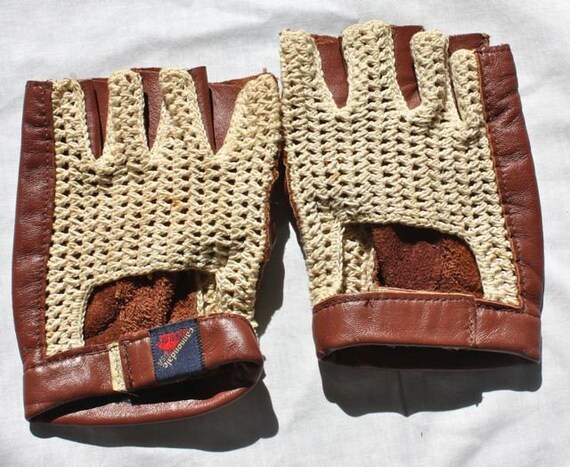 |
| The best glove ever made--by far! |
I wish I could find a pair of them--or something as good--now. Back then, a pair of those gloves retailed for $25-30, which, it seems, is what a "good" pair of gloves costs now.
I'm guessing that Cannondale couldn't continue to make them in Pennsylvania--or anywhere in the US--without raising the price significantly. So production of those gloves was sent overseas. Later, that of their bike apparel and accessories and, finally, their bikes followed. Around the time Cannondale introduced their bicycles, they stopped making and selling backpacks, parkas and other non-bike-related gear.
(If you want to learn more about what Cannondale was doing before they started building bikes, check out this site.)