16 September 2021

A Monument Befitting A Giant


 Yesterday I mentioned a monument to a pioneer of his sport and the struggle for civil rights.  Today I came across a story about a new monument to Robinson’s sporting and historical grandfather, if you will.

As readers of this blog—and those with even a cursory knowledge of cycling history—know, Marshall Walter “Major” Taylor was not only the first Black World Champion cyclist; he was also the first African-American champion in any sport. 

(George Dixon, the African Canadian who won the bantamweight boxing title in 1892, was the first Black champion of any sport. Interestingly, Taylor first won his title in Montréal.)

While Major Taylor is most often associated with Worcester, Massachusetts, where he lived much of his adult life, and New York, Paris and other places where he achieved his victories, he was born and raised In Indianapolis—where, I suspect, few people have been aware of him.

Until now, that is.  As part of the city’s bicentennial celebration, its Arts Council commissioned a “Bicentennial Legends” mural series. (If you’re a regular reader of this blog, you know that I love murals!) The latest is a five-story homage to Major Taylor.

His great-granddaughter Karen Brown Donovan attended the ribbon-cutting ceremony last week, along with 1984 Olympic sprint medalist Nelson Vails, pro cyclists Justin Williams and Rashaan Bahati, and mural artist Shawn Michael Warren.


15 September 2021

Jackie In The Jersey Theater

Today I took a ride into New Jersey for the first time, I think, since the pandemic began.  I know, that sounds odd, considering how often I’ve pedaled to Connecticut. But I finally got up the courage to board the ferry—which, much to my surprise, was nearly empty—to Jersey City.

I’d forgotten just how odd and interesting parts of the city are.  In Journal Square stands this monument to one of the icons, not only of sports, but also of racial equality and human rights:


Jackie Robinson is one athlete I wish I could have seen in his prime.  What I learned from looking at this sculpture, though, is the emotions he tried not to show, and the ones that he couldn’t help but to reveal.


Sporting events at their best are theater, or at least dramatic. So, perhaps, it’s not surprising to see this theatre across Kennedy Boulevard:


It’s long fascinated me that during the 1920s, when movies first reached mass audiences and studios built towering, cavernous shrines to them, Art Deco and a fascination for all things Egyptian defined the visual style of the time just as jazz was its soundtrack.  Looking at buildings like the Loew’s Jersey, though, shows me how congruent those things were: the lines and shapes of Art Deco building details and Egyptian carvings mirror each other as much as they echo the tempo changes of the era’s best music.


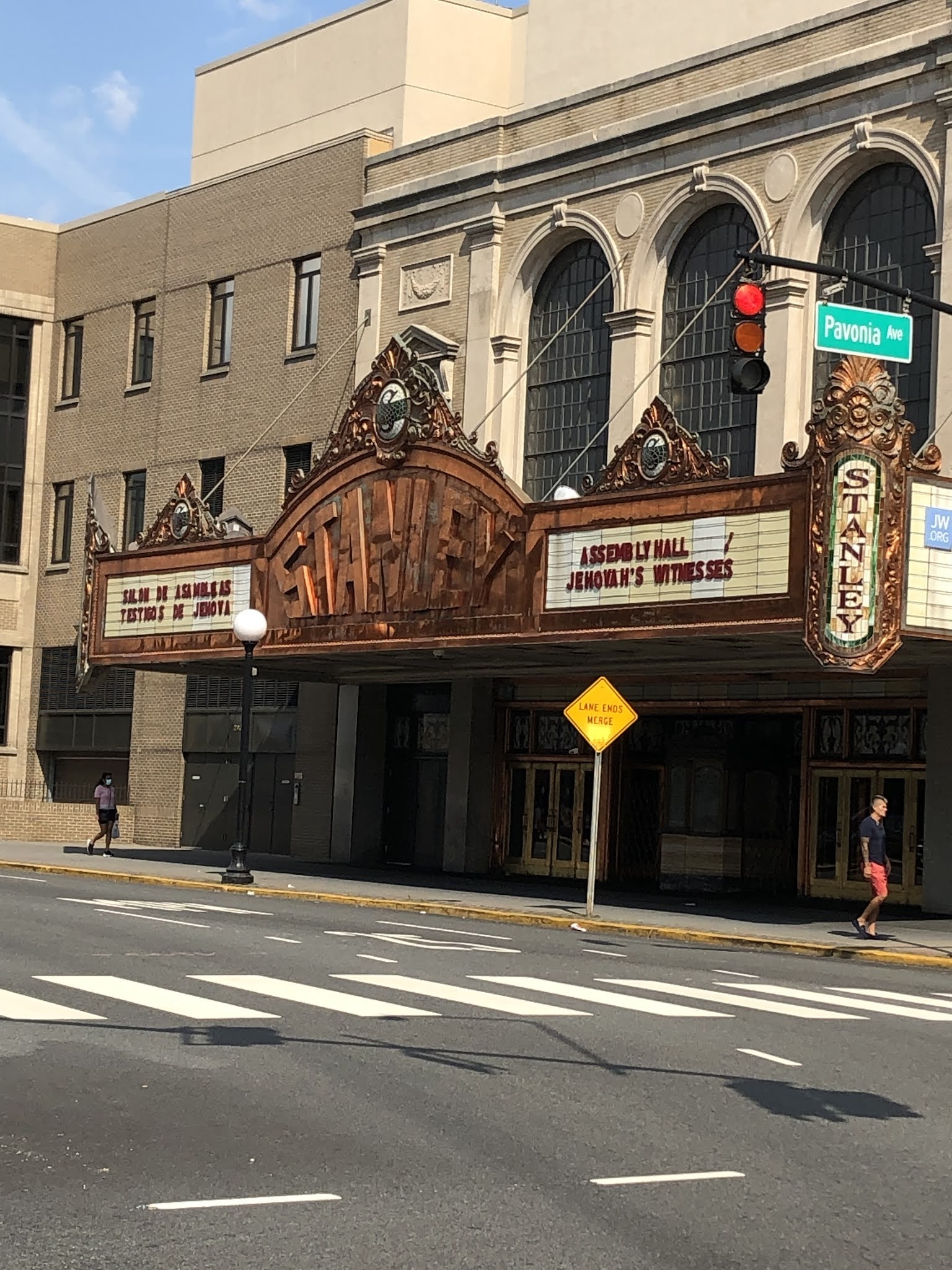
So a theater stands across from a monument to a man who played out one of this country’s real-life dramas.  To his right, across Pavonia Avenue, stands another former movie theater:


Like many other former cinematic cathedrals, it’s become a house of worship. That makes sense, as the interior dimensions of those old movie houses closely resemble theaters.  And when you come down to it, a mass or service is a kind of theatrical performance—just like a ball game or bike race.

And I got to see the theater of the street from my bike.


14 September 2021

After A Century—Airbags For Cyclists?

The first US-made automobiles with airbags were introduced in the mid-1970s.  The pneumatic restraints became common about two decades later and mandatory in 1998. However, the innovation is just over a century old: In 1919, Harold Round and Arthur Parrott of Birmingham, England filed a patent, which was approved the following year, in the United States.

(Interestingly, the airbag’s inventors were dentists. If they’d marketed their device, it would’ve made a fun ad slogan:  The Round Parrott takes the bite out of crashes!)

It took another three decades, however, for someone to patent a version for use in automobiles. John W. Hetrick, an industrial engineer, came up with the idea of a bag that would inflate on bumper impact after working on Navy torpedoes. Unfortunately, he became one of many who didn’t profit from his work:  No auto company wanted to finance it, and his patent expired just before Ford installed it on a few experimental cars.

That leads me to wonder whether the product I’m about to describe had a similar fate. Evoc Sports of Germany has just introduced its Commute Air Pro 18.  


It’s a set of football-style shoulder pads designed to inflate within 0.02 seconds after an impact is detected. They are intended to protect a cyclist’s neck, shoulders, chest and collarbone—the last of which is the site of frequent and painful injuries. The sensor is activated by an electronic magnetic buckle on the waistband. It can be unbuckled so that the rider can bend over (say, to pick up his or her bike) without deploying the airbags. The bags themselves are re-usable but, after they are inflated, the CO2 cartridge will need replacement.

The device is contained in a backpack that has enough room for a laptop and more. When it reaches the market next year, it’s expected to go for 900 Euros (about $1065 at current rates). I hope that a.) the price comes down, b.) it’s as effective at preventing injuries as it’s claimed to be and c.) its inventor benefits more from it than John Hetrick did from automotive air bags.

13 September 2021

By Another Name

Photo by Charlie Kaijo, from the Northwest Arkansas Democrat-Gazzette


We’ve all heard Juliet’s plea to Romeo: “A rose by any other name would smell as sweet.”

There are entire academic sub-disciplines based on a negation of that premise.  So, what I am about to describe is ironic to me, as someone who’s been in the academic world.

When I worked in bike shops, I was classified, and described myself, as an assembler or mechanic.  The same can be said for others who did that work.  The other bike shop employees in shops—usually the larger ones—were salespeople and managers.  In smaller shops, though, employees (and, sometimes, the proprietor) wore multiple hats. Nearly all of us learned on the job:  Little, if any, formal training was available.

That last facet of the industry is changing.  Organizations like the United Bicycle Institute hold training programs and camps.  And community colleges—most recently Northwest Arkansas Community College—have launched programs to prepare students for the bike industry.

What has brought about this development?  Well, I think that one reason is that bicycles are increasingly included in transportation and infrastructure planning.  No one can argue any longer that adult cycling is a passing fad or a recreational activity for the privileged.

I believe there’s another another reason why academic institutions are seeing that the bicycle is not just a way to get around campus or an option to fill a Physical Education requirement—and that preparing students for a career in the industry is a worthy endeavor.  You see, now colleges like Northwest Arkansas and Minnesota State College Southeast are training bicycle technicians.

Now, in a way I can understand the name change: There is more technology, not only in design, but also in making, assembling and repairing new bikes and components than there was when I worked in shops.

I have to wonder, though:  Would the trajectory of my life have been different if I’d been a bicycle technician?


12 September 2021

Whose Orders Would I Have Followed?

Years ago, someone tried to convince me to join a rowing team--what we call "crew" in the States.

Up to that time, I'd rowed maybe a couple of times in my life.  She didn't see that as a disqualifier.  If anything, she said, my other athletic pursuits, including cycling, would help. "People don't realize how important the legs are in rowing," she said.

She had a point.  She'd spent a lot of time with the rowing team:  She was its coxswain.

And, as  inexperienced as I was with oars, I'd spent more time with them than she'd spent on a bicycle:  She'd never learned how to ride. 

Oh, perhaps I should mention that we were dating.

I politely declined.

Our relationship didn't last much longer.

What if I had followed her "suggestion"--or she had learned how to ride?


From Stockphoto


11 September 2021

Twenty Years Later

If you don't remember where you were and what you were doing on this date twenty years ago, you either were in solitary confinement or of the generation after the children I would've had, had I been so inclined.

Perhaps the unluckiest people in the history of this city were the ones who went to work and didn't make it home.  In addition to firefighters, police officers and other first responders, and the folks who worked in and around the World Trade Center towers, they included messengers and others who made deliveries on bicycles. 


Photo by Jin Lee, from the 9/11 Memorial website


Their bikes were among those attached to a rack found mostly intact on Vesey Street.  The moment of the attack--8:46 am--would have been a busy time for them, as many office workers were arriving and those already at their desks were ready for, say, a bagel and a cup of coffee. The rack and bikes were largely shielded from debris by 5 World Trade Center, which remained partly intact after 1 WTC was struck.

A year after the attacks, only one bicycle had been retrieved.  The others, and the rack, are among the displays in the 9/11 Memorial Museum.

During the past week, the remains of two people who perished that day were finally identified.  More than a thousand victims' remains have yet to be identified.  Among them may be the messengers and delivery workers who pedaled those bicycles through the canyons walled with glass, steel and concrete and floored with asphalt.  Sadly, those folks, who brought everything from documents to donuts, might never be identified, as some of them may well have been alone in this city, in this country, on one of its most terrifying days.

10 September 2021

She Deserves A Smoother Road

Tomorrow will mark 20 years since the deadliest terror attack on US soil.  During the commemorations, there will be much talk of "heroes."  And that awful day produced many, some of whom didn't survive the day. 

I will say more about them tomorrow. (Don't worry:  The post will relate to bicycling as well as that terrible event.)  Today, though, I want talk about another hero who had yet to be born on that day. 


Jyoti Kumari, self-portrait


Jyoti Kumari bought a purple bicycle for the equivalent of $20.  Unlike other 15-year-olds, however, she didn't pedal it to school or work.  Instead, she used it to bring her father home.

To say that was no small feat was an understatement.  Mohan Paswan was a big man, carrying a big bag.  A migrant worker had been injured on a job near New Delhi, about 1200 kilometers (700 miles) from his family's home. Compounding the difficulty of that situation was the lockdowns, then some of the world's strictest, that had been imposed on India.  So, even if he could've worked, there was no work for him.  He was stranded, broke, just as India and the world were plunging into the abyss of the COVID-19 pandemic. 

Home, for him and Ms. Kumari, was a village near the Nepalese border.  Their journey would take them along a route where people younger and healthier than Mohan died in the brutal heat, or were run down by trucks or trains.  And there would be few places where he and Jyoti could find food or water.

Still, Kumari managed to bring her father home.  She pedaled all the way back, with her father riding in back.  Along the way, some locals jeered or castigated her for pedaling while her father sat.  But others offered help, including the use of their cell phones so she could let her mother know she and her father were on their way.

After they arrived, she garnered a lot of media attention, from the likes of people and outlets far bigger and more famous than yours truly.  The Prime Minister gave her the National Children's Award, which included a medal and about $1300.  There were offers and promises of jobs, scholarships and other kinds of help.  And Onkar Singh, the chairman of the Cycling Federation of India, invited her to a tryout for the national team, which could mean a trip to the 2024 Olympics in Paris.

Singh's offer still stands. Kumari, however, is more anxious to finish her studies (understandable, especially given that she comes from a lower-caste family).  To do that, she would need to catch up on academic work she missed while helping to care for her father.  She has been taking some lessons from a local teacher, but her village's school remains closed.  

And some of the offers and promises of help were not fulfilled.  So, while her family were able to build a bigger house with water and toilet connections and sustain themselves for a while, some of the money was used to pay off debts.  Now "the funds are drying up," explains Mukesh Kumari Paswan, Kumari's brother-in-law.  He was an X-ray technician but, like everyone else in his family, is out of work. "We don't know what to do now," he says.

As if the family weren't facing enough difficulties, her mother isn't well and minor physical activity leaves her out of breath.  Worst of all, in May--one year after Kumari brought her father home--he died of cardiac arrest.  

Whether or not Jyoti Kumari takes up Onkar Singh on his offer, one can only hope that the road ahead is less difficult for her and her family isn't as difficult as it's been.  Any teenage girl who can pedal her father home through the conditions she endured certainly deserves better!

09 September 2021

More?

Just what we need...more rain!


A week after Ida dumped more on us than we normally get in a month, the "remnants" of some other storm--I've stopped keeping track of the names--washed up our way.  It doesn't look nearly as bad as Ida, but I think many of us feel about rain the way we felt about smoke, loud noises or plane crashes in the days after 9/11.

The weather reports say the rain might stop later this afternoon or tonight. If it does, I'll go for a ride, even if it's only a short local trip.  I might go even if it doesn't rain as heavily as it is now:  Barely any wind has blown, so far.


Oh, well.  As long as we don't experience floods again, I won't complain--not too much, anyway! 


08 September 2021

125 Years After Major Taylor, She’s A Milestone


 The Tour Cycliste FĂ©minin International de l’Ardèche has become one of the premier women’s bike races. Since its first edition in 2003, èlite cyclists and teams have used its long climbs in the Alpes Maritimes and high-octane sprints in the RhĂ´ne and Ardèche valleys as late-season preparation for the World Championships, held in late September.  The race has also served as a window to up-and-coming riders and teams.

That is why it’s significant that Ayesha McGowan is making her debut in this year’s edition of the race, which begins today.  For years, she has ridden for teams of the Liv brand in the US.  On 1 August, she was promoted to Liv’s top-tier racing team, which competes internationally.

Understandably, for McGowan, “there will be tears of joy” because “the hard work is now paying off.” Last year, Cyclingnews  named her to its Power List of the 50 Most Influential People in cycling.

She was named to that list for, not only her cycling accomplishments, but also her advocacy for more diversity in the sport’s brands, organizations, teams, events and media.  If I were her, I might be crying other kinds of tears for having the need to call for more inclusion, a century and a quarter after Major Taylor won the World Championship and was acknowledged (if at times grudgingly or even with hostility) as the world’s greatest cyclist.

07 September 2021

I Rode Under This "Canopy"

 On Saturday, I did my 140 km ride to the Greenwich Commons, in Connecticut, and bike.  It was the first time I'd done the ride in nearly a month.  I decided on that ride because, well, it's become a favorite and clear skies, brisk breeze and high temperature of 24 C (about 75F) belied the hideous conditions that prevailed a couple of days earlier, when Ida breached my apartment.  

As lovely as the day was, I wondered what I'd find in Ida's wake.  There wasn't as much water as I'd expected but, not surprisingly, I encountered a few downed trees, including this one on the path through Pelham Bay Park in the Bronx:


Where others would see an obstacle that would detour or turn them back, I saw a canopy.  The "arc" was just barely high enough for me to ride through, bent down with my hands gripping the bottom of my Nitto 177 bars. But I made it through, slowing down only slightly.

I encountered a few large fallen branches along the back streets of Rye and Port Chester, and Glenville Street, which winds through woodlands and along the edge of the gentry's estates in Connecticut.  But at least I could easily ride around those, even if it wasn't as (ego-) gratifying as riding under the "canopy" in Pelham Bay Park.