29 October 2021

Marianne Martin Finally Gets Her Due--Somewhat

 It's one thing to call a baseball player "the Black Babe Ruth."  One player wore that moniker.  But some called "the Bambino" "the White* Josh Gibson."

Gibson died at age 35, three months before Jackie Robinson broke Major League Baseball's color barrier.*  Yet he wasn't enshrined in the sport's Hall of Fame until a quarter-century after his passing.

Five years ago,  Rogatien Vachon was inducted into the Hockey Hall of Fame--more than three decades after he played his last game in the National Hockey League.  When he retired, he was among the sport's top five or ten in several categories for his position.  He spent the bulk of his career with the Los Angeles Kings, where he became the franchise's first superstar. But, as great as he was, he was overshadowed by other goalies like Ken Dryden, who played for the dynastic Montreal Canadiens teams, and Ed Giacomin, who spent his career with the New York Rangers and Detroit Red Wings.

So why am I mentioning them on this blog?

Well, a parallel just played out in the world of cycling.  On 6 November, Marianne Martin will accept her induction to the US Bicycling Hall of Fame in Colorado Springs.  She actually was inducted last year but, due to the pandemic, her ceremony was postponed.  

Her enshrinement comes three decades after she retired from competition and nearly four after her most notable achievement on two wheels.  That her induction was so late in coming is also a sad commentary on the state of competitive cycling.

Marianne Martin and Laurent Fignon, winners of the women's and men's Tour de France, 1984


In 1984, she won the inaugural edition of the women's Tour de France.  The race, 18 days long, ran in tandem with  (though on shorter courses than, with the same climbs and peaks as) the men's version.  Six editions of the women's Tour were held, the last coming in 1989, the year Greg LeMond came back from a near-fatal hunting accident to win the men's Tour for the second time.

LeMond got his induction, well-deserved as it was, five years after his last race.  Martin's honor took a quarter-century longer to come her way.  Still, she doesn't express anger or resentment. "Half my friends don't even know that I was a cyclist.  It's not something I carry out in front of me," says Martin, who is a photographer.  While she says that cycling was something she did, not who she was, it's hard not to compare her post-cycling life and reputation with that of LeMond who, in turn, is less famous than the disgraced Lance Armstrong.

*--The only athletes I respect as much as human beings as I respect Jackie Robinson are Billie Jean King, Muhammad Ali, Colin Kaepernick and Simon Biles. That said, I will not refute (or confirm) the rumors that Jackie wasn't the first Black Major League Baseball player, as others--including Babe himself--were rumored to be Black.  Also, it wouldn't surprise me if some light-skinned Black players moved north (where all of the MLB teams were, and Jim Crow laws weren't) and passed themselves off as white.  

28 October 2021

Employee Killed At Bicycle Company Headquarters

When it comes to hazardous occupations and workplace violence, the bicycle industry probably isn't the first that would come to most people's minds.  Even less likely to occur to some would be an employee killing another in a well-respected bike company's headquarters located in a town that is home to many young professionals who work in a nearby city.

But the scenario I've described seems to have played out in the headquarters of Jamis, in Northvale, New Jersey.  Yesterday morning, Northvale police responded to a call about an injured employee.  When they arrived, they found the body of 43-year-old Jeanette Willem, a 20-year employee.  


She had a head wound which, according to authorities, was caused by a blunt object.  They believe that warehouse employee Christian Giron inflicted that wound with a hammer. He was arrested and charged with murdering Ms. Willem, weapon possession and hindering his own apprehension.

In light of these developments, Jamis' headquarters will be closed until Monday, 1 November.


27 October 2021

If You Can't Find It...

Some of you may already know what I'm about to say:  Some bikes and parts are really, really hard to find right now.

Those woes seem to have begun a month or two into the pandemic, when lockdowns shut down factories, warehouses and distribution centers, and disrupted supply routes.  In some places, even bike shops were shut because they weren't deemed "essential businesses."

Now, a year and a half in, the situation doesn't seemed to have improved.  I was able to do my most recent build only because Mercian built the frame (which the insurance settlement paid for) and I had most of the parts on hand.  

Mat Brett (Good name for a hero in a detective novel, isn't it?), on the British road.cc website, relays some of the recent woes of Matt Page, a  contributor on sibling site (We can't be sexist here, can we?) off.road.cc, in sourcing replacement pads for his Shimano disc brakes.  He's set up stock alerts, it seems, with every online retailer in England as well as the country's official Shimano distributor.  His alerts include notifications for, not only original equipment replacements for his model of brake, but any other compatible pads.  I'm not familiar with all of the disc models, but the situation he describes seems something like what you might encounter if you had to replace your Dura-Ace 9, 10 or 11-speed cassette or front derailleur and couldn't find, not only Dura Ace, but also Ultegra/600, 105, Tiagra, Sora or other Shimano road parts.

Page also encountered another problem. Here in the States, some people have managed to find stuff, sometimes via Amazon, from retailers in France, Germany, Spain and other European countries.  But some of those outfits won't ship to the UK.  Or, if they will, customers have to pay sometimes-hefty import duties now that the UK is not part of the EU.

Not long ago, Bicycle Habitat, one of my longtime go-to shops, started carrying Giant bicycles, I would guess, because they actually had bikes to ship to Habitat.  Many shops say they don't expect to have new stock, whether of bikes, parts or accessories, until some time next year, if at all.  That means that if the shop you patronize doesn't have the bike, helmet or shoes in your size, let alone the color you like, you have to wait or buy another model--if indeed that is available.  I would imagine this situation, like the one Page describes, is also further complicated in the UK because some companies, even those based in Asia, serve the UK through distributors in Continental Europe--which means, of course, import duties.

(Ironically, for a time earlier this year, all-leather Brooks saddles like the B17 and Professional were unavailable in England--where they're made--because after they're finished, they're sent to the parent company's distribution center in Italy.)

So, while I don't encourage hoarding, I think that if you don't have some spares of brake pads, chains, casettes, tires, tubes and other parts that normally wear, it might be a good idea to buy them--not to mention the bike you want, if you can find it!

Oh, and be aware of fake websites--like the one of a "Shimano Clearance Store"  Page encountered in his searches:


26 October 2021

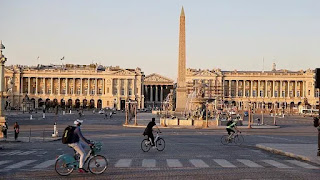
Tout A Velo In Paris

 As I said on Saturday, and in earlier posts, if any municipality is serious about getting people to ride bikes rather than drive to work or school, or for fun, building bike lanes is just one step.

And it’s a legitimate step if and only if (See what I learned in my formal logic class?) those lanes are well-designed, -constructed and -maintained—and practical.  

On that last condition:  Building bike lanes that begin  and end in seemingly-arbitrary locations, without any markers or any other indicators, serves no one.  People will give up four wheels for two if, among other things, bike lanes actually connect places people ride to and from, safely.  Of course, I don’t mean that people should have lanes directly from their front doors to their desks or work stations. But bike and pedestrian paths should make it possible to go from, say, a central point in a residential neighborhood to a business or cultural district in the way of good mass transit systems—like, say, the one in Paris.

Photo by Ludivic Marin, for Agence France Presse


Apparently, the City of Light’s Mayor, Anne Hidalgo, has such a vision.  She won a second term last June on a platform that included making Paris a city “tout รก velo”—totally cycleable—by 2026. To that end, the French capital is investing 250 million Euros to improve its cycling infrastructure.  

Among other things, 52 km (about 32 miles) of “coronapistes”—temporary lanes created during the pandemic—will be upgraded and made permanent. To that, another 130 km will be added to the existing 100 km.  These additions and upgrades will make it possible to cycle from one end to another, and to and from key locations, within the city as well as in the adjacent suburbs.Even more important, those lanes will be planned to make it safer for cyclists to cross intersections, thus addressing another concern of people who say they’d consider cycle commuting but worry about safety.

Hidalgo’s plan will also address another concern—bike theft—by adding 100,000 new secure parking spaces, including 1000 for cargo bikes.


25 October 2021

Budding Fall At The Harbor

Yesterday I started riding to Connecticut.  But in Mamaroneck, a bit more than halfway up, I detoured into a couple of cute downtowns and onto lanes that wind by mansions, country clubs and horse trotting courses, and through tax-shelter farms.

When I ended up back on Boston Post Road in Mamaroneck, I stopped to eat the bagel and small wedge of cheese I packed in the bag of Zebbie, my Mercian King of Mercia with the striped seat tube.  

Honestly, I rode her for one reason:  She looks autumnal.  So did the scene at Mamaroneck harbor, at least somewhat.


If you look closely or enlarge the image, you can see budding Fall foliage on the right.  Actually, it looks (to me, anyway) like someone lightly brushed red and orange across a cluster of leaves.  


24 October 2021

He Lost His Key, Not His BIke

The pandemic has brought both out the altruism and avariciousness of people.  It's also revealed their creativity and hideboundedness, as well as their brilliance and sheer stupidity.

Examples of the latter include the woman who got busted for using a fake vaccine card.  Her forgery was detected because the name of the vaccine she didn't receive was spelled "Maderna."

As if there isn't enough boneheadedness to go around, a probably-soon-to-be-former San Jose Sharks forward Evander Kane got himself suspended for a quarter of the season because he violated the National Hockey League's COVID-19 protocol.  His offense?  He submitted a fake vaccine card.

And, to prove that idiocy knows no boundaries, there's Singapore Police Station inspector Ong Chee Seng.  On 26 May, the 50-year-old rode his foldable bicycle to a shopping mall so he could buy lunch. When he returned to his bike, he couldn't find his key.  He tried to borrow a cutter from the mall's security personnel, but they wouldn't help him because they couldn't verify that the bike was his.

Later that day, he sent a message on his WhatsApp group chat, asking whether he could borrow a cutter.  One friend jokingly suggested that he call the police and claim he'd found his stolen bicycle.  The constables, this friend jested, could then perform a "free service" for him.

The rest of this story illustrates something else we've learned during this pandemic:  There's no counsel so bad that nobody will follow it. (Think of the folks who followed Trump's advice and injected themselves with cleaning products.) So, Ong called the Punggol Neighborhood Police Center and told the officer who answered, "I found my stolen bicycle here at the bicycle bay of Waterway Point.  I need police assistance."


Google Street View image


He led officers dispatched to the scene to another nearby location, claiming it was stolen when he locked it there.  When one of the officers said he'd check the CCTV cameras, Ong confessed to his lie. He was then charged with providing false information to police that led to an investigation.

On 3 September, he was suspended from the Singapore Police Force and the other day, he was fined $3000.  The SPF has also initiated "internal action" against him. If stupidity were a crime, his sentence surely would have been greater.

23 October 2021

Real Cities Have....

 Earlier this week, New York City Mayoral candidates Eric Adams and Curtis Sliwa debated.  The latter, best known as the founder of the Guardian Angels, expressed one position I wholeheartedly agree with:  his stance on animal welfare.  He said that, if elected, all of the city's animal shelters would become "no kill" shelters.  He deemed it "barbaric" that there are still horse-drawn carriages on city streets.

The only purpose those animals and carts serve is the amusement of tourists around Central Park. Thus, his wish to ban them is, I believe, well-founded.  The same cannot be said for his stance on bike lanes and traffic.  He believes there's a "war on cars" on this city, and has vowed to remove bike lanes in neighborhoods where they're less-used.

I think, like any good politician--which is what Sliwa has always been--Sliwa is echoing his supporters, many of whom believe that "their" streets and parking spaces are being stolen, "invasion of the body snatchers-style" by terrible, evil cyclists.  

Apparently, that sentiment echoes in other cities:

  You can't even go to South Water Street in Providence anymore, at least not without wearing a bulletproof vest and duct taping AirPods to your ears.  Nothing screams "thug" like a skinny person in bicycle shorts.

Dan McGowan obviously doesn't think that way.  He followed that paragraph in his Boston Globe editorial with this:  Said absolutely no one ever.  He used his platform to praise outgoing Providence Mayor Jorge Elorza for building bike lanes and in general planning with the recognition that the future of his city, and others, cannot be car-centric.  Those efforts, and similar work by other officials, led McGowan to this conclusion:  Real Cities Have Bike Lanes.


Bike lane on South Water Street in Providence.  Photo by Barry Chin, for the Boston Globe.


He is partially right.  Bike lanes can be an integral part of a city's infrastructure and thus encourage cycling if those lanes are well-conceived, -designed and -constructed.  They need to make cycling safer by taking into account the actual experience of cycling on urban streets or county roads. (As an example, the lane has to be built and traffic signals coordinated so that cyclists can proceed through an intersection, or make a left turn, ahead of right-turning motorists.)  And those lanes should be practical:  They should enable cyclists to pedal from their homes to schools, workplaces, shopping areas and other common destinations.  I've seen too many bike lanes that begin in seemingly arbitrarily locations and end abruptly.  

So, I would amend Dan McGowan's conclusion with one word:  Real cities have practical bike lanes.

22 October 2021

All Aboard The Bike Train--To School

Some people can be enticed into bicycle commuting if it's practical, safe and convenient.  Bike lanes that connect--or at least facilitate connections--between cyclists and everyday destinations like schools and workplaces are one "carrot," if you will.  Another is safe bicycle parking facilities, not only at said schools and workplaces, but also at transportation hubs.  After all, if someone's job is a 45 minute train or bus ride away, he or she isn't likely to pedal all the way.  But that commuter could be persuaded into riding instead of driving to the train or bus station. 

Now, here's something that is rarely, if ever, addressed in planning bicycle (or other transportation) policy and infrastructure:  getting more kids to ride in school.  In some rural areas, where the bus ride might be even longer than it is for a suburban resident's commute to the city office, that might not be practical.  But it could make sense in urban and suburban areas, or even in some small towns, where the trip to school might be a ten-minute bus ride--or a half-hour walk.

The biggest hurdle to getting kids to ride to work, though, might not be convincing the kids themselves.  Rather, it's allaying parents' not-unjustifiable fears for their kids' safety.  But a solution is one that's been in use for some time, though not for bicycling.

On any school day, you might find yourself stopping at an intersection--or somewhere along the path in your local park--by a "train."  I'm not talking about the ones that run on steel rails.  Rather, I am talking about a line of kids who might be latching onto a rope or other line, and supervised by their teacher or aide.  Well, some folks in East Lansing, Michigan are guiding kids to school in the same way:  The kids ride in a line, accompanied by a chaperone who picks each one up along the way.


Photo by Margaret Cahill, from Fox47 News


This "bike train" was organized by Jeff Potter, an aide and substitute teacher at Red Cedar Elementary School who also just happens to be a cyclist.  While he admits that keeping the kids together is "like herding cats," he thinks the "train" is a "community builder."  The kids have a chance to interact with each other on the way to school.  This, he believes, has "improved school behavior and their awareness of the neighborhood." 

Principal Rinard Pugh agrees and adds there is another benefit.  "There's fewer kids in cars," he explains.  That "helps to improve health and fitness" which, he explains, "is really important with our kids coming off COVID."  In addition to getting kids to exercise and interact, it also gets them outside which, Pugh explains, is especially important during the pandemic.

So, bicycle trains not only help to accomplish, for kids, one goal of good bicycle policy:  making bicycling safe and convenient.  In addition, it helps in dealing with the pandemic.  Perhaps more people and communities will get "aboard" with this idea.

21 October 2021

Will Seattle Repeal Its Helmet Law?

In March, I wrote about how debates over Seattle's bike-helmet law came to include arguments about racial and economic justice.  As with so many laws, it has been unequally enforced:  African-Americans and Native Americans (the latter of whom the Emerald City has one of the largest communities) are more likely to be cited, fined and even arrested for cycling bareheaded.  If Black and Native cyclists ride bareheaded, it's not because they value their brains less or feel more impervious than, say, White or Asian cyclists.  Rather, helmets--which, I believe, should be bought unused--sometimes cost more than the bicycles people ride, which may have been bought cheaply, donated or gifted to their riders, or rescued from a dumpster.

Now another facet of that racial/economic justice has surfaced as the King County Board of Health considers a vote to repeal the law, which has been on the books since 2003.  Most bike lanes in US cities didn't exist when law was passed.  Neither did three kinds of vehicles that, today, often outnumber traditional bicycles on those lanes:  electric bikes, motorized bikes and scooters.  While scooters, especially those with electric or motorized assists, are ridden (at least here in NYC) mainly by the young and relatively affluent, riders of e-bikes and motorized bikes are older or, most often, delivery workers who are (again, at least here in NYC) most likely to be poor immigrants who may speak little, if any, English and thus have few other options for earning income.

Ever since I started wearing a helmet, I've encouraged others to do likewise.  My endorsement of them has grown more emphatic over the past year because the surgeon who examined me said, in essence, that I came out of a crash I suffered last year because I was wearing one.  And, while I was once sympathetic to the libertarian arguments against helmet laws, I feel that there should be incentives for wearing them.

Most important, though, I think that if any jurisdiction wants to mandate helmets, it has to enforce the policy consistently and fairly.  That has been the main argument for repealing King County's law:  It has never been enforced equitably, let alone fairly, and doing so has become even more difficult.  So, the argument goes, why should a law exist if it can't or won't be enforced.


Photo by Sylvia Jarrus, for the Seattle Times


That logic makes sense for some laws, such as the ones against using, possessing or selling marijuana.  As with the 1920s prohibition against alcohol or the cabaret laws that ostensibly led to the 1969 Stonewall Inn raid, it was used mainly as a weapon against certain groups of people.  I agree that a law shouldn't be enforced disproportionately against some people, but I also think that not all laws are equally valuable, or even necessary.  To wit:  I think there's no reason to prohibit marijuana, alcohol or some other substances.  The only laws regarding them, I believe, should impose an age limit on who can purchase or use them and the contents of those substances.  And there's no reason to limit what goes on in a bar or cafe as long as it doesn't harm employees, patrons or the general public.  On the other hand, the burden of obeying a law shouldn't fall on some people more than others.  People who pedal traditional bicycles are far more likely than those who ride motorized or electric bikes, or scooters.  (I almost never see a scooter-rider with a helmet.)  

So, if the folks in King County want to repeal their helmet law, I hope they do so for the right, or at least good, reasons.  An unwillingness to enforce it--equitably, or at all--is not one of them.

20 October 2021

Because That's Where The Bikes Are

Because that's where the money is.

So responded Willie Sutton to the question of why he robbed banks.  I got to thinking about him when I wrote yesterday's post and a story that came my way afterward.

One reason why some people don't include cycling in their daily commute is their all-too-justifiable concern that when they park their bikes at the train or bus station in the morning, it won't be there when they return in the evening.  Bike thieves know that transportation hubs are mother lodes for bikes that can be quickly sold or parted out.

Another rich vein for velocipedic gold, if you will, is college campuses.  Students at California Polytechnic State University (Cal Poly) in San Luis Obispo have discovered this the hard way.  

While some students lost their bike through carelessness--  they thought they could leave their bikes "for a minute" or used their big, strong U-Locks only on the front wheel--others who were careful and diligent nonetheless have lost machines they depend on for transportation as well as recreation.

Students who lost their bikes echo a common refrain of victims in other venues:  The cops don't care.  Their complaint is valid:  The percentage of stolen bikes that are reunited with their owners is abysmally low.  That, even though, "At bike shops in town, it's not uncommon to see stolen bikes come in," according to Sam Coyle, a Cambria Bicycle Outfitters Employee.

And the the thieves went to where the bikes are.