05 December 2021

"Like Herding Cats"

 You've heard the expression that something is "like herding cats."

Well, have you ever tried to teach a cat to ride a bike?

You'd think that with all of my experience as a cyclist, teacher and professor, I could teach anyone anything when it comes to cycling.  Well, some things tax even my wealth of experience!

I'm going to try visualization.  Maybe if she sees enough images like this one, she'll accompany me on a ride:


There's still time!


04 December 2021

A Bike Lane Or A Parking Spot

 If you’ve been reading this blog for a while, you know that one of my pet peeves is bike lanes that put cyclists in more danger than they’d experience in riding on the streets.

Bike lanes can be hazardous in all sorts of ways:  They can be poorly constructed or maintained.  They can be poorly conceived and designed. (How many lanes begin or end “out of the blue” or lead cyclists straight into the path of trucks or buses turning right in intersections?) Or they can be marked (or not) in ways that confuse motorists and pedestrians as well as cyclists.


The latter situation confronts drivers and cyclists along Lake Avenue on Cleveland’s West Side. Recently, the city installed a bike lane there.  What they neglected to do, however, was to remove 30- and 60-minute parking signs.  

Not only is it inconvenient for cyclists when motor vehicles pull in and out, or park in bike lanes: it’s also hazardous. “It creates a situation where motorists don’t expect cyclists to veer out into the roadway because there is a bike lane,” explained Jacob VanSickle of Bike Cleveland.

He says BC has contacted the city about removing the signs.  The city said it’s the duty of a contractor for the Ohio Department of Transportation to remove the signs.  According to Isaac Hunt, the lane is expected to be completed by mid-December and the signs will be gone “in a few weeks.”

“Those are bike lanes now,” Hunt says and cars are therefore not permitted to park in them. But, many drivers are understandably confused by the signs: perhaps they don’t see the bike lane markings or realize they aren’t supposed to park in a bike lane.  

Then, of course, there are motorists who resent having “their” road space taken from them, or just don’t care about rules. For them, the rules have to be enforced.  For everyone else, those rules—and the very existence of the bike lane—need to be clarified.

03 December 2021

Where Are The Bikes—And Docks?

 I’ve ridden Citibikes a few times, always for the same reasons:  I could ride there, but not back (like the time I pedaled to a procedure that involved anaesthesia) or I went to pick up one of my own bikes.


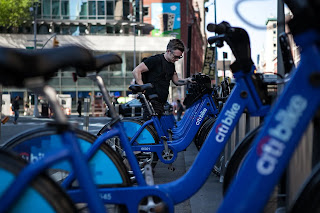
Photo by Christopher Lee for the New York Times


On the whole, it’s a good system, given its inherent limitations.  The main non-inherent limitation is that it still isn’t available to about half of this city’s residents:  Nearly all of the bikes and docks are in Manhattan or nearby neighborhoods (like mine) in western Queens and northern Brooklyn. 

Of the inherent limitations, perhaps the most significant is the mismatch between the availability of bikes and ports at any given moment.  As an example, on one of my trips, I had to go to three different docking station before I found an empty port where I could leave the bike.  That left me about half a kilometer from my destination.  The nearest docking station was only a block from where I needed to go.

Sometimes people encounter the opposite problem:  no bikes at the docking station. This typically happens at times and in areas where many people are leaving, or leaving for, their jobs or schools.

As much as I liked Curtis Sliwa’s position on animal rights, I voted for Eric Adams to become our next mayor because of just about everything else—including his mention of expanding Citibike to areas not yet served by it—and, too often, un- and under-served in so many other ways.

02 December 2021

How Not To Sell A Stolen Bike

When I wrote for a newspaper, I talked with a man who was (or at least claimed to have been) a "professional thief."  In other words, he said, stealing--jewels, mainly-- was his metier. And, as such, he and others like him had a set of guidelines--a code of professional conduct, if you will.  They included such gems as "Never kill unless there is no other alternative" and "Never steal from anyone poorer than yourself."

One thing that separates professionals, like the one he claimed to be, and others is that he stole strictly to "get paid," he said.  "You steal, you sell, you spend," he explained, unlike amateurs who might, say, steal out of poverty and desperation or to support a drug habit.

By implication, that meant "you shouldn't steal to support your stealing"  and "you shouldn't use something stolen to steal." In other words, a professional thief never  should do what two men in Oregon seem to have done.

A bicycle was stolen in Eugene, the state's capital.  The victim found it for sale on Facebook Marketplace and arranged to meet the sellers at the Walmart in nearby Springfield.  He apprised the cops of what he was doing.


Just before the gendarmes arrived, one of the sellers, who drove the car used to transport the bike, went into the store.  The officers, seeing the bike in the back seat, took the passenger--35-year-old Guy Devault--into custody on a warrant.  Shortly afterward, they caught the driver--Juan Sanchez, also 35 years old--in the store.

An investigation concluded that Devault was responsible for the stolen bike. But, as it turned out, the car was also stolen.  So, in addition to his outstanding warrant on for kidnapping, Sanchez now also faces a charge of being in possession of a stolen vehicle:  the car used to transport the bike.

The fellow I talked to when I was writing for a newspaper would have known better than that.


01 December 2021

Unparliamentary?

 Virtue signaling has been around forever.   Corporations and other major institutions, as well as mainstream politicians and celebrities, have long tried to show one audience or another that they are in agreement on some issue. A current example might be companies that make their products in overseas sweatshops running commercials in which models wear T-shirts or accessories emblazoned with a Black Lives Matter logo.

There is a subgenre of this called greenwashing.  In it, some organization or person tries to convince people that it really, really cares about climate change and other environmental issues by offering "green" versions of its products.  As often as not, the item doesn't actually cause less environmental impact than its "dirty" counterpart, just as so-called "healthy" snacks are sometimes just as hazardous to our waistlines as what they're supposed to replace.  

Now, it seems that some folks are being accused of a sub-subgenre of greenwashing. I'll call it "bikewashing."  Some accused Pete Buttigeg of it when he rode a bike.  Granted, he didn't look like he had much practice, but reliable sources say that he didn't get out of his car and ride a few feet to show the world that the new Transportation Secretary indeed cares about alternatives to fossil-fueled vehicles.

Now a Conservative member of the Canadian parliament has accused the country's Minister of the Environment of using a bike as an "unparliamentary prop" in a Zoom call.  First of all, calling a bike an "unparliamentary prop" is as ignorant as you-know-who taunting John Kerry for breaking his leg in a "bike race."

Can someone tell me what, exactly, is "unparliamentary" about a bicycle?  I like it myself, not in the least a purple Marioni.  My only quibble is that it seems to have a single gear but a pair of downtube shifters.  I guess someone was in the middle of converting it from a derailleur-equipped to a fixed-gear or single-freewheel bike.


To be fair, whether or not Steven Guilbeault actually rides the bike, that it's there is understandable:  He probably was in his home and the bike happens to be wherever his computer or other device was set up.  Nobody has complained about seeing my bikes--or, for that matter, Marlee-- during Zoom meetings.  

If anything, the bike makes me think of the bike that was always hanging in Seinfeld's apartment. (Trivia question: What kind of bike was it?) Did he, or anyone actually ride it?

And Ed Fast's reaction to seeing a bike behind Guilbeault makes me wonder whether members of parliament, conservative or otherwise, have other things to think about--you know, like the latest variant of COVID-19.


30 November 2021

She Rides To Work--And Through Labor

 The next time you don't feel like pedaling to work or school because you're tired, have a headache or worried about the weather, think about Julie Anne Genter.

She's a member of New Zealand's Green Party and Parliament--and perhaps not surprisingly, a cycling advocate.  On Sunday, she did something she'd planned on doing:  She gave birth to her second child after arriving at the hospital by bicycle.


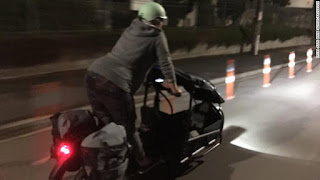
The way she got there, however, wasn't quite as she'd anticipated.  Her original plan was for her partner, Peter Nunn, to pedal a cargo bike with her in the front.  But when her contractions started, she realized that she and her hospital bag would add up too much weight. So she "just got out and rode," she explained.

Fortunately for her, the ride to the hospital took only ten minutes. Her daughter, whom she described as "happy and healthy," was born at 3:04 am local time.


The daughter is her second child.  She also pedaled to the hospital for the birth of her first child, which resulted from induced labor.  That same year, New Zealand's Prime Minister, Jacinda Ardern, gave birth while in office and brought her three-month-old baby to the United Nations assembly hall.

So, if you're trying to decide whether to ride to work, remember that Julie Anne Genter "wasn't planning to cycle in labor," but did.  

29 November 2021

What's The Wright Thing To Do?

 Two months ago, I wrote about a Dayton, Ohio building that once housed a bicycle shop.  Over decades, after the bicycle boom that straddled the 19th and 20th Centuries faded, the building came to serve other purposes, including the headquarters of an ice cream company.  

Now that building is in severe disrepair and, according to one city official, "could fall down at any moment." Moreover, the city's Director of Planning says that if the owners of the bicycle shop come back, "they would not recognize the building," as a new façade was added when the ice cream company moved in and other changes were made.

 Others argue, though, that the city--which has owned the building since 1998--allowed it to deteriorate and therefore should be responsible for repairing it and making it the historic and cultural landmark they believe it should be.

Last Tuesday, the city's zoning appeals board voted to approve the city's request to demolish it. Part of the rationale for the vote is that it's all but impossible to return the building to what it was. Even if such a thing is possible, the pro-demolition people say, the city can't afford it:  De-industrialization and the 2008 financial crisis ravaged the city in ways from which it still has not recovered.

I have never been to Dayton, but from what I've read and heard, it suffered a similar fate to cities like Camden, New Jersey (where I have been) after jobs were lost and people moved to the suburbs.  But, interestingly, Dayton also played a role in two significant historical events.  One of them involved the owners of the bike shop; the other led to the creation of a nation.

In 1995, the parties in a conflict involving the former Yugoslavia negotiated a peace accord that resulted in the founding of Bosnia-Herzegovina. (Say that three times fast!)  The treaty was signed in an Air Force base just outside the city, but the agreement is known by the name of this city.  And the bike shop owners became two of the most famous people in the history of the world.

The settlement I've mentioned is known today as the Dayton Accord.  So, if you ever go to B-H, remember that it's there because of a city in Ohio.  And those bike shop owners...perhaps you've heard of the Wright Brothers.

Yes, the building I mentioned was home to their business.  Almost everyone agrees that they learned the principles (including aerodynamics, via experimentation with riding positions) of creating a vehicle designed for flight from building, assembling and riding bicycles.


Photo by Ty Greenlees for the Dayton Daily News 


Now, I must say that as a cyclist and someone who cares about history, my heart is in the preservationists' camp, even though I understand the pro-demolitionists' arguments. As I am not a structural engineer and have never been to the building site, I am in no position to say whether the edifice can be saved.  I would aver, however,  that struggling cities have used their cultural and historic heritage as keys that opened the door to revitalization.  For two decades or so after World War II, even "the Hub"--Boston--was on the ropes.  Of course, it had many things going for it:  an attractive location, world-class universities, hospitals and museums and diversity in its population, in addition to an historic and cultural heritage few other American cities can rival.  The same can be said for Pittsburgh, which later underwent a renaissance similar to Boston's. 

I realize that Dayton is a smaller city in a different part of the nation, but I should think that embracing its historic and cultural heritage couldn't hurt. I mean, how many other places can claim to be "the birthplace of aviation?"  The Wright Brothers might not recognize the building that housed their bicycle shop, but I think the world recognizes their contribution--which was made possible by their work with bicycles.


28 November 2021

Clothes Make The---Cyclist?

While I disagree with Grant Petersen, the force behind Rivendell Bikes (and, before that, Bridgestone bikes) on matters of bike fit and, sometimes, design, I wholeheartedly agree with him on other things.  Among them is cycling attire:  Reading his blog convinced me that I didn't have to wear team kit--or anything else made of lycra--in order to ride and, more important, enjoy riding.

So I think he would appreciate this:


27 November 2021

Maybe They'll Get It Right...Some Day

I think it was Winston Churchill who said that Americans will do the right thing after they've exhausted all other possibilities.

Sometimes I think he was an optimist, at least when it comes to laws and polices regarding bicycles.  In my own humble (OK, I gotta say that:  I know I'm right because...well, I'm so damn smart and I've been riding for almost half a century!) opinion, no vehicle--whether it has one, two, three, four or more wheels--with a motor should be allowed in any lane designated for pedestrians, pedaled bicycles or any vehicle that doesn't have a motor.

I've presented my wisdom, I mean, opinion to everyone from the folks at Transportation Alternatives (of which I'm a member) to City Hall.  The response is almost always the same: "You're right. But how could it be enforced?"

So, we have to contend with "rocket" scooters, e-bikes with boosters, and hand-throttle e-bikes in bike lanes that are six feet wide--for bike traffic in both directions.  Or, in some places, we and pedestrians are "protected" by wrongheaded regulations.

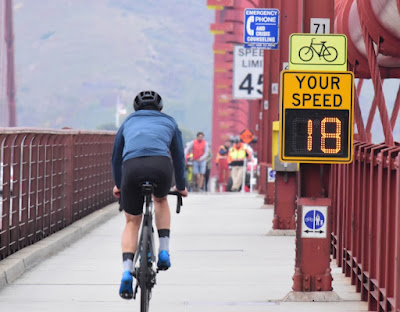
The new year will begin with such a policy for folks who cross the Golden Gate Bridge.  Starting on 1 January, there will be a one-size-fits-all 15 MPH speed limit in the bike/pedestrian lane.  Currently, bridge-crossers are "advised" to remain within that limit.


Photo by Sherry LaVars, for the Marin Independent Journal


While I understand the concerns of pedestrians (having walked across a number of bridges, including the Triborough/RFK and Queensborough/59th Street, in bike-ped lanes), I can also say that most cyclists who are going more than 15 MPH have a commensurate level of handling skills.  The same cannot be said, I believe, for folks riding e-bikes and motorized bikes and scooters at 25 or 30 MPH.  Plus, a motorized bike (which, as often as not, is really just a scaled-down motorcycle) can inflict more serious injury or damage than a pedaled bicycle at any given speed.

My hope is that Churchill will be proven right and whoever came up with the new Golden Gate Bridge regulation will realize the error of it and come up with something more sensible--like, say, banning anything with a motor from the pedestrian/bike lane. 

26 November 2021

I Wouldn't Be Caught Dead In...

 The '80s brought us "fade" paint jobs.

The '90s--oh, where do I begin?  It was (mostly) a great time for me personally (including as a cyclist), but there was all manner of insanity in the bike world.  As someone who was both a road and off-road (mainly the former) cyclist for most of the decade, I can say I'm unbiased in laying much of the blame on mountain bikes, which brought us bar ends in weird shapes, wheels with spokes that looked like the twist-ties from bags of bread and anything that could be made in a neon color.

This century/millenium has also brought its share of unfortunate trends.  Some of them start off as sensible, even laudable ideas, like bike garments designed to make us more visible to motorists (and, sometimes, each other).  But they end up in absurdity or just sheer tackiness:


I mean, why do you need an emoji to be seen?