28 January 2022

Barelli: Raising The Bar On The Hill

Throughout my life, I've read various books, poems and other works of literature that brought me into other worlds.  Among them are, of course, Shakespeare's plays and Charlotte Bronte's Villette (which I liked even better than Wuthering Heights). Currently, I'm reading Colson Whitehead's Nickel Boys, which brings me into yet another world I can scarcely imagine.

While it wasn't a work of great literature, in its own way the Palo Alto Bicycle catalogue did something similar for me.  Its pages were filled with images and descriptions of equipment even more exotic--and less affordable--than Campagnolo's.  At that time, I probably could've counted, on one hand, the number of Campy-equipped bikes ridden by people I actually knew.  So, in perusing the pages of PAB, I found myself imagining, not only the components themselves, but the folks who rode (or simply bought) them.

Among those parts were pedals that, to this day, I have not seen in "real life" but recently came across on eBay when I was looking for another part. In the mid-1970s, it seemed that every other cyclist with an engineering background, or simply a lathe, was trying to improve in one way or another in what they were spinning in races or club rides.  Among those folks were Bob Reedy, the folks at East Rochester Tool and Die--and Geoff Chapman.

A member of Cambridge (Town & County) Cycle Club in the UK, Chapman owned an engineering firm in nearby Bar Hill.   He would use a near-anagram of that name, with an Italian touch,  for the brand of his products:  Barelli.

At that time, the North American Bike Boom had crested.  Many of classic British builders were still producing their legendary frames, but the country's bike component industry was in steep decline, in part  because some manufacturers didn't update their designs or factory equipment.  As an example, Williams, which made some of those pencil-thin cottered cranksets found on classic British lightweights, finally produced a cotterless crankset--years after Campagnolo, Stronglight, Specialites TA and other companies introduced theirs.   And Sturmey-Archer, which was all but synonymous with internally-geared hubs, was losing not only because derailleurs had become more popular, but also because the quality of its products was slipping. (SA 3-speed hubs made from about the mid-80s until 2000, when the company went into receivership and was bought by SunRace, are all but unrideable.)  

So it was interesting, to say the least, that someone like Chapman would not only try to improve upon the design of what he was riding, but would also produce something worthy, quality-wise, of a Jack Taylor, Bob Jackson, Mercian, Hetchins or Ron Cooper frame.


Barelli Supreme


Barelli B-10


He seems to have produced two models: the Supreme and B10.  The former looks like an amalgam of platform pedals like the Lyotard Berthet and traditional quill pedals.  The latter took a shoe cleat that fit into the body and was secured with a traditional toe clip and strap.  (Shoe cleats of that time typically had a slot that fit onto the pedal cage.)  The B10, perhaps not surprisingly, seems to have had some following among track riders because it had such a secure hold which some described as "impossible to get out of."

That might be the reason why Barelli didn't share the same fate as Reedy and ERTD, whose designs were used by companies like SunTour. While Reedy and ERTD were really just lighter and more aerodynamic versions of traditional pedals (albeit with sealed bearings and a nicer finishes), Barellis--especially the B10--might have been just too radical.  Or the difficulty of dismounting B10s might have reminded them of the Cinelli M71, often nicknamed the "suicide" pedal.

So, while I'd like to see some Barellis in "real life," and might buy a pair if I were more of a collector (or simply had more money), it's probably a good thing I couldn't afford them when they appeared in the Palo Alto Bicycle catalogue.


27 January 2022

A Symbol Of....?

I don't often talk about my attempts to draw or paint, and I won't now. But I think that some of them, at least, were better than this:


I mean, I could draw a better bicycle--if that's what it's supposed to be--about the time I could pick up a pencil.  I could just see some archaeologist a thousand years from now (if indeed there are still archaeologists and stuff like this for them to find) chancing upon this and wondering whether it was a symbol for a fertility goddess--or a sketch for some sort of device or weapon. Or, perhaps, this future Indiana Jones muses, it might have been an emblem for some secret society.

Now, since it's next to an anthropomorphic shadow-figure, and I'm writing about it in this blog, you know it's supposed to denote the cycling side of a bike-pedestrian lane.  Perhaps not surprisingly, the lane, which winds its way through Maidenhead, a market town about 50 kilometers west of Charing Cross, London, is as bad as the drawing itself.  I'll admit that my perceptions were influenced by that photo:  It looks like cyclists and pedestrians are sharing two meters of space, if that, at that bend.  But some comments confirm my impressions about the lane.

Heck, I probably could do a better job of designing a bike lane--and painting or drawing its markers!


26 January 2022

Entry, Late In The Day

Yesterday, for the first time in a week, we had more than a couple of hours with temperatures above freezing (0C or 32F).  Breezy still, the day refracted hues of sea and sun stretching into, and stretching, the end of the day.


A late afternoon ride along the North Shore meant riding home into the sunset along the Malcolm X pier between Flushing and LaGuardia Airport.  I think of passengers on descending flights and how some of them are coming to this city for the first time--and how the skyline they've seen in countless images is so close, but is still so far away--something as clear yet impenetrable as the window of a plane keeps it all even more distant from them, at least for the time being, than the lattice of tree limbs along the cold gray water.


Do they get to see the skyline as a reflection of the water that channeled all of us--from the Maspeth tribe to Milennial tech workers--into streets where we can get lost, or find ourselves?


25 January 2022

He Understands The Value Of A Bike

Bicycles are extremely valuable pieces of equipment.  Quite often, they are more valuable than the motor cars their owners possess.

That insight comes from William Hart.  That is, Judge William Hart to you—and me.

The Bristol Crown Court magistrate made that observation in sentencing Michael Whatley and Steven Fry to 66 and 4O months, respectively, for charges that include stealing several high-end bikes from Friction Cycles in Bristol.

For that statement alone, I would be willing to sponsor Judge Hart were he willing to abdicate Her Majesty’s justice system and bring his wisdom to this land of anti-vaxers. Of course, it’s difficult to imagine why he’d want to do such a thing—or that he would need sponsorship from me, or anyone else.


I am guessing—or at least hoping—that such a wise and worldly person would understand that the value of bikes to their owners, whether intrinsic or relative to their cars, is more than monetary—especially for folks like yours truly who don’t have a car, or even a driver’s license.  

If nothing else, the Honorable William Hart merits my respect—and, I am sure, that of many readers of this blog—simply for understanding that bike theft should be taken as seriously as other kinds of crimes: something too few of his colleagues, or law enforcement officers, in the United States do.

24 January 2022

My First View, From A Bike

Yesterday I rode Zebbie, my 1984 Mercian King of Mercia, through the brownstones and rowhouses of Queens and Brooklyn.  Such a ride could easily involve a trip across the Kosciuszko Bridge, now that it has one of the better bike-pedestrian lanes in this city.

And so it was yesterday.  Tourists on Citibikes almost always ride across the Brooklyn Bridge for the views.  But no longtime New York resident does that.  Rather, in-the-know Big Apple cyclists opt for the Williamsburg Bridge or, if we simply want a visually interesting ride, the Kosciuszko.

In the spring and summer, the view consists mainly of skyscrapers foregrounded by trees and the factories and warehouses along Newtown Creek.  But the denuded limbs of winter reveal a landscape of differing verticalities. (Does that sound like a geeky phrase or what?)

When I lived in Manhattan and Brooklyn, one of my worst fears was--moving to Queens.  Mind you, I took many good rides, and enjoyed other activities, in "the world's borough."  But my first glimpse of it came from my family's car, en route to visit relatives:


Tell me, how would you feel about a place if the first thing you saw in it was a cemetery?  I'm guessing that I probably saw it for the first time on a winter day like yesterday, with leafless trees screening, but not shielding, the tombstones.  


But I did eventually move to Queens--to Long Island City, not far from where I live now.  Since then, I've visited Calvary Cemetery.  I know that there are tours of some of this city's necropoli, like Greenwood and Woodlawn.  Anyone who has a taste for such things (which I do, sometimes) should also go to Calvary.  Largely before of it, there are--wait for it--more dead than living people in Queens. (Thomas Wolfe once claimed, "Only the dead know Brooklyn."  What would he have said about Queens?)  In fact, more people are buried in Calvary than in any other American cemetery--or than live in Chicago!

Like Greenwood and Woodlawn, Calvary is the final resting place for some famous and infamous people, as well as everyday New Yorkers.  Also in common with them, Calvary began after the 1840s cholera epidemic: At that time, most of Queens and the farther reaches of Brooklyn and the Bronx (the locations of Greenwood and Woodlawn, respectively) were rural. And there wasn't enough room left in Manhattan to bury the victims of that epidemic, so the city mandated that they be interred elsewhere. 

All of those cemeteries have chapels large enough for masses or services.  But Calvary has a full-blown cathedral (not visible in these photos) at least somewhat reminiscent of the Sacre Coeur in Paris.


It's ironic that those same trees I saw yesterday obscure the tombstones in spring and summer.  Could their lush leafage during those seasons be nourished by the "residents" of Calvary?


23 January 2022

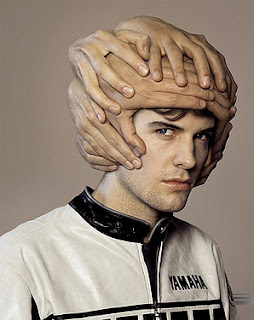
It's All On My Head

If you are my age or older, you may have ridden with a "leather hairnet."  Similar to the headgear worn by US football players until the 1950s, they were a lattice of foam-filled straps that might have prevented a scrape or two in a minor crash but probably were useless in a headlong fall or impact with a motor vehicle.


I had one such helmet in my youth. (Yes, believe it or not, I had one of those.) But I never wore it because it was too cumbersome and hot.  I had those same complaints when I first started wearing a hardhat--  a later-version Bell "turtle shell" nearly four decades ago--but have covered my head while riding ever since.


My "hairnet" disappeared into the mists of history. Actually, I think I lost it during a move.  I got to thinking about it when I came across this:


22 January 2022

Why Does One Steal For Three?

 I've been told, by people who have worked in it, that the art business can be as shady as any other.  Perhaps I shouldn't be surprised:  It's a world of secrecy with very little regulation.  And, as with real estate, stocks or anything else that's bought and sold, paintings, sculptures and other created objects sell for, essentially, whatever people are willing to pay for them, which leads to all sorts of unethical behavior.

Still, I have trouble imaging that anyone has ever said, with a straight face, "Psst!  Wanna buy a Monet?"  I don't know whether I'd laugh or call the police if I were to hear that.

That is the reason why I don't understand art theft--or theft of anything but basic necessities, and then only by desperate, destitute people. (Mind you, I don't condone any sort of pilferage:  I simply can better understand the motives of a person who's simply trying to survive or feed his or her family.)  After all, what do you do with Rembrandt's Storm on the Sea of GalileeOr Van Gogh's Poppy Flowers? Or Cezanne's Boy In A Red VestHang them on your wall and invite your friends over for dinner?  I mean, if you were to try to sell those paintings to anyone who recognized them, they'd know that it was fake or stolen.  You can't make it "go stealth" the way you can with, say, a contraband high-end watch.

So it is with unusual bicycles.  Most bike thieves want to sell the bikes or their parts, so they steal stuff that's valuable but common. (That makes even more sense when you realize that for several years running, the most-stolen car was the Toyota Camry.)  I would think that it's more difficult to unload a tandem, especially a high-end one.  And I would expect that a bicycle built for three (which was misidentified as a tandem in the article in which I learned about its theft) would be even trickier to sell, "chop shop" or simply disappear. How many triplet fames have you seen?


The Rumseys.  Courtesy: Salt Lake City Police Department


Fortunately for the Rumsey family of Houston, it didn't take long for their three-seater to be recovered after it was stolen in Salt Lake City.  They commissioned the bike 18 years old, not only so Dave and Merle could pedal with Ford, their 36-year-old son with Down's Syndrome, but also so it could travel with them.  The bike can be disassembled to fit into a suitcase and has therefore accompanied the family on every trip they've taken.

So, as you can imagine, the bike entwines all sorts of memories with its usefulness to the family.  That is the reason why they were so glad it was returned to them.  And perhaps it was a good thing that the bike is unlike almost any other.  The Salt Lake Police didn't say whether they'd caught the thief. If they hadn't, perhaps he realized it would be too difficult to sell or otherwise unload and abandoned it. What would he have done with a Picasso or a Caravaggio?


21 January 2022

What If He'd Stayed?

Yesterday, I wrote about an effort to make Austin, Texas more bike- and pedestrian-friendly. I haven't been there, but if it's anything like the parts of the Lone Star State I've seen, the complaints of its cyclists and pedestrians don't surprise me:  Even Houston, its biggest city (and the fourth-largest in the US) can seem like an expanse of auto-centric suburban sprawl, especially if you're accustomed to a city like mine (New York), Boston, San Francisco or most major European burgs, bourgs or bergs.

Then again, I have to admit I was a little bit surprised that, from what I was reading, bike lanes and sidewalks are so poorly conceived, designed or maintained--or nonexistent outside central parts of the city.  After all, during the past three decades, many young, educated people--the ones who, during the same period, were most likely to become recreational or commuting cyclists--moved to the Lone Star Capital.  And it has a major university, which usually is enough to ensure a significant number of cyclists.

Today I was reminded of another reason why one might expect Austin to be a better place for cyclists.  Now, I know that almost anything that happened more than two years ago seems as distant as the Mesopotamian civilization but, believe it or not, three decades ago isn't so long in, as Doctor King said, the long arc of history.  

Just as there was indeed a time before COVID-19, there was also a time when Lance Armstrong was a kind of "golden boy."  He had just won the World Championship and was seen as an heir apparent to Greg LeMond and the generation of American riders who put their country on the sport's map for the first time in decades.

Well, back then, Lance lived in Austin. Professional cyclists are like other professional athletes in that they aren't "working" only when involved in a race, game or match.  Having been a racer for very brief time in my life, I know that in order to be competitive, you have to pedal for a few hours every day.  It's really as much of a commitment as going to the office, factory, school or wherever you make your living or forge your identity.  In addition, most cyclists, as well as other athletes, spend considerable amounts of time in other kinds of conditioning, such as running or weight-lifting.


Photo by Jeff Wilson for Texas Monthly


But one would think that with all of the cycling Lance--and, most likely, others--were doing, the city would have been more conscious of their needs.  You see, not only was he seen as a "rising star;" he had yet to be tainted by accusations of drug use.  In fact, he may not have been using any banned substances (at least, not in detectable quantities) in those days, before his cancer diagnosis. If you look at pre-illness photos of him and compare them to images of him after he returned to the sport, it's not difficult to believe as much.

Anyway, I couldn't help but to wonder whether Lance, had he retained his status, could have made a difference in hometown's cycle and pedestrian infrastructure.  Maybe he could have.  Then again, maybe he couldn't have:  After all, aside from people who bought Trek bicycles in the US Postal Service Team colors, I'm not sure he influenced much else

Still, it makes me feel old to think there was a time before COVID-19--and when Lance was revered.  

20 January 2022

Mapping What’s Missing


From the City of Austin 


My first time in Paris, so many things impressed me.  Among them were, of course, the food and the architecture—and that an entire street—l’Avenue de la Grande Armeé —was lined with boutiques of every major French bike maker and a couple of étrangers like Raleigh.  

And the city’s Métro system seemed like a fleet of high-tech yachts compared to the only such system—New York’s—I knew at the time. The feature that seemed most other-worldly, though, was the interactive route maps in the major stations like Châtelet-Les Halles.  Three decades before GPS, it was about as high-tech as urban subterranean navigation got: You pointed your finger to the name of a street or landmark and a string of lights marked the route and transfer (correspondance) points.

Now the city of Austin, Texas has something that reminds me of that old Paris map. The city’s Public Works and Transportation Departments have collaborated to create the ATX Walk Bike Roll to solicit ideas for improvements to the Lone Star capital’s bike and pedestrian infrastructure. To that end, they’ve designed an interactive map where residents can drop a “pin” wherever they find, say,  “hilariously narrow “ or non-existent sidewalks or bike lanes that are more like “obstacle courses.”

If we had such a map here in New York, I—or any regular cyclist—alone could fill it.  And to think this city is better than others in the US—including, possibly, Austin—for pedestrians and cyclists!


19 January 2022

Extending The Day, And The Season

 Yesterday I went for a late afternoon ride and noticed that, among other things, late afternoon is stretching later into the day.  I shouldn’t have been surprised:  Almost a month has passed since the Winter Solstice.

Something else I noticed also shouldn’t have surprised me, but did: It seems that Christmas decorations have remained on homes and businesses, and in public places, for longer than in any other year I can recall.  I’m sure it has to do with the fact that nearly two years have passed since the COVID-19 pandemic arrived here.  Some people, like health care workers, are tired in body; many more, I am sure, are fatigued in spirit.  Perhaps putting up those decorations, or simply trying to muster up some cheer, sapped them. 

Or they may simply want to cling to whatever flickerings of joy that are illuminating days that, while lengthening, are still followed by long nights.

I suspect that such is the story of the Toufous family, who gives our neighborhood one of the best and most extravagant holiday displays I’ve ever seen:


They’ve put on a great show for years,  But I think they outdid themselves to honor the memory of a family member.


They, like so many people, have endured so much during the past year.  If they want to leave that display up all year, even if only to make themselves feel better, I’m all for it!