07 February 2022

Winter Vista On A Sunday Afternoon Ride

Yesterday the temperature rose into the balmy (at least for those of you in places like North Dakota) 20's, or around -5C.  So I went for an afternoon ride which, among other things, zigzagged the border between Brooklyn and Queens.

The border between the US and Canada has a Peace Garden.  Probably the closest thing our interborough boundary has is Highland Park, with the Ridgewood Reservoir as its centerpiece.


Somehow it feels even more like a reflection of deep winter than all of the displays or any day-after-snowstorm vista in this city.


I usually see at least a couple of cyclists there. Yesterday I was riding solo, though I saw a fair number of people walking their dogs, or with each other. Some looked happy to be there, but others eyed me, and other strollers, with suspicion, as if we'd intruded on their own private Idaho, if you will.


I can't say I blame them.  I know I've referred to Highland Park as our local Montmartre for its location on the highest point in the area and the views it offers.  Of course, it doesn't have the onion-domed cathedral (my favorite building in Paris) and I reckon that fewer people visit the park in a year than visit one of the most iconic places in the City of Light in a year.

It's kind of ironic that in writing about it on this blog, I'm more likely to tip off someone in Belleville or Berlin than the folks in Bensonhurst or Belle Harbor about a place where I go for a quick ride and the cheapest form of therapy (along with  a cuddle from Marlee) I know about.


06 February 2022

WWMS: What Would Marshall Say?

 Marshall McLuhan famously said, “The medium is the message.” 

What would he have thought of this?:


I encountered it while riding down Driggs Avenue, one of the north-south thoroughfares of northern Brooklyn. The corner gifted with that message is South 2nd Street, just a couple of blocks from the bridge named for the neighborhood.


Given that Williamsburg, Brooklyn (at least the part north of the bridge) is the world’s capital of trust fund kids posing as hipsters, I have to wonder whether it’s one of their lame attempts at being “ironic.”

05 February 2022

C-L: A Classic

 A few years ago, Andy Richman resurrected a classic name in British cycling:  Chater-Lea.  It had shuttered its factory and offices three decades earlier.  

From 1890 until its demise, the company made components and frame fittings that were, arguably, of superior quality to anything else made.  Indeed, when Richman persuaded the owner of Condor cycles to sell him a 1948 Condor frame, the owner remarked, "You do know there's only one set of components worthy of going on this bike? Chater-Lea."

That meant, among other things, that their stuff wasn't cheap. Lower-priced imports, along with the rise of the motorcar, helped to fuel the company's decline.  Also, as well-made as their products were, late in their history, they didn't keep up with changes in the cycling world.  For example, they never produced a cotterless chainset (what the Brits call a "crankset") or bottom bracket and clipless pedals would displace high-end traditional cage or platform pedals on the kinds of bikes that would have been adorned with Chater-Lea stuff.

But Ron Kitching, whose catalogues were eagerly awaited by cycling enthusiasts for decades, blamed the company's demise on another factor: By the 1960's Raleigh had achieved a near-monopoly on the British cycle industry, which allowed it to force down suppliers' prices and put many out of business.

I am glad Richman decided to resurrect a part of cycling history, albeit with somewhat updated designs and superior materials.  In keeping with one of the company's traditions, the new Chater-Lea parts have their own distinctive looks, just as the old stuff did.


Notice the "CL" embedded within the pattern.  It's kind of funny that people pay insane amounts of money to wear a designer's initials (or waste their money on knock-offs that begin to fall apart the moment they've paid for it).  But somehow I wouldn't mind bearing the monogram of Chater-Lea if I were riding a bike with its equipment.  

04 February 2022

Will Bicycles To Bring Them Back To Buffalo?

For at least a couple of decades, young people, particularly the educated ones, have gravitated toward cities like San Francisco, New York, Boston and Washington, DC.  All of them--with the possible exception of Washington, government basically is the economy--are what might be called "post-industrial" cities, where the chips and digits have largely replaced furnaces and smokestacks.

Buffalo, in media depictions and the public imagination, is anything but such a city.  It might one of the "poster children," along with Detroit and smaller cities like Youngstown, Ohio and Gary, Indiana, for what is commonly known as a "Rust Belt" community.  Because they have--or are perceived to offer--few opportunities, the educated and ambitious young rarely move to them, in spite of other attractions and resources some offer, not the least of which is housing (and an overall cost of living) that are a fraction of that in the coastal metropoli.

That incentive could become more powerful if the trend toward working at home continues.  But most such cities and towns will need to offer even more, such as cultural events and lifestyle amenities.  In the latter category is something I'll mention in a minute and relates to one of the disincentives to move to some place like Rochester, New York.

The home of Kodak was the smallest city in America with a subway line until 1956, when the downtown track beds were used to construct sections of two Interstate highways.  Other "rust belt" cities suffered similar fates when the Interstate system was built and automobile companies bought subway and trolley systems to destroy them and eliminate competition. (Buses, or at least the parts for them, were made by the auto companies.)

Buffalo had a similar story.  Ironically, it has a subway system "from nowhere to nowhere" that was built during the 1980s.  But, in a similar way to Rochester and other cities, it had a system of streetcar (tram) lines that connected different parts of the city and the city itself to some surrounding communities from the 1830s until 1950.  

I mention this history because it points to a disadvantage many of many "Rust Belt" cities:  the lack of a transportation system, whether because, like Rochester and Buffalo, it was disbanded or because the city never had one in the first place.

So, some folks in Buffalo--specifically, the Buffalo News editorial board--understand that making their city more bicycle-friendly might help to lure some young residents.  They seem to understand that many of us (OK, I'm not as young as the folks they probably have in mind!) bike to work, school or shop simply because it's often the most convenient or even fastest, not to mention the least expensive (aside from walking) way to go.  


Go Bike Buffalo members painting arrows for the area's first protected bike lane--which lasted only a year due to protests from motorists.  Photo by John Hickey for the Buffalo News.


Perhaps even more to the point, they understand that there's more to  making their city more amenable to young cyclists than building bike lanes. They also mention that such efforts must include "re-educating resistant drivers and residents who think the roads are theirs, alone" (That's the first time I've seen a comma used in such a contenxt in a long time!) or people who "don't see the advantages of creating spaces that might attract new, younger residents."

The folks at the Buffalo News sum up their case thusly:  "Making the roads safer for cyclists makes it safe for everyone, improves the quality of life and atracts young people to the area."

They won't get any argument from me.  I just hope Buffalo doesn't become Williamsburg-on-the-Niagara, complete with $15 slices of avocado toast and $25 craft beers.


03 February 2022

Here's What You Need To Climb The Next Hill

Racers and cycling's trendistas (who generally spend more than they ride) have long been obsessed with having the lightest bikes and equipment possible because they've bought into the notion that lighter=faster.  Now, it's true that a lighter bike is easier to accelerate, all other things being equal.  However, once a bike reaches a given speed, a heavier bike will maintain its speed with less input from the rider: This phenomenon is known as momentum.  But it will also decelerate at a faster rate because of headwinds or other factors.

Anyway, during the 1970s and early 1980s, the obsession with weight led to a fad called "drillium."  It's what it sounds like:  holes were drilled (or slots were cut) into parts to reduce weight.  In most cases, the mass saved--a couple of grams, usually--wouldn't make any difference for any rider save perhaps a time trialist.  

Interestingly, track riders--whom one would expect to be most obsessed with weight-- don't seem to have embraced the "holey" look as much as other riders.  did. If I'm not mistaken, NJS, the governing body for Japan's Keirin racing system, prohibits the practice. And when some companies offered pre-drilled or -slotted parts--like Campagnolo's brake levers--they were actually heavier, if ever so slightly, than their smooth-surfaced counterparts.  The reason, I was told by a company rep, is that the Campy used slightly thicker material to compensate for what they believed was a loss of strength that resulted from drilling or slotting.

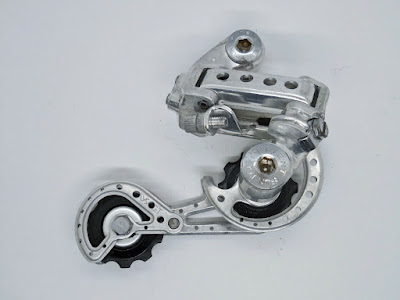
That leads me to another point about "drillium:" the parts that were drilled or slotted were usually among the lightest to begin with.  As an example, I've seen Huret Jubilee derailleurs--to this day, the lightest made--with pinpoint apertures in it pulley cages. And the poked and gouged parts were almost always intended for racing.

So, I was surprised (even if I shouldn't have been) to come across this:


Now, the SunTour Vx-GT wasn't porky:  Even by today's standards, it's more than reasonably light for a rear derailleur that can handle a 34 tooth rear cog. (And, it shifted better than almost any other wide-range derailleur made before indexed shifting became the standard.) But that capacity is the main reason why racers and others who rode with narrow-range gearing didn't use it:  If they rode a derailleur from the Vx series, they used the shorter-caged version.

So...I guess someone thought he or she simply had to save weight on the rear derailleur to make up for something he or she carried in a pannier or handlebar bag.  It reminds me of someone I knew who made floats with Haagen-Dazs ice cream--and Diet Coke:  the lack of calories in the latter, she said, balanced out the abundance of same in the former.

02 February 2022

What You See Depends On Your Vantage Point

 Philosophical question of the day:  Is a groundhog more likely to see his* shadow as an active cyclist


or as a passenger?


I ask because today the critters didn't get their stories straight:  Punxsawtney Phil, the most famous groundhog, saw his shadow, but our local forecaster, Staten Island Chuck, saw his.  According to Phil, there are still six more weeks of Winter, but Chuck says Spring is arriving early.

Which one glimpsed from the saddle, and which one got his view from a basket?

*--It seems that all of the groundhogs consulted for the seasonal forecast are male.  Does that mean that only they have the power to predict?  Or could it be that it's a big deal when they rise from hibernation because the females have been awake all along?


01 February 2022

Helping Healers Stay Healthy

I have passed the Memorial Sloan-Kettering Cancer Center many times, by bike and on foot.  Every time, I noticed two things:  few, if any, bikes parked in its vicinity--and how many people in lab coats or scrubs were smoking just outside its doors.

And I've been accused of "ignoring the risks" for cycling in Manhattan, and other parts of New York City. 

(For the record, I've never smoked, wear a helmet, am fully vaccinated and wear a mask when I'm within a couple of meters of any other person.)

Anyway, I have noticed more health-care workers of all kinds riding bicycles.  As a matter of fact, in the pandemic's early days, I gave the old Cannondale M300 mountain bike I fixed up to someone who works in Mount Sinai-Queens, a block and a half up the Crescent Street bike lane from my apartment. His is not the only bike I see parked in the racks outside the facilities.  

I mention all of this because I wonder whether what I'm experiencing and observing is indicative of wider trends, as they say in academic and marketing (!) circles. The question particularly interests me in light of a story that came my way:  the Mayo Clinic, in Rochester, Minnesota, has been named a Bronze-Level Bicycle Friendly Business by the League of American Bicyclists.  In conferring this designation, the LAB cited "improved bike racks, secure parking rooms and tips for employees to ensure a safe and secure ride to and from work" as bases for so categorizing the Mayo. 


We've all heard the admonition, "Healer, heal thyself" (Cura te ipsum.)  It looks like the Mayo is taking steps to encourage its employees to follow that nugget of wisdom.  I hope other health-care facilities are doing the same--which, I admit, can be a difficult thing to do when perhaps no other profession has so many stressed-out people, especially in a time like this.      

31 January 2022

After A Snowstorm

From Friday night through Saturday, we in New York experienced one of the biggest snowstorms we've had in a while.

Now, if you live in a place like Vermont or Montana or the Alps, you might think it's funny that we'd make such a big deal about 30 centimeters (12 inches) of snow.  But city officials and media are expressing gratitude that the storm--which brought winds of up to 110 kph (70 mph) and a low temperature of -12C (10F)-came our way at the start of the weekend.

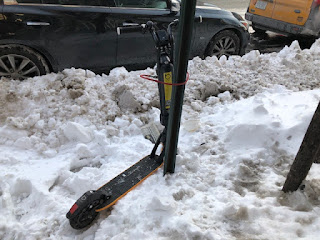
Because the temperature has remained well below freezing, the snow hasn't melted.  I have to wonder, then, how snow accumulates in the ways and places it does:


I also can't help but to wonder about vehicles parked on the street.  Are they parked with the knowledge of the approaching storm?  Or do people leave them, go and do wherever and whatever, and the weather just happens to turn:


Does anybody make knobby or studded tires for scooters?

30 January 2022

Really, I Didn't Crash!

 In nearly half a century of cycling, I have had two incidents that sent me to the emergency room.  Both happened in 2020:  I was "doored" in October after suffering a "face plant" in June.  I hope not to endure anything like either of those accidents again (or something worse!).  But if I do--and I'm not seriously hurt--this is how I'll explain it:


29 January 2022

As Kucharik Goes, So Has The World Of Bicycling Gone

Steel to aluminum to carbon.

Hand-built wheels to boutique wheelsets.

Hubs and freewheels to freehubs and cassettes.

Quill stems to threadless; threaded headsets to threadless.

The "baselines" for bikes and components have changed so much in the past couple of decades.  While some of those changes are beneficial to some cyclists, too many simply added cost and complication for others.

Those changes have also brought innovators and investors with deeper pockets than the mom-and-pop operations that dominated cycling until the 1980s.  One way you can see what I mean is to look at the sponsors of riders and teams:  Jerseys in the 1960s and 1970s bore the names of local or regional enterprises like Molteni and the bikes and components were made by companies (or sometimes individuals) that were involved mainly, or solely, in the bike industry.  Now bike and component makers tend to be parts of larger conglomerates, and sponsors include them as well as large companies (like Coca-Cola) that have little or nothing to do with the design or manufacture of bikes or parts.

Like all changes, the ones I've mentioned have brought casualties, if you will.  Some once-revered bike, component and accessory makers no longer fabricate their wares in Europe, Japan or the United States--or might build one or two of their most expensive models in their home country while outsourcing the manufacture of their mass-market goods to low-wage countries.  Still others are no longer in the bike business--or in business at all.  

And then there are smaller (what might be called "niche" in other industries) enterprises that ended when the main or sole proprietor--or even employee--retired, died or simply wouldn't or couldn't change with the rest of the industry.  I think in particular of small-scale frame builders like Ron Cooper and Brian Bayliss who had small but devoted followings.

Another change came with the ones I've mentioned. When I first became a dedicated cyclist, nearly half a century ago, high-mileage cyclists almost always wore wool--year round.  Those black shorts you see on cyclists from the 70s were made from it; so were there jerseys.   That, of course, is why bike kit of that time wasn't as flashy as today's:  Since colors and patterns have to be knit into wool, it's much more difficult (if not impossible) to include some of the intricate (or busy) graphics and loud colors you see on the "billboard" jerseys and matching shorts (or bibs) of today.      

During the North American Bike Boom of the 1970s, some companies got into the business of making bike clothing.  Most are gone now--offhand, I can think of Protogs and Weyless.  And there were the European, mostly Italian, makers. One reason the American apparel makers--aside from one I'll mention--didn't last more than a few years was that many cyclists had an attitude expressed by one shop employee I encountered:  "Buy right, buy Italian."  Also, Weyless (which made some nice components) claimed their wool clothes wouldn't shrink.  Well, shrink they did, and it's said that the warranty claims torpedoed a business that was already sinking as the tide of the Bike Boom receded. 

And, honestly, most of the Italian clothes fit (at least folks like me in those days) better. But one American company, almost entirely unknown save to dedicated cyclists, made wool shorts, jerseys, arm and leg warmers and other apparel that were better-constructed with higher-quality wool.

That company was based, seemingly incongruously, in Southern California.  Well, that location seems incongruous to anyone who doesn't understand wool:  Because it wicks moisture, it helps to keep you cooler.  And it keeps more of its insulating qualities than other materials when wet.  That is why it's been worn by people who live in areas that experience both extreme heat and cold, as well as other kinds of harsh weather.


John Kucharik Jr. has been extolling those virtues for the past 50 years.  He's about to turn 69 and, he says, he promised his wife they would "travel and do some stuff." So, although his company's sales grew during the pandemic, he is about to close the business his father, who died at age 93 in 2008, founded 88 years ago. 

That anyone can keep a business going for that long, with the family's surname, while making products that changed little, if at all, is an achievement.  And he's done it with the same workforce--seven people--for the past thirty years.  That, I think, may be a reason why he's closing up rather than selling out:  They're "my family," he says.  "I tell people:  They don't work for me; I work for them."

It will be sad to lose one of the last companies to make bike apparel from wool, or any other natural material (e.g., cotton and leather in the gloves).  But the cycling world will lose something else:  a place that repairs bike bibs, shorts and other items.  "I don't make money on repairs," Kucharik explains,  "I just do it because I do it.  My dad did it; I did it."  Their repairs include replacing or re-sewing pads and fixing zippers.  "[T]hese guys pay $200, $250, $300 for a bib short. They ride it once and they can't ride it again.  A bike shop doesn't want it back."  He said his shop was averaging about 40 such items--none made by his company--a week.

The closing of Kucharik Bicycle Clothing company also is another change in the bike industry.  Call me a cynic, but the more expensive bike clothes (and other items) become, the less durable they are.  And the bike industry has become more like the fashion industry and others in that it seems more oriented to affluent cyclists who won't ride a jersey, a pair of shorts or bibs--or a bike--for more than a season.