One reason I cycle is its effect on my mental health.
In short, bicycling makes me happy. How happy?
When I cycle, I'm a cat on a tandem and I allow a mouse ride on the rear. And I mean ride: The mouse doesn't even have to pedal.

Wheee!
One reason I cycle is its effect on my mental health.
In short, bicycling makes me happy. How happy?
When I cycle, I'm a cat on a tandem and I allow a mouse ride on the rear. And I mean ride: The mouse doesn't even have to pedal.
Wheee!
Bare branches veil
late afternoon windows
before they open


early Spring
red buds
pink blossoms


my ride ahead
opens

late afternoon
early Spring.
Whitney Gregory turned her son into a menace to society.
No, she didn't teach 12-year-old Jeffrey how to vandalize, steal, assault people or torture puppies and kittens. She told him to do something done by nearly all boys his age in his milieu--in a different place from where he'd been doing it before.
Susan Garcia felt so threatened by it. The Homeowners Association member in Santa Ana, California--no doubt motivated by the possible threat to her property value as well as her corporeal security--yelled at the boy and pushed him.
His mother probably taught him not to respond violently. If that was enough to get Martin Luther King Jr. arrested more times than he could count, it was more than sufficient to escalate Ms. Garcia's ire.
"Please don't touch me," he pleads with her.
She smacked him. "Why did you just hit me?" he asks.
Being a master of the Socratic and Talmudic methods of inquiry, she responded with a question, "Want me to hit you again?"
Jeffrey's parents came out of their house at that point. Not surprisingly, given the lessons they taught their boy, they de-escalated the situation and sent Jeffrey into their house.
So what did his mother tell him to do that so threatened Ms. Garcia?
She told him to ride his bicycle on the sidewalk.
Now, to you, dear reader, and to me, that may seem misguided. But Ms. Gregory, being the concerned mother she is, told Jeffrey to ride on the sidewalk because when he rode on the street, he almost was hit by a car. Were I not a cyclist myself, I might do the same for my kid.
I have to wonder, though, about what lessons Jeffrey Gregory has learned from the incident. Actually, I don't. You see, even though I have always had an independent spirit (for which I've been praised and scolded), as a kid--even at his age--I obeyed my parents, and most authority figures, to the degree that I could. And that is why, by that time in my life, I'd learned that at some point, doing what my parents, or some other adult, told me to do could get me into trouble with some other adult. And, of course, as an adult, you can obey the law and still get arrested or do whatever is expected of you and get into some kind of trouble.
All I can hope is that Jeffrey doesn't give up bicycle riding--and that he's not too emotionally scarred--as a result of an encounter with a woman who saw him as a menace--for riding his bicycle on the sidewalk.
With his intense, knowing face, shock of hair at the top of his head and focused eyes behind black-framed glasses, he looked like a combination of a philosopher, Indigenous warrior, surgeon and professor.
He pretty much had to be all of those things to do what he became known for. Being a cyclist also helped, I'm sure. He biked around his hometown, where he "loved living," according to his wife and, she added, wore "protective clothing" and used lights when he rode at night.
I can well understand why he loved living in Montclair, New Jersey: It's about 25 miles from New York, my hometown, and has anything one would like about a city and a college town: cafes, galleries and an active cycling community, of which he was a part.
Note that I am talking about him in the past tense. On Monday night, he met his end while out for an evening ride. In one way, his ending was like that of too many cyclists in the Garden State, and elsewhere in the United States: He was struck by a motorized vehicle. But said vehicle wasn't a car, bus or truck: It was a New Jersey Transit commuter train that many of his fellow town residents take to and from New York or Newark.
I wouldn't have been surprised if he'd written or otherwise called attention to some hazard or another for cyclists or pedestrians, or for the need to provide the education and infrastructure that would make those modes of transportation and recreation safer and more enticing as an alternative to driving. I say that because he spent so much of his life exposing all sorts of hazards and, more important, what brings them into, and continues their, existence.
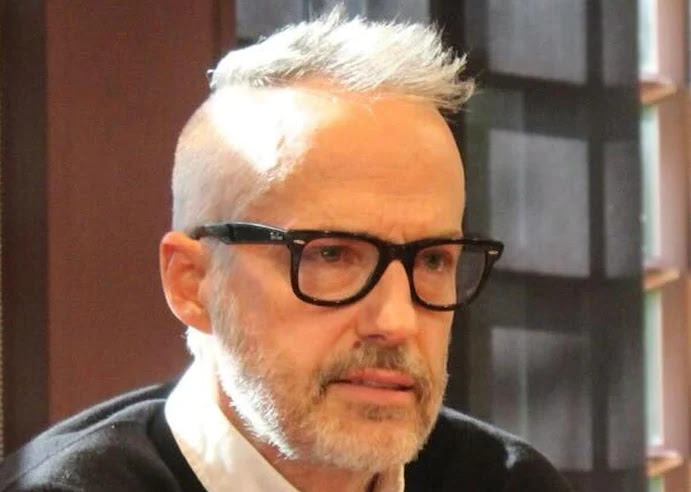
If your go-to source of (mis)information is Faux, I mean, Fox News, or even if you take everything printed in mainstream media (which, of course, does not include this blog!) at face value, you probably were not a fan of Eric Boehlert. While he was labeled, usually with justification, as "liberal" or "leftist," he was just as willing to take on the New York Times as OAN and even, at times, the publications for which he wrote and the programs on which he appeared. "We can't fix America if we can't fix the press" was not just a catchy sound-bite; it was his operating philosophy.
As his evening ride was part of his life, to and at the end. I, and his many fans--and fellow cyclists--extend our sympathies to his wife, Tracy Breslin and his kids, Jane and Ben.
The first known public bike-share program began in La Rochelle, France in 1974. About three decades would pass, however, before other cities in significant numbers would adopt such programs.
Since then, the successes, difficulties and criticisms of bike share schemes have been similar. In the latter category is the allegation--credible--that share programs were serving only central downtown areas and nearby neighborhoods where the young and affluent live and shop.
Since then, some cities have tried, with varying degrees of success, to make share bikes available to older, poorer--and sicker--residents. I've seen Citibike ports by city housing projects whose residents, for a variety of reasons, are more likely to have chronic and acute health conditions (including COVID-19) than other New Yorkers. Rides and memberships have been made more affordable, or even free, for residents and others who receive public benefits in an effort to improve their health and transportion options.
 |
| Photo by Jeff Wheeler, for the Star-Tribune |
Minneapolis, it seems, is going even further than most other cities. Its "Nice Ride" share bikes and scooters will return to the city's streets in the middle of this month. The city has just signed new contracts with vendors (Lime and Spin for scooters, Lyft for bikes, e-bikes and scooters). What is interesting, and possibly unique (at least for now) about the new arrangement is that it attempts to remedy the problem I mentioned.
According to the agreement, the vendors must distribute at least 30 percent of their scooters in Equity Distribution Areas of north and south Minneapolis. A maximum of 40 percent of vendors' scooters are allowed in downtown and surrounding neighborhoods.
But the contract goes even further: All of the vendors are required to offer low-income pricing arrangements. It also includes incentives for the operators to provide more parking infrastructures, including bike racks, parking stations and on-street corrals. Moreover, the vendors are mandated to provide ongoing education and outreach on safe riding and parking behavior, and on state laws for motorized and manual scooters.
It will be interesting to see what comes of these efforts. If anything, they sound like more integrated efforts than those in most other cities to provide a true alternative transportation infrastructure that includes bicycles. As I've said in other posts, bike lanes and share programs, by themselves, don't make for an infrastructure that will encourage people to trade four wheels for two, at least for local trips.
In January, I wrote about a British judge who, in sentencing two thieves, took into account that each of the bicycles they swiped costs more than many automobiles. His thinking on this matter is more advanced than that of just about any of his counterparts in the US, or almost any American law enforcement officer.
In that post, I also expressed the hope that his insight also includes other effects of bicycle theft on the people who lose their machines. While I empathise with the shop owner who loses multiple bikes with five-figure price tags, like the one who was victimized by the perps the judge sentenced, similar incidents probably don't comprise the vast majority of bike thefts. More often, I imagine, those episodes include the nurse, teacher, store employee, student or someone else who locks their bike to a street sign outside their place of work or study in the morning and returns to find said sign sans velo at the end of the day. Those incidents also include folks whose garages, sheds or homes are broken into and who may also lose other items or cash along with their bikes.
The latter scenario unfolded in Windsor. As in the Duke Of. The unfortunate property owner lost a Trek Madone with a graphite-colored Land Rover and other high-monetary value items. In response, Thames Valley police tweeted an appeal for help in finding the bike. Their message included a description, taken from surveillance videos, of the thieves and their getaway vehicle: a white Audi A3 with plate number GN64 XMM.

That message "boiled my bacon," in the words of one respondent. For one thing, that person complained about the constables heading the tweet with the title "high value burglary" so that "some resident who is very very well off for a bob or three can pull strings!"
That respondent has a point, and amplified it with this, "Yet a local fella in Caversham has his electric bike stolen while in Reading and he can ill-afford to replace it until he's saved up enough earnings, and Thames Valley Police weren't interested."
That person has a great point. While some ride electric bikes for pleasure or to commute to school or well-paying jobs, if the situation in England is anything like it is here in New York, I imagine that the majority of electric bikes are used by delivery workers. Most of them are immigrants who speak English not well or at all and have few, if any, marketable skills or credentials recognized in their adopted country. Therefore, as the person who reacted to the bobbies' tweet pointed out, they either save for their machines or buy them on credit or an installment plan, whether payment arrangements are made with their employer or bike dealer.
And the student or worker who parks and loses a battered old ten- or three-speed is losing his or her means of transportation and, possibly recreation or fitness. Such things are often more important, especially where mass transportation is spotty or unreliable and for people who may not have the spare funds to join a gym or for other recreational activities.
I think the judge I mentioned in my earlier post and whoever reacted to Thames Valley Police tweet should get together and preside over a court for bike theft!
If you cycle because you want to, non-cyclists probably have referred to you by any number of adjectives and epithets. One of them might be "crazy."
I'll admit that I actually called one of my fellow cyclists "crazy." So, however, did other members of our "crew." Actually, Ray Tirado wasn't crazy so much as he was fearless and seemingly incapable of feeling physical pain. (All right, some might argue that such a combination of traits might add up to a listing or two in the DSM.) Most of our rides together were off-road and he made jumps and descents that, even when I still had most of my insecurity and testosterone, I wouldn't have dared. Even on a straightaway on a the road, under a clear sky with the wind at our backs, I could see that his attitude toward riding, and life, was different from anything I could imagine.
That said, I admire him to this day. Even though he seemed to be riding "gonzo," whether on off his bike, he always seemed to understand who he is--which meant that the risks he took weren't just acts of hubris: He was pushing his boundaries because he understood what they were and didn't want them to be boundaries any more.
I must admit that, to this day, I value few compliments I've ever received for anything more than the ones he gave me for my riding (!) and "for being you," as he once said. "You know why you ride, or do anything you do."
He got half of that statement right. To this day, I sometimes do things without knowing why. Cycling is not one of them, which is why it's one of the few things I can't imagine my life without.
You see, after half a century of dedicated riding--which has included commuting, touring, racing, messenger work, riding on and off the road in all kinds of conditions in about two dozen different countries--I can say that I understand the risks of sluicing through city traffic, barreling down a rocky hill or pedaling into the teeth of a mistral as well as anyone.
And I know, as "Crazy Ray" surely did, that those risks are outweighed by the benefits, not the least of which are the ones for our mental health. One of the world's most influential people also understands as much--which is why he got me to thinking about Ray.
He's just published his latest book, Rationality: What It Is, Why It Seems Scarce, Why It Matters. One way you know he's an academician is that the book title has a colon in it. But he's more than that: a real intellectual, a thinker. That means that, as much as he enjoys cycling, it's not an unconscious or reflexive act for him. "Given the value you put on your life and the fact that there's even a very small probability of getting killed," he asks, "does it outweigh the pleasure and health benefits of continuing to ride?"
 |
| Steven Pinker. |
The people who can't understand why we ride are usually focused on the first part of his question: the risk. But Steven Pinker, a Harvard psychologist who specializes in psycholinguistics and social relations, has been thinking about why he rides for as long as he's been riding. For example, as a kid, he tried to understand how he could remain upright while riding, which would lead him to learn about the brain's workings and how they relate to Newton's law of gravity. Also, while growing up, he heard about men--including three uncles and several of his father's friends--dying prematurely of heart attacks. So, he says, as a young man he resolved to keep himself in good cardiovascular health. His studies in neuroscience would confirm the wisdom of his choice: "physical exercise is one of the best ways to extend brain health."
So, the Harvard researcher and my old riding buddy--who, by the way, was a plumber--would agree on this: Riding a bicycle is as about as rational as anything a human being can do.
When you reach a certain age, you see young people who don't ride nearly as much or eat as well as you do, but are skinnier.
Here is one possible explanation:

I have to admit that I never worked an unpaid internship. But I have worked for very little money and, like the cyclist in the illustration, survived on food not bought in my local bodega!
Because I was brought up working-class, and have spent much of my life teaching people from backgrounds similar to or poorer than my own--including immigrants and refugees--I am aware that many people have talents and skills that go unrecognized and, therefore, unrewarded.
A recent encounter reminded me of that. I was pedaling away from a Dollar Tree store when I saw a woman--from Senegal, I think (How do you tell a Senagalese? In Yoruba or French, of course!)--balancing a load on her head. Many girls and women do the same every day, in that woman's native country and others but their ability to balance, not to mention their strength is almost never translated into cycling, in part because girls and women are discouraged of even forbidden from riding. Such skills are also not transferred to remunerative activities because women are similarly discouraged or forbidden from work that pays as well or better than their husbands', brothers' or uncles', or any paid work at all.
To be fair (After all, I'm trans: I have to see all sides of the argument!), many boys and men have skills and talents that aren't validated, let alone valued, because those talents and skills weren't incubated in the walls of prestigious or even state-recognized academies, universities and other institutions. The lucky ones, at least here in the US, became rappers, break dancers, graffiti artists, BMX riders, skateboard stunt performers and the like.
To the list of such folks we can add this man in India:
A commenter described him as a "human Segway with a built-in gyroscope." He reminds me of people I saw in Cambodia, Laos and in the Turkish countryside, who carried loads in every imaginable way while riding their bicycles. I even see cyclists here in my native city, lugging bags almost as large as themselves (or so it seems) full of recyclable cans and bottles. As much as I like the speed and spectacle of racing, and enjoy riding a finely-tuned bike, I actually have more respect for people who carry--without the newest panniers or backpacks--whatever they need to transport from Point A to Point B.
In Florida, the Palm Beach County Department of Transportation has announced plans for a new protected bike lane.
This new ribbon for riders will link the Palm Beach Barrier Island with mainland Palm Beach County. It will include a new segregated lane along the Royal Park Bridge.

The stretch along the barrier island will include what promises to be the "most amazing" cyclists' cafe, which will offer new, exclusive versions of Garmin as well as varieties of coffee, tea and other libations that won't be available anywhere else.
That part of the route also offers easy access to a golf course, with free bicycle parking, although a PBCDT spokesperson admitted that few cyclists will avail themselves to that amenity.
The mainland segment of the bike lane, while not quite as opulent as the island leg, will nonetheless offer many places for cyclists to "fuel up," including some "health-conscious" options. The route will continue along some scenic waterfront roads to the renowned city of Lake Worth, on the a block of South Congress Avenue between Alabama and Ohio Street that "has a lot of character," according to locals.
The PBCDT spokesperson added that the island end of the bike lane will be on South Ocean Boulevard, at the request of one of its most famous residents.
While plans for this bike lane have been rumored for some time, the PBCDT spokesperson waited until today to announce it, believing "there is no better, more appropriate, day."
