14 August 2017

When In Rome...

Bikes and Kisses.

That was the name of the place from which I rented my bike when I was in Rome.

With a name like that, how could I go anywhere else?


Actually, it's called Bici & Baci, which of course has a rhyme and consonance the translation loses.  As I mentioned in an earlier post, they also rent Vespas and, in fact, the branch I patronized has a Vespa museum.

The branch in question is near the foot of the Via Cavour, only a few pedal strokes away from the Forum and Colosseum.  Other branches are found near the Piazza Spagna (at the foot of the Spanish Steps) and la Piazza della Repubblica.


The real charm of the Via Cavour branch, though--aside from its location--is the folks who work there.  Especially Roberto, who guided me around on my first day.  The three-hour tour is 30 Euros and Roberto gave me a choice between the "tourist sites" tour and one of "hidden Rome".  Of course, I took the latter and was treated to some interesting stories, made all the more interesting by Roberto's storytelling as well as his intimate knowledge of the city. (I tipped him 20 Euros!)

The bike rental fee is 12,5 (that's 12.50) Euros per day, but I was charged 40 Euros for 4 days.  They will place a "hold" of 200 Euros on your credit card if you keep the bike overnight--which, of course, is removed when you return the bike.  

Another recommendation is for the hotel in which I stayed:  Il Tirreno.  The location is hard to beat: literally steps from the Santa Maria Maggiore Basilica (which is worth visiting for its ceiling alone!) and about a five-minute walk from Bici & Baci, the Forum and the Colosseum.  About ten minutes in the other direction will take you to Termini, the city's central depot for intercity--as well as airport-bound-- buses and trains.  


It's on a very narrow street--an alley, really--that winds from the Basilica down to the Via Cavour, which in turn slopes down to the Forum.

My room was small but well-kept and clean. Since I usually get in late after a full day of riding (or walking) and sightseeing, I really don't ask much more of a hotel room.  Also, the breakfast selection is decent (the usual rolls, butter, coffee, cereal, etc, as well as fruit and hard-boiled eggs) and abundant.  There is also a nice little patio/terrace where you can sit and eat, drink or whatever.

The best part of the Tirreno, though, is the staff:  They are friendly and helpful with everything from suggestions for places to go and services.


One of their suggestions included a tiny restaurant directly across the street/alley:  Il Brigantino.  It's really more of a pizzeria than an restaurant, and it's easy to miss.  But I had an utterly decadent pie made with buffalo mozzarella, porcini mushrooms and a local ham.  The lighting is low, but it's has a friendly, inviting "vibe", mainly because of the people in it!

13 August 2017

I Don't Think Picasso Tried This At Home

If you can't get to the Musee Picasso, don't worry:  You can still see the "bull's head" he made from an old bicycle saddle and a pair of handlebars.  I've included a picture of it in a few of my posts.  

Somehow I don't think this was his inspiration.  At least, I hope it wasn't:

From Farmer's Weekly

12 August 2017

Motor Doping In 1865?

Yesterday, I indulged in a bit of "What If?"cycling history.  If Greg LeMond hadn't won the 1986 Tour, would Americans be aware of bike racing at all?  If he hadn't finished--and won--the 1989 Tour in such dramatic fashion, would many Americans care?  And, if Lance hadn't raced from 1999 to 2005, would any cyclist have become a celebrity in the US?

Now, I'm going to engage in a bit of "What If?" about the bicycle itself.


What if the "safety" bicycle--one with two wheels of equal (or nearly equal) size, i.e., what most of us ride today--hadn't been invented?  What if we were still riding "penny farthings":  bikes with on which the pedals and cranks are affixed to the axle of the front wheel, which is usually much bigger than the rear?


Well, for one thing, to obtain a gear anything like what I ride normally, I would need a front wheel that's as tall--or even a bit taller--than I am!  So would most cyclists, I believe.  Since I have never ridden a "penny farthing", I can only imagine how it feels.  My guess is that it's something like riding a fixed-gear bike that's a few sizes too large.  Riding a fixie on a frame that's a couple of centimeters too high is difficult enough; I don't want to think about what it would be like on a bike that's about twice as high as what I ride!


I won't even try to conceive of what it would be like to ride such a bike with a motor.

Apparently, though, someone has thought about it.  


The designers of Ding3000, a German design studio, worked with BASF to come up with what riders in the Tour, Giro and Vuelta might be riding if someone hadn't realized that a bike with two wheels the same size and a gear-and-chain drive is safer and more efficient than a bike with a very tall front wheel.

You see, this bike not only has a motor in it (which makes the latest form of "doping" possible), it is made of "thermoplastic polyurethane".  Now, we all know that the carbon fiber tubes used in bike frames are woven strands bound together with a resin (plastic).  So, in terms of technology, the modern penny-farthing would seem to be a cousin-in-an-alternative universe to the bikes ridden in today's races.

But you could take this modern relic on your daily commute:  It is equipped with puncture-proof tires and integrated LED lighting.  And, I guess that sitting up so high on the wheel would make you visible to drivers!

What would it be like to see throngs of cyclists pedaling penny-farthings to work every day, or taking trips to parks and beaches?

Or--what if all of those guys (nearly all are male) who deliver pizzas and Chinese food were to trade their e-bikes or motorized bikes for the Ding3000-BASF concoction?


11 August 2017

Why Bicycle Racing Has Only Moments In America

When it was still interesting and relevant, Saturday Night Live did a feature called "What If History?"  

Now, I'm going to engage in a bit of speculation "what might have been," at least as it relates to cycling.

What if Bernard Hinault had won the 1986 Tour de France?


What if Greg LeMond hadn't ridden that amazing final time trial in the 1989 Tour and Laurent Fignon had won instead?

Finally, what if Lance hadn't ridden in the Tours of 1999-2005?

In the humble opinion of this blogger who has much to be humble about (!), cycling would never have enjoyed even those brief spurts of popularity it had in the US.  And your blogger who has so much to be humble about would be even more of a geek than she is.

I am thinking about that now in light of some coverage I found on the Colorado Classic.  It's a four-day race in the Centennial State, and today is the second day of this year's edition.

The Denver Post's coverage very clearly showed why interest in racing in the US has been so sporadic, at best.  The one article today's edition devoted to the race focused on an ultimately meaningless breakaway made by Taylor Phinney.  If that name sounds familiar, it's because he is the son of Davis Phinney and Connie Carpenter, two icons of American bicycle racing's near-golden age in the 1980s. 

But his lineage isn't the reason the Post focused such attention on Taylor Phinney.  Rather, he is a "local boy":  he lives in the cycling mecca of Boulder, not far from Denver.

To be fair, most American media outlets aren't paying attention to the race at all.  Still, it's disturbing--at least to those of us who care about cycling--that it only gets attention when it has a "local" angle.  When perhaps the greatest rider of all, Eddy Mercx, was in his prime, almost no attention was paid to him in the US.  The same can be said for Bernard Hinault, who was probably Mercx's most worthy successor, let alone Jacques Anquetil, who held the mantle before Mercx took it.

Whatever comes of Lance's bans or any American racer on the horizon, cycling will never become a sport that vies with baseball, football and basketball--or, for that matter, tennis or golf-- for the attention of Americans unless more attention is paid, by the media and the public, to the overall sport and not only to the "American heroes."

When a sport is about individuals rather than teams (Lots of people consider themselves Yankee fans even if they can't name the second-string catcher.), it is especially important for would-be fans to know how important the domestiques as well as the near-champions are to the sport.  I know it takes a lot of time and dedication, which not everyone has, or wants to devote. That, I think, is a reason why horse racing is dying:  Most people pay attention only to the Triple Crown races and the horses that win them.  A true racing fan knows all of the other horses and riders. (I was never such a fan, but members of my family were, which is how I know this.)

Anyway, congratulations to John Murphy, who won the stage in which Taylor Phinney made his breakaway.

10 August 2017

I've Got A Bike, You Can Ride It If You LIke...

Some might say I've lived two cycling lives because I've, well, lived two lives:  as a guy called Nick and a woman named Justine.

Of course, others might say that they are two parts, stages or chapters of the same life.  I wouldn't disagree with that, or that I've lived two lives.

Whichever (if either) is true, I know that some of my experiences while riding as Nick were different from the ones I've had as Justine, while others have been the same.

As for the latter category:  As both Nick and Justine, I've heard shouts of "Nice legs!" from other cyclists, as well as drivers and pedestrians.  I've also heard "You're built!" in both of my cycling incarnations.

When I was in Rome, riding the cute red bike I rented from Bici & Baci, a man on a much lighter and sleeker bike pulled up alongside me and intoned, "Tutto Campagnolo!"

I know he wasn't referring to the bike I was riding. Not his, either:  I could see just enough to know that his Olmo frame had mid-level Shimano stuff on it.  Perfectly good, but certainly not "Tutto Campagnolo."

Since then, I've wondered if his call had another meaning I hadn't picked up.  I mean, I know a bit of Italian, but I certainly am not up to speed on local slang.  

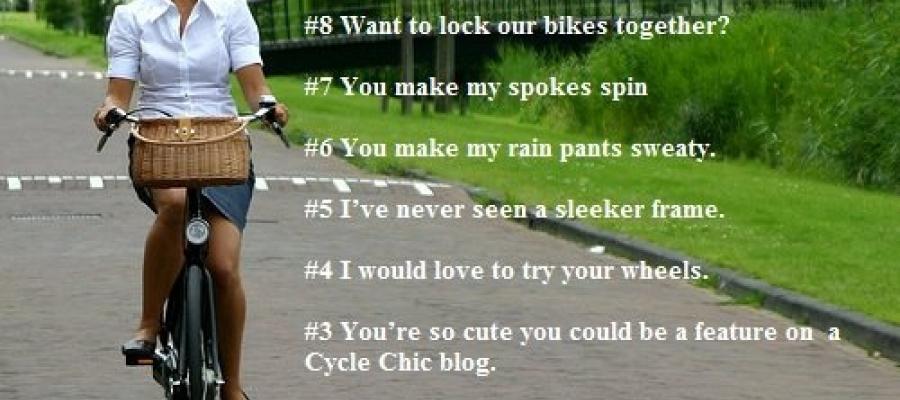
Hmm...Could it have been a pick-up line?  After all, cyclists (and other people) have said stranger and cheesier things:

From the Cascade Cycle Club blog.


09 August 2017

Crossing The Tracks

One of the invaluable life skills I learned in my youth is that of crossing railroad tracks on a bicycle.

If you've done it before, you know that you should approach them with your tire at a 90 degree angle--a.k.a. perpendicular (I remember that much from my geometry class!)--to the rails.  This is especially true if you are riding skinny road tires.


However, at many railroad intersections, this is not possible.  I have seen junctures where the road or path is nearly parallel to the rails when they meet.  Such intersections are all the more hazardous when, as often as not, the road or path has a sharp turn or curve just before it meets the tracks.  You then are faced with the same hazard presented by many urban bike lanes:  You are riding into the path of turning cars--at the same time you're negotiating the tracks.


So, perhaps, it's not surprising that in at least one locale, the most dangerous spot for cyclists is a railroad crossing.  


Knoxville, Tennessee is one such location.  Chris Cherry knows the spot all too well:  He watched his wife "really mangle her knee" after taking a spill at the Neyland Drive crossing.


Turns out, her mishap was one of 53 crashes recorded over a two-month period (2 August-3 October 2014) by a camera at the site.  As hazardous as railroad crossings are in general, this, city authorities acknowledged, is an unusually high number.


Cherry, an associate professor of engineering, at the University of Tennessee, decided to investigate.


  The problem was that the Drive crossed the tracks at a 45 degree angle--and, not surprisingly, the stretch of the drive leading to the tracks had a sharp curve.  

As a cyclist and engineer, Cherry knew that he best solution would have been to reconfigure the street so that it would cross the tracks at a right angle.  The city wasn't going to do that, however because the involvement of the groups it would have required--and the crossing's proximity to the Tennessee River--would have pushed the cost to $200,000.  Instead, the city used the "jughandle" approach (If you've cycled or driven on New Jersey State routes, you have seen it) to create a 60-degree angle.

Cherry, who was consulted on the project, knows it's not an ideal solution.  But, he hopes, it will reduce the number of crashes at the site.  So far, he thinks it's been effective.

Still, I think the intersection is one I'd approach with heightened caution:  I've pedaled through many others like it.

08 August 2017

Working Undercover?

In the US, the term "states' rights" has become a dog-whistle for those who, essentially, want to roll back the clock to 1861 or thereabouts.

"Local politics" has an almost equally-sullied reputations, as school boards, cities, counties and, yes, states have used their authority to excise any mention of evolution, climate change or slavery from school textbooks and to mandate all sorts of other ignorant, mendacious and mean-spirited policies.

But, sometimes, there is something to be said for localities having the power to make their own rules and deciding how their money will be spent.  An example of that is occurring now in Davis, California.

As I mentioned in an earlier post, Davis may well have been the original "bicycle friendly" city in the US.  Home to a major University of California campus, its planners--at least some of whom were and are cyclists--have a long history of taking cyclists seriously.  

At the same time, other California cities grew exponentially.  So did their motor vehicle traffic:  The Golden State has, to many people, become synonymous with car-clogged freeways and smog-choked skies.  

(Of course, not all of California is like that.  I have seen it for myself!)

Sacramento, the state's capital, is one such city.  Not so long ago, it was a west-coast version of Albany or Springfield:  a town that rose and slept with its legislative sessions.  More recently, however, the high-tech boom that turned fruit orchards into corporate blocks in the Santa Clara Valley has spread eastward from the Bay Area.  So, Saramento has experienced the sort of growth in population--and traffic congestion--cities like Los Angeles witnessed in earlier decades.


Image result for bicycle ambassador
The President would not approve!


Thus, some folks in Davis are taking it upon themselves to encourage their neighbors in Davis (and the ones closer to home) to trade four wheels for two. They want cyclists who "know the Sacramento area inside and out" to share their knowledge and experience as "Bicycle Ambassadors."

In doing so, these "ambassadors" will,  according to Bike Davis President Trish Davis, help the city and region in its effort to reduce greenhouse gases.

Now, do you think the current occupant of the White House--or Congress, as it's currently constituted-- would ever implement such a program?  Hmm...Could it be that all of those tree-hugging liberals are really working undercover for the conservative Republican agenda?  Local control, indeed!

07 August 2017

The Dilemma

So..After ten days of hot and mostly dry weather in Italy, I came home to...a week of hot--and humid--weather in New York, punctuated by rain.

Yesterday was a respite.  I could not have asked for better cycling weather.  When I started, the skies were partly cloudy and the temperature was 17C.  The skies cleared along the way and the temperature increased a bit, but I was pedaling into 20-25 kph wind most of the way.  Still, I barely sweated all the way to Connecticut, where the sky was overcast.

On my way home, the clouds broke for some sun, but I didn't feel the need to replenish my sunscreen.  I think the temperature reached about 26C by the time I finished, in mid-afternoon.


The ride was completely pleasant and uneventful.  I was riding Arielle, my Mercian Audax, so it could hardly have been smoother or more effortless.  Although it's a drop-bar all-arounder road bike, I felt less strain on me than I did when I was riding an upright bike in Rome.  It probably has to do with the Mercian's fit.  Also, being a lighter bike, it's simply easier to pedal in  higher gears.  Most of all, it's my bike, so even when I don't ride it for a couple of weeks (or months, as sometimes happens during the winter), it takes me no time to re-acclimate myself to it.

So, which is better:  Going to faraway places and riding among sights you will rarely, if ever, experience again--or riding a bike you know and love on a route you know?

Such a dilemma!  It used to be so much easier back in the day, when most airlines (the non-US carriers, anyway) would take your boxed bike (with pedals, front wheel and handlebars removed) as one of your pieces of luggage as long as it, and whatever else you brought, was within the weight limit.  For most European carriers--as well as Air India, Air Pakistan (yes, I flew them to Europe), that limit was 44 kilos.

These days, it seems, airlines don't want you to bring your bike, or charge some exorbitant fee for it.  I figured that for a ten-day trip, it was easier to rent a bike, especially since I wasn't going across the countryside with loaded panniers and camping gear.

Of course, the obvious solution would be to get one of those bikes that travels easily like Bike Friday or Brompton, which would cost about as much as going on a trip somewhere.  Or, perhaps, there's some other way to take Arielle or one of my other bikes across the seas with me.

That would make my choices a little easier.  Then again, when I come home from a Connecticut ride--or one to Point Lookout or the Jersey Shore--Max and Marlee are waiting for me!

06 August 2017

A Croc Of...?

Grant Petersen of Rivendell Bicycles has been called a "traditionalist iconoclast".  At first glance, that sounds like an oxymoron.  What it means is that he advocated a return to tried-and-true designs, methods and materials for bicycles and components at a time when the industry was moving toward carbon fiber and such.

On the whole, I'm with him.  In fact, you might say my bikes are, at least somewhat, Rivendells without being Rivendells.  All of my frames are lugged steel; all of my components are steel or alloy: there's no carbon fiber anywhere on them. For that matter, I don't use brifters, clipless pedals or low spoke-count boutique wheels, although I've tried them all.

I also agree with him when he says you don't need special clothes for cycling.  I say this as a reformed Lycra Lizard.  

But he also thinks that Crocs are perfectly fine shoes for cycling.  Again, there was a time in my life when I wouldn't even ride to the local bookstore (remember that?)  unless my foot was attached to my Look pedals with the stiffest shoes Carnac or Sidi made.

Now I ride mostly in "normal" shoes.  Still, I have never pedaled in Crocs.  In fact, I have yet to own, or even try on, a pair.  Maybe I won't, ever, especially after seeing this:


If A Sims Thief And Dr Seuss Have A Baby And A Hipster Raises Him
From Memecenter

Even after shedding skintight racing gear and jettisoning clipless pedals and cleats, there are still some things I won't wear on a bike!  I'm sure Grant would concur.

05 August 2017

Space

After my trip to Italy and writing about bike lane controversies in Brooklyn, I got to thinking about my sense of space, as a cyclist.

It took a couple of days of riding in Rome to acclimate myself to the ways drivers behave around cyclists.  I can say the same for Paris and France, but I had an even more acute sense of how drivers' and cyclists' sense of shared space is different while in the land of Michelangelo and Caravaggio.

You can ride through one of those traffic circles, or any other intersection, and a motorist might be a gear-cable's breadth from you.  Yet you would be in less danger than if you'd had a wider berth--or even riding in a "protected" bike lane--in most US cities.  

Italian--particularly Roman--drivers are often called "crazy".  Yet they not only are more aware of two-wheeled vehicles (including Vespas and motorcycles, as well as bicycles) than their American counterparts, they are more accustomed to driving in--and sharing--really tight spaces.

I was reminded of this when looking, again, at this street in Florence, between the Ponte Vecchio and Uffizi Gallery.


It's about half as wide as most sidewalks in New York!  Yet I actually saw a car and bike pass through it at the same time.  And the driver didn't honk his/her horn!

I also couldn't help but to notice the condition of the bicycles parked next to it.  If they'd been locked to a New York City parking meter or sign post, this could have been their fate:


04 August 2017

Making More Sense Than The Department of Transportation

The New York City Department of Transportation seems to operate from the same misguided notions that guide other cities' efforts to be--or seem--"bike friendly". 

Once again, the NYCDOT is showing its ignorance in a report it released recently.  That report, among other things, designates two Brooklyn neighborhoods--Ditmas Park and Sheepshead Bay--as "Priority Bicycle Districts" that could receive new lanes.

Now, if you've been reading this blog, you know that I am, at best, ambivalent about bike lanes, at least as they are usually conceived, designed and constructed.  From what I can see, the NYCDOT wants to repeat the same mistakes it has made in other parts of the city, the most egregious of them being "bike lanes" that are little more than lines painted on asphalt and run next to the parking lanes of streets--into which drivers open their doors, delivery vehicles stop and drivers of all kinds double-park.  

An all-too-typical "protected" bike lane in Brooklyn


Oh, did I mention that too many of those lanes lead cyclists straight into the paths of turning or merging vehicles?  I wouldn't be surprised sif the proposed lanes did the same.

Anyway, of the two neighborhoods I mentioned, one--Ditmas Park--might welcome the new bike "infrastructure", at least somewhat.  Parts of it are quite charming, with Victorian houses and the kinds of cute little shops one finds in neighborhoods with young creative people before they turn into, well, Williamsburg.  That means there are a number of people who cycle for transportation as well as recreation.

The other neighborhood--Sheepshead Bay--lacks such cyclists.  It lies further from the central areas of Brooklyn and Manhattan than Ditmas Park and is far less served by mass transportation.  In fact, one subsection of Sheepshead Bay--Marine Park--has no subway and little bus service at all.

What that means is that most residents of Sheepshead Bay drive.  Some drive their cars to their jobs; others are building contractors or self-employed in other ways and are therefore dependent on their vehicles to transport equipment and for other purposes.  Sometimes families ride their bikes to the park, or individuals might go for a late-day or Sunday ride, but relatively few ride for transportation.  

It is in such neighborhoods that one finds the most opposition to bike lanes and other amenities.  Some of it is class or generational resentment:  Cyclists are seen as entitled elitists or worse.  Some of the other objections, if they don't have merit, are at least understandable:  People who depend on their motor vehicles in places where streets are narrow and there is no room to expand are, understandably, wary of anything that might make driving or parking more difficult or, at any rate, more inconvenient.

Something really interesting is happening, however in Sheepshead Bay--especially in and around Marine Park. In New York, when a city agency like the DOT makes a plan, it is presented to the local community board for the neighborhood that would be affected by the plan.  Last year, the DOT sent a proposal to the local community board for Sheepshead Bay/Marine Park.  The community voiced its objections to it, partly for the same driving and parking issues I've mentioned.  

But they also made some of the same arguments I, and other experienced cyclists, have made against bike lanes.  They pointed out that a cyclist is no safer in a bike lane that runs next to a parking lane than he or she is in a traffic lane.  They also mentioned, as I have, that too many lanes lead cyclists directly into the path of turning or merging vehicles.

They also described a situation that makes their neighborhood different from the more central urban areas like Williamsburg and most of Manhattan.  Sheepshead Bay--especially the Marine Park area--bear more semblance to a suburban town than a city neighborhood in at least one respect:  The majority of residences are detached or semi-detached private houses with driveways rather than than apartment buildings.  Cars and vans frequently pull in and out of those driveways.  

The proposed bike lanes would have run right in the path of those cars entering and leaving the driveways.  Too often, drivers pulling out of driveways are driving in reverse, which makes it more difficult to see cyclists (or anyone or anything else) in the bike or parking lane.  And, when cars make turns to enter driveways, they would turn right into what would be the path of the proposd bike lanes.

So...While we still need to help drivers who aren't cyclists understand, if not empathise with, cyclists, we still need to hear them out--especially when they're making more sense than the Department of Transportation!


03 August 2017

Lost And Literary

I'm thinking, again, about one of the many times I got "lost" in Rome last week.

In previous posts, I've said that sometimes I mount one of my bikes and let it decide where I ride.  For example, I might sling my leg over Arielle, my Mercian Audax, and without thinking about it, I find myself pedaling toward Connecticut or the North Shore.  Or I might slide my foot into a pedal of Tosca, my Mercian fixed-gear and the next thing I know, I'm on my way to the Rockaways or Coney Island.


So, I think I can blame the bike I rode in Rome for leading me in circles and through far corners of the city--and even outside of it.  The pretty, shiny red bike I rented from Bici & Baci (which I recommend) led me, after my tour of the Catacombs, though some near suburbs and back into the city, albeit a far corner.  


You never know who you'll run into in such places:


Yes, the mayor New Yorkers love or hate has familial roots in the country that sent some of my ancestors to America.  Now, I'm all for a liberal immigration policy, but it might've been nice to have someone like Trump (Really? Did I just say that?) running the country, even if only for a day, when Rudy's parents were ready to get on the boat.  


Then again, it might've been nice to have Trump--or, at least, the immigration policy he just endorsed--when his grandfather was about to be deported from Germany. (I have to hand it to him:  It takes some doing to get yourself kicked out of the country in which you were born and raised!)  If this country hadn't let him in, he would've gone to...I dunno...Canada?  Australia?


Anyway, I won't speculate (at least, not now, anyway) about what New York City and the USA might be without Giuliani or Trump.  Just a couple of minutes after seeing that sign for Rudy's relatives, I wandered into a section of drab apartment buildings where the streets had some interesting names:


I know that all of them spent time in Italy:  In fact, James Joyce spent much of his adult life there.  He once remarked that although Italy, at the time, was plagued with poverty and mismanagement, it at least had a nice climate and lively intellectual atmosphere.  His native country of Ireland, he said, was Italy without those two things.


Even if his assessment were off, I couldn't blame him for living in Italy.  Could you?


02 August 2017

Looking Up: A Tourist!


You can usually tell when someone is a tourist:  He or she is looking at all of the stuff (and, sometimes, people) the natives take for granted.


In downtown and midtown Manhattan, they are usually looking up--at the Empire State Building, Liberty Tower and other skyscrapers.  I haven't stopped noticing such things, but I think I've developed some sort of peripheral vision that allows me to look at the spires and other architectural features that are expressions of somebody's reach.


I realize now that in Italy, I must have been as obviously a tourist as someone from North Dakota or Oklahoma is while ambling along Broadway.  Or someone speaking Italian on Mott Street:  Little Italy is all but gone, so that person is more than likely from Milan.


Of course, I could've been taken for a tourist on my appearance alone.  The Italians usually greeted me with a friendly if somewhat deferential "signora", but they could not have seen me as one of their women:  I am taller and lighter than most of them.  Also, my Italian--such as it is--doesn't sound anything like what anyone speaks in "The Boot."  If anything, I probably sound like pure Bay Parkway by way of Asbury Park.


There is one other thing, though, that surely gave me away as a visitor--aside from the fact that I was consulting maps.  You see, I was like all of those gawkers I see in my home town:  I spent a lot of time looking upward.


In an earlier post, I mentioned that the skylights in the catacombs' chapels must have turned those early Christians' attentions skyward, i.e., toward the heavens.  I couldn't help but to thin that so much cathedral architecture--internal as well as external--was at least somewhat influenced by a memory, historical as well as visceral, of that:  Worshipers were usually looking up, whether at the altar (which was raised) or the stained glass windows or statues above.


Even when I wasn't in a basilica or some other such place, it seemed that I couldn't look anywhere but up.  And, yes, my gaze was often turned above me even as I was navigating those Roman streets and traffic circles.


Was Eddy Mercx thinking about something like that when he told George Mount that if he really wanted to learn about bike racing, he had to go to Italy?

01 August 2017

A Ride Back

I will tell you more about my Great Italian Adventure, and post more photos of it, soon.  I promise!  

In this post, however, I want to talk about something that happened to me today.

The sky was mostly clear, the day warmer and humidity a bit higher than it's been since I got home, even if neither the heat nor moisture was oppressive.  So, of course, I went for a ride:  my first long(ish) trek since coming back.  At least, that's what I'd planned.

A familiar route down to the Rockaways and along the South Shore of Queens and Long Island took me to a familiar destination:  Point Lookout.  Since it's a flat ride and the wind blew lightly, I took out Tosca, my Mercian fixed gear.  

Even if the ride couldn't thrill me as much as pedaling up and down the Roman hills, it sure was nice to ride one of my own bikes again.  Of course, a fixie is going to be more responsive than an internal-geared hub, and a Mercian is going to feel more lively than a heavy utilitarian rental bike.  Still, the difference in "feel" was even greater than I anticipated.  

The ride was pleasant and completely uneventful; I felt good and nothing complicated that.  After I crossed the Veterans Memorial Bridge from Rockaway Beach back to the Queens "mainland", I stopped at a deli for something cold to drink.  While sipping on some combination of slush with cherry Jolly Rancher flavoring (I wanted a bit of a sugar rush), a man and woman pedaled in.  

He pointed to me.  "Where do I know you from?"

Turns out, we rode--occasionally the two of us, but usually with a group of other riders--in Prospect and Central Parks, and on some longer rides, back in the day.  He also worked in a couple of bike shops I frequented in those days.  We recalled those shops, some of the guys (yes, they were men) who rode with us, a few of whom also worked in those shops at one time or another.

He introduced the woman who accompanied him.  They married seven years ago, he said.  That wasn't the only surprise of our encounter.

For another, he was smiling.  I never, ever saw that in all of the time we rode "back in the day".  In fact, a few of us half-jokingly called him "El Exigente", whom he resembled in his facial hair and other physical features--including the seemingly-permanent scowl.   We all respected him as a rider; his forays into racing were certainly more successful than mine! 

In those days, we didn't actually talk much.  Some time ago--possibly in those days--I read a book by an anthropologist or some other researcher that said, among other things, that women form relationships by talking but men bond by doing things together.  Perhaps one could see that in our rides.  It also could be a reason why I always had the sense that he disapproved of me somewhat:   Someone once described me as an "extroverted introvert", meaning that even though I am more comfortable within myself than without, I am not averse to talking.  

Or, perhaps, I just insecure that I wasn't, and probably never would be, as strong or fast a rider as he was--or is.  

He certainly didn't care about that today, as I rode with him and his wife.  Their route home paralleled mine part of the way, but they invited me to follow them to their home, in Brooklyn, if I wanted to.  "Well, there's nowhere I have to be", I said.  Really, the only reason I had to get back to my place tonight was to feed my cats.

So my ride was a bit longer than I'd planned:  I reckon about 140 kilometers instead of 120. But I felt more nimble, more supple, as we wove through the building rush-hour traffic in the streets of East New York, Brownsville, Bedford-Stuyvesant and their Flatbush neighborhood.

We all shook hands as we parted.  If he was surprised to see my red nail polish, he didn't show it.  She didn't register any surprise, as she didn't know me when I was Nick.

He knew me then.  But he took to my new and current name with no trouble.  We all promised to stay in touch and get together for another ride.

My ride home involved climbing a couple of long but gradual hills to Crown Heights and the east side of Prospect Park, past the Brooklyn Public Library toward the Navy Yard.  From there, I rode through Williamsburg and Greenpoint, easily passing riders who could have been my children and grandchildren, as if I were one of them.

Back when I was riding with him, I was.


31 July 2017

Home Yet?

I spent most of yesterday sleeping just long enough to wake up needing more sleep but not being able to get it--and staying awake just long enough to get nothing done.  I guess that's normal after crossing a few time zones.

Anyway, I am going to take a ride today.  I haven't decided where just yet.  Maybe I'll just get on my bike and let it decide, as I sometimes do.

One thing I must say, though, is that the streets here seem so wide after pedaling through passages like this:


Will my ride make me happy to be home again--or miss Italy?  Probably both!

30 July 2017

It's Great To Be Back So I Could Tell You How Much I Wish To Be Back In Italy

Now I'm back in La Grande Mela.  I'm still on Italian time and, really, want to stay on it for as long as I can.  I'm not talking, of course, about being six hours later than New York, but about living like an Italian.  

Of course, for my first meal back, I had two bagels.  I mean, after being in Italy, what was I going to eat in New York--pizza? Pasta?

I'm going to tell you more--and share those photos that would still be uploading had I tried to share them in Italy!--after I redecorate my apartment:


and take a nice Italian-style lunch break!

29 July 2017

An Italian Linus?

In Rome, I haven't seen as many cyclists as I have in, say, Paris, New York or even Firenze (Florence).  That means, of course, that I haven't seen as many interesting or unusual old bikes parked on the streets. 

I have seen some people ride bikes with the legendary names of Itaian--and European--cycling on them.  I am thinking of Mosers, Viners, and others known for classic racing machines (and victories in the great races).  Take away the decals or transfers, and some of those bikes  would look like those aluminum things with toothpaste welds and flashy paint.

But there seem to be  a few bright spots, even as the world shifts to aluminum and carbon fiber


"Adriatica" seems to be doing in Italy what Linus is doing in the US:  offering practical yet vintage-inspired bikes in steel.  I saw this one in a shop near my hotel.

28 July 2017

Going The Appian Way And Becoming Native

I ended yesterday's post by asking, rhetorically, "How lost was I today?"

Well, today I fooled a few people into thinking I wasn't lost at all.  I wasn't trying to do any such thing; it just happened.

You see, I began by riding past the Colosseum and through a portal in a huge stone wall that once formed part of the gate around the city.  At one time, most cities were so fortified and the entrances in them were called "portas" ("portes" in French).  Many of those places still retain those names, and there is usually a piazza (or place or the equivalent) where the door or gate used to be.  And a road leading to that porte might parallel--or might in fact be--a road that led to the gate or door.

Anyway, after passing through the Porta San Sebastiano, I turned onto another road I followed for maybe half a kilometer to a road that had more traffic than I wanted to deal with.  So I made a U-turn and, near the Porta, took a right, which took me onto a road with a stone wall on one side and trees on the other.  I didn't see a sign for it but it was, or became, the Via Appia Antica.  You probably have heard of it:  The Old Appian Road, or The Appian Way. 


Although it's narrow and doesn't have a shoulder for most of its route, it's actually safe for cycling, mainly because the drivers are accustomed to seeing us (as well as pedestrians and runners).  If traffic approaching from the opposite direction doesn't leave a driver on your side of the road with enough room to pass you, he or she will wait.  At least, they did for me.

Along Appia are some of the catacombs.  I stopped at the one of St. Callistus which, the guide averred, is "the most important" because the very first Popes were interred there until they were exhumed and moved to what would become the Vatican.  Photography isn't allowed in any of the catacombs, but I think the images of those layers of tombs as well as the living spaces and even chapels that were carved into the ground will stay with me.  

As our guide mentioned, the catacombs along Appia were outside Rome's city walls because, at the time they were built, Christianity still wasn't allowed in Rome.  After seeing the dome of the Pantheon yesterday, I was intrigued by, among other things, the skylights that were built into the catacombs.  They were needed for ventilation and light, but I realized they--particularly the ones atop the chapels--served another purpose:  They directed the worshipers' vision upward, i.e., toward heaven.  When I understood that, I realized that much of what one sees inside a cathedral serves the same purpose, and I couldn't help but to wonder whether cathedrals were thus influenced by chapels in the catacombs.

After that interesting tour, led by a nice young lady, I rode further along Appia to some other road I couldn't identify, which led me into some other areas with those charming terra cotta and sun-colored houses surrounded by fields or woods.  I just kept on following the roads I was on simply because I was enjoying the ride.  Even after I made a couple of "wrong" turns and found myself in one of those suburban industrial zones one finds just outside European cities, I wasn't worried.  

Eventually, I saw signs pointing in the direction of "Roma" and, a little later "Centro" and, still later, "Colosseum".  So of corse I followed them and found myself wending along some old streets not much wider than most of the cars in this country.  I passed the intersection of the Four Fountains and stopped to drink water and eat yellow plums in the Piazza Santa Susanna, where a four-century-old church named for her occupies the former site of the Baths of Diocletan.  

Well, I was there for maybe thirty seconds when an Asian couple from California asked how to get to the Quirinal--the place with the great viewing spot I discovered yesterday.  I pointed and told them, "Just keep going, up this hill, about half a kilometer."

No sooner had I finished that sentence when three young dark-skinned women approached me.  I overheard them speaking French as I helped the Asian couple, so when one asked how to get to Termini--the main rail station--I told her, "Descendez la" as I pointed in their direction.  "Passez trois coins, tournez a droite et descendez."  Pass three corners, then turn to your right, and keep going.  

Yet another Asian couple saw me giving directions and, after the young women left, asked whether I spoke English. I nodded, and they asked whether I knew how to get to the Trevi Fountain.  I did, and even assured them that yesterday I made a wrong turn in the very spot where we stood but found my way to the Fountain, which actually was close by.

I guess people figure that cyclists know their way around.  In some places, I do. But just yesterday I was as lost and confused as the people I helped (I hope!) today.