In the middle of the journey of my life, I am--as always--a woman on a bike. Although I do not know where this road will lead, the way is not lost, for I have arrived here. And I am on my bicycle, again.
I am Justine Valinotti.
19 August 2018
18 August 2018
Biking While Black
I read Huey Newton's Revolutionary Suicide many years ago. As I recall, it recounts, among other things, his and his peers' often-tense interactions with the police of his native Oakland. Many of the incidents would today be called Driving (or Walking, Barbecuing, Reading or Fill-in-the-Activity of Your Choice) While Black.
Frustration over such incidents inspired him and his friends to start the Black Panther Party. Whether or not you agree with his way of dealing with the poverty, racism and violence that defined life on the mean streets where he grew up, it's hard to argue against his observations and analysis. After all, so much of what he described could have happened yesterday.
As a matter of fact, it did--or, two weeks ago, anyway. On 3 August, Najari "Naj" Smith was leading a group of 40 young cyclists through the streets of Oakland on a regularly-scheduled First Friday ride. You guessed it: He and most of those cyclists are black.
They all belong to organizations that consist mainly of African-American members. One of those organizations, Rich City Rides, was founded and is led by "Naj" himself in the nearby city of Richmond. RCR teaches young people bicycle mechanics and gives them opportunities to work for their own bicycles. It also offers guidance on healthy lifestyles and positive social interactions through group rides, public path maintenance and civic advocacy on transportation issues.
It should be noted here that Richmond today, in many ways, parallels the Oakland of Huey Newton: It is darker (in skin tone) and poorer than surrounding Bay Area communities. It also, until recently, had one of the highest violent crime rates in the nation, and many residents feel they are always "under suspicion" by the police. Oakland, on the other hand, is quickly gentrifying as even well-paid professionals find themselves priced out of San Francisco and other communities on the west side of the Bay. This has exacerbated tensions between the remaining African-Americans and the Oakland Police Department (which disproportionately stops and arrests African-Americans) not to mention the white gentrifiers who too often call the police when black people simply live their lives in public.
Such was the case two weeks ago, when someone apparently complained about Naj and the other riders when they formed a "bonding and healing circle". A police officer broke into it without warning and grabbed Naj's handlebars.
The officer explained that Naj was being detained for "excessive noise" coming from a stereo on a trailer behind his bike. Smith says he immediately complied with the officer's request and turned off the stereo. The officer told him to "stay put" and momentarily walked away. Smith thought the officer was going to write him a citation. Instead, the cop handcuffed him, confiscated his bicycle and stereo equipment and whisked him off to the Santa Rita Jail, where he spent the weekend. Smith made his $5000 bail and has a court date for the 31st of this month.
"I cooperated with the officer as much as possible," Smith said. Members of the group were upset and he was "trying to put the best example forward" so the incident "wouldn't turn into a mess."
It seems, though, that no amount of compliance is any match for police officers who make up the rules as they go along. According to Oakland PD spokesperson Felicia Aisthorpe, Smith was detained for "interfering with traffic and playing music too loudly." Moreover, she said, he did not have proper identification. (Italics mine.)
The officer who stopped me in Harrison two years ago was looking to make the same charge against me. As it happened, I had my New York State non-drivers' ID with me. He tried to claim that he could arrest me for not having "official" ID; I countered that the document was issued by the New York State Department of Motor Vehicles and is therefore official. He wasn't too pleased with that; so he wrote a citation with the largest fine he could get away with.
Since then, I've checked with a number of reputable sources, all of whom confirmed what I'd already known: that there is no law in New York State (Harrison is in Westchester County) or anywhere in the US that requires people to carry ID or to show it to police officers. But I carry mine with me anyway for situations like the one I've described.
Whether or not "Naj" Smith had his ID on him or needed it probably isn't the real issue, as far as Ms. Aisthorpe and the arresting officer are concerned. He is from Richmond and he was in Oakland, cycling while black.
Frustration over such incidents inspired him and his friends to start the Black Panther Party. Whether or not you agree with his way of dealing with the poverty, racism and violence that defined life on the mean streets where he grew up, it's hard to argue against his observations and analysis. After all, so much of what he described could have happened yesterday.
As a matter of fact, it did--or, two weeks ago, anyway. On 3 August, Najari "Naj" Smith was leading a group of 40 young cyclists through the streets of Oakland on a regularly-scheduled First Friday ride. You guessed it: He and most of those cyclists are black.
They all belong to organizations that consist mainly of African-American members. One of those organizations, Rich City Rides, was founded and is led by "Naj" himself in the nearby city of Richmond. RCR teaches young people bicycle mechanics and gives them opportunities to work for their own bicycles. It also offers guidance on healthy lifestyles and positive social interactions through group rides, public path maintenance and civic advocacy on transportation issues.
It should be noted here that Richmond today, in many ways, parallels the Oakland of Huey Newton: It is darker (in skin tone) and poorer than surrounding Bay Area communities. It also, until recently, had one of the highest violent crime rates in the nation, and many residents feel they are always "under suspicion" by the police. Oakland, on the other hand, is quickly gentrifying as even well-paid professionals find themselves priced out of San Francisco and other communities on the west side of the Bay. This has exacerbated tensions between the remaining African-Americans and the Oakland Police Department (which disproportionately stops and arrests African-Americans) not to mention the white gentrifiers who too often call the police when black people simply live their lives in public.
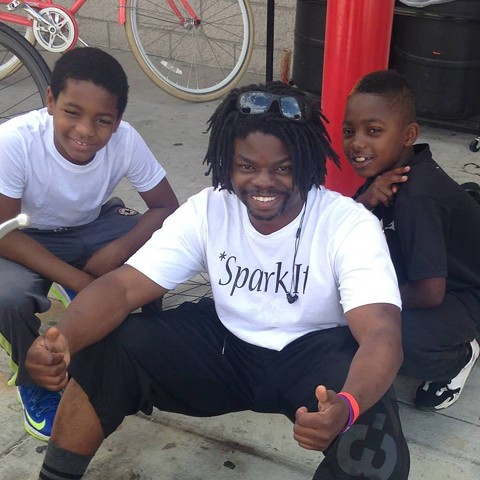
![]() |
| Najari "Naj" Smith |
Such was the case two weeks ago, when someone apparently complained about Naj and the other riders when they formed a "bonding and healing circle". A police officer broke into it without warning and grabbed Naj's handlebars.
The officer explained that Naj was being detained for "excessive noise" coming from a stereo on a trailer behind his bike. Smith says he immediately complied with the officer's request and turned off the stereo. The officer told him to "stay put" and momentarily walked away. Smith thought the officer was going to write him a citation. Instead, the cop handcuffed him, confiscated his bicycle and stereo equipment and whisked him off to the Santa Rita Jail, where he spent the weekend. Smith made his $5000 bail and has a court date for the 31st of this month.
"I cooperated with the officer as much as possible," Smith said. Members of the group were upset and he was "trying to put the best example forward" so the incident "wouldn't turn into a mess."
It seems, though, that no amount of compliance is any match for police officers who make up the rules as they go along. According to Oakland PD spokesperson Felicia Aisthorpe, Smith was detained for "interfering with traffic and playing music too loudly." Moreover, she said, he did not have proper identification. (Italics mine.)
The officer who stopped me in Harrison two years ago was looking to make the same charge against me. As it happened, I had my New York State non-drivers' ID with me. He tried to claim that he could arrest me for not having "official" ID; I countered that the document was issued by the New York State Department of Motor Vehicles and is therefore official. He wasn't too pleased with that; so he wrote a citation with the largest fine he could get away with.
Since then, I've checked with a number of reputable sources, all of whom confirmed what I'd already known: that there is no law in New York State (Harrison is in Westchester County) or anywhere in the US that requires people to carry ID or to show it to police officers. But I carry mine with me anyway for situations like the one I've described.
Whether or not "Naj" Smith had his ID on him or needed it probably isn't the real issue, as far as Ms. Aisthorpe and the arresting officer are concerned. He is from Richmond and he was in Oakland, cycling while black.
17 August 2018
Why We Need Her: Aretha Franklin
Spoiler Alert: Today's post is on a non-cycling topic.
The other day, the Andrew Cuomo said something that will probably haunt him for the rest of his days: "America was never that great."
Now, I just happen to think that Cuomo wasn't expressing a lack of patriotism. Rather, I think the utterance shows, more than anything, that he doesn't quite share his father's intelligence or eloquence.
I'm guessing that he was trying to refute Trump's oft-echoed mantra: Make America Great Again. If anything, I would say that America was never great (rather than "not that great") because no nation in the history of this world has ever been great. Some nations have been powerful, have been mighty. Others have been prosperous; still others, influential. A few nations have combined more than one of those qualities.
But no nation* has ever been great, including my own.
To me, the proof is this: Aretha Franklin. No one ever would have sounded the way she did had her nation, or any other, had been great. In fact, nobody ever could have sounded like that, like her.
If any nation in history had ever been great, there never would have been any need for someone to sound like her. And that's why, to me, almost all of her work is art of the highest order.
Yes, I said art. I see no contradiction between it and popular music or other entertainments. Shakespeare was popular in his own time; so were any number of painters and sculptors who received commissions from wealthy patrons and whose works we gaze at, with awe, in museums and galleries today.
Of course, we've all heard Natural Woman and Respect. In those songs, she combines vulnerability and strength, anger and empathy, joy and grief, need and the yearning for freedom, the need to sing and the urge to fly, better than just about anyone who's ever sung. In other words, she captures the complexity--and the fearsome complications--of our existence.
For my money, though, her best expression of the gifts only she could bring us was on I Never Loved A Man. On the surface, it seems like just a song that expresses--if you'll pardon my appropriating the title of an '80s self-help book--the dilemma of a woman who loves too much, or at least seems to love the wrong man. But, to me, it's really about being beaten down and beaten up by, not only another person, but by life itself--and realizing that the only choice is to move forward. The world is excruciating, people are mean, and her man is cruel--but she cannot do anything but love: love him, love the world. I think it's what W.H. Auden meant when he wrote, "We must love one another or die."
That song alone would place her in my pantheon of great American artists. To me, it's worthy of Leaves of Grass, Their Eyes Were Watching God, Kind of Blue,Christina's World, The Great Gatsby, Citizen Kane, Blue and Green Music, the first Godfather film and Rhapsody in Blue.
Now Aretha Franklin is gone. Well, she--her body--has left us. But not the body of her work. As long as there are no great nations, we'll need it. And if there ever is a great nation, we'll have the luxury of simply savoring it.
*--By "nation", I mean geo-political entities, which are not to be confused with the cultures or peoples contained within them, which often are great.
The other day, the Andrew Cuomo said something that will probably haunt him for the rest of his days: "America was never that great."
Now, I just happen to think that Cuomo wasn't expressing a lack of patriotism. Rather, I think the utterance shows, more than anything, that he doesn't quite share his father's intelligence or eloquence.
I'm guessing that he was trying to refute Trump's oft-echoed mantra: Make America Great Again. If anything, I would say that America was never great (rather than "not that great") because no nation in the history of this world has ever been great. Some nations have been powerful, have been mighty. Others have been prosperous; still others, influential. A few nations have combined more than one of those qualities.
But no nation* has ever been great, including my own.
To me, the proof is this: Aretha Franklin. No one ever would have sounded the way she did had her nation, or any other, had been great. In fact, nobody ever could have sounded like that, like her.
If any nation in history had ever been great, there never would have been any need for someone to sound like her. And that's why, to me, almost all of her work is art of the highest order.
Yes, I said art. I see no contradiction between it and popular music or other entertainments. Shakespeare was popular in his own time; so were any number of painters and sculptors who received commissions from wealthy patrons and whose works we gaze at, with awe, in museums and galleries today.
Of course, we've all heard Natural Woman and Respect. In those songs, she combines vulnerability and strength, anger and empathy, joy and grief, need and the yearning for freedom, the need to sing and the urge to fly, better than just about anyone who's ever sung. In other words, she captures the complexity--and the fearsome complications--of our existence.
For my money, though, her best expression of the gifts only she could bring us was on I Never Loved A Man. On the surface, it seems like just a song that expresses--if you'll pardon my appropriating the title of an '80s self-help book--the dilemma of a woman who loves too much, or at least seems to love the wrong man. But, to me, it's really about being beaten down and beaten up by, not only another person, but by life itself--and realizing that the only choice is to move forward. The world is excruciating, people are mean, and her man is cruel--but she cannot do anything but love: love him, love the world. I think it's what W.H. Auden meant when he wrote, "We must love one another or die."
That song alone would place her in my pantheon of great American artists. To me, it's worthy of Leaves of Grass, Their Eyes Were Watching God, Kind of Blue,Christina's World, The Great Gatsby, Citizen Kane, Blue and Green Music, the first Godfather film and Rhapsody in Blue.
Now Aretha Franklin is gone. Well, she--her body--has left us. But not the body of her work. As long as there are no great nations, we'll need it. And if there ever is a great nation, we'll have the luxury of simply savoring it.
*--By "nation", I mean geo-political entities, which are not to be confused with the cultures or peoples contained within them, which often are great.
16 August 2018
What Did It Cost?
Whenever anyone asks what my bikes cost, I find a way not to answer. Muttering "none of your business" is a sure signal that it's expensive; so is replying with "Why do you ask?"
This leads me to wonder whether the advice given by police in Roodespoort, South Africa will be helpful to the bike shop owners who received it--or, more important, customers of said establishments.
Then again, I am a New Yorker who lived in the Big Apple during the '80's and early '90's, when crime of all kinds was rampant. I remember pre-hipster Williamsburg and when the Lower East Side really was "lower" in more ways than one. Each of those neighborhoods bookends the Williamsburg Bridge which, even before the bike lane was reconstructed, was the best way to cross the East River by bicycle.
Apparently, some criminals knew as much. Or, at least, they knew that in-the-know cyclists preferred (and still prefer) "Billyburg" to the Brooklyn, Manhattan or Queesnboro (59th Street) Bridges. And, they knew that in-the-know cyclists were riding the most valuable bikes.
You can guess what happened: A few cyclists I knew, and quite a few more I didn't know, were attacked for their bikes on either side of the bridge. In fact, an employee of one shop I frequented had his machine stolen just days after he bought it--and that after working more than a year to save up for it.
Somehow I don't think those riders told anyone--certainly, not random strangers-- what their bikes cost. But then again, they didn't have to: Such information is easy enough to find.
This leads me to wonder whether the advice given by police in Roodespoort, South Africa will be helpful to the bike shop owners who received it--or, more important, customers of said establishments.
The gendarmes told the pedal purveyors--you guessed it--not to disclose the prices of their most expensive bikes with the media. They shared their sage wisdom after a cyclist was robbed and shot for his bike in the Kromdraai area of the city.
![]() |
| Medics carrying the injured cyclist. |
That cyclist is alive only because of the efforts of a Good Samaritan who heard his cries for help and stopped. "They had shot him twice in the leg and in the back," said Jon-Jon Pietersen who had only a rubber glove, a towel and box tape.
Fortunately for the cyclist, more people stopped by and helped until the ambulance arrived, 20 minutes later.
15 August 2018
Is A Picture Worth A Thousand Words When It Gives Us Two?
As The World's Only Transgender Bike Blogger (at least, the only one I know about!), you can understand why this got my attention:
Well, all right, the colors are hard to miss. But the design is not exactly to my taste (at least, not anything I'd wear). What piqued my interest were the words: "Femme" (woman) on the jersey, "Homme" (man) on the shorts.
Hmm....
![]() |
| From bikechaser |
Well, all right, the colors are hard to miss. But the design is not exactly to my taste (at least, not anything I'd wear). What piqued my interest were the words: "Femme" (woman) on the jersey, "Homme" (man) on the shorts.
Hmm....
14 August 2018
At Least He Survived--We Hope
Some stories bring me no joy. But sometimes I feel the need to tell them, if only because they hit close to home.
At least this one hasn't ended in tragedy...so far.
A few days ago, I wrote about Madison Jane Lyden, the Australian tourist run down by an inebriated garbage truck driver as she cycled up Central Park West. Well, I've gotten word of another cyclist struck by a motorist on a route I ride frequently.
Just before 8 pm yesterday, an 11-year-old boy (whose name hasn't been released) was riding his bike in Far Rockaway, in an area I pass through when I ride to Point Lookout or other points on Long Island's South Shore. Occasionally, "Far Rock" is even my destination, especially when I'm trying to get a ride in during an abbreviated winter day.
Anyway, a black sedan slammed into him--and kept going. The impact sent him airborne for several car lengths. He landed in the hospital with internal injuries, but he is expected to survive.
At least, according to the NYPD, the driver of that car--41-year-old Aghostinho Sinclair--has been arrested. Needless to say he's in a heap of trouble: The charges against him include reckless endangerment, leaving the scene of an accident--and driving without a license. (The latter charge is called "aggravated unlicensed operation".) I wonder whether "endangering the welfare of a child" or some similar charge can be added to the list.
At least this one hasn't ended in tragedy...so far.
A few days ago, I wrote about Madison Jane Lyden, the Australian tourist run down by an inebriated garbage truck driver as she cycled up Central Park West. Well, I've gotten word of another cyclist struck by a motorist on a route I ride frequently.
Just before 8 pm yesterday, an 11-year-old boy (whose name hasn't been released) was riding his bike in Far Rockaway, in an area I pass through when I ride to Point Lookout or other points on Long Island's South Shore. Occasionally, "Far Rock" is even my destination, especially when I'm trying to get a ride in during an abbreviated winter day.
Anyway, a black sedan slammed into him--and kept going. The impact sent him airborne for several car lengths. He landed in the hospital with internal injuries, but he is expected to survive.
At least, according to the NYPD, the driver of that car--41-year-old Aghostinho Sinclair--has been arrested. Needless to say he's in a heap of trouble: The charges against him include reckless endangerment, leaving the scene of an accident--and driving without a license. (The latter charge is called "aggravated unlicensed operation".) I wonder whether "endangering the welfare of a child" or some similar charge can be added to the list.
13 August 2018
Judaism And The Art Of Bicycle Riding
If you're of a certain age, as we say, there's a good chance you've read Zen and the Art of Motorcycle Maintenance. Some English classes--including a few at the college I attended--actually assigned it. I escaped that fate: I didn't have to take the English classes that assigned it because, when I entered my college, the person (or folks) in charge of placement decided that I was a better writer than I actually was, based on an essay I wrote as part of my entrance exam.
I did, however, read Zen on my own. I didn't expect to learn how to fix motorcycles or about Zen. If I recall correctly, the book's author, Robert Pirsig, included a disclaimer advising readers not to have such expectations. Even if he'd intended to instruct his readers on how to wrench their rice rockets (That was a term for Japanese motorcycles, which were much lighter than Harleys.) or meditate, I'm not sure of what I might've learned because, really, I had little idea about motorcycles except that my uncle rode one or about Buddhism save for guys in orange robes.
I'm not sure of what, if anything, I learned from the book. That's not to say it wasn't worth reading: At that point in my life, I was a sucker for stories about folks who left jobs, families and other bourgeois expectations behind, even if only for a time, to traverse the country or world, mainly because--you guessed it--I wanted to do something like that.
Pirsig's prose had little, if any, stylistic grace. He probably wouldn't have wanted to have any--which, I believe, was part of the appeal of his book. You don't quote him the way you would, say, Thoreau, let alone Virginia Woolf or Shakespeare. (About my friend Bill: I remember reading that some researcher found that the average English speaker quotes him at least 20 times a day, mostly without realizing he or she has done so!) But I remember this: "The real motorcycle you're working on is yourself." Or something like that.
So, what aphorisms can one glean from an experience of Judiasm and the Art of Bicycle Riding? It's hard not to think that Abigail Pogrebin, the author of an article by that name, didn't read, or at least hear of, Pirsig's volume. And she indeed reveals a thing or two she learned about herself from riding a mountain bike through Arizona brush--with a Native American guide named George. And, oh, her rabbi.
The irony is, as she says, that George imparted so much Jewish wisdom. In particular, he offered this nugget that could have come straight from Moses (who, in my mind, always looks and sounds like Charlton Heston):
Always look way ahead of you. Never look down. As soon as you look down, you will hesitate, overthink, negotiate, get stuck. Always be moving into the future. Bike into the future.
The last two sentences, she admits, can sound pretty corny, but, as Ms. Pogebrin points out, "How many times does our tradition ask us to 'go forth'? How many times in our history have we had to keep going despite what's thrown in our way?" There is no other choice, really: By definition, we can only move toward the future. Living in what I call the Eternal Present--and I've known lots of people who've done, and who do, exactly that--is a pretty good definition of a living death.
But, of course, George wasn't trying to be rabbinical. As Pogrebin learned, his admonitions were entirely literal: "Once we were out on the trails, as soon as we looked down, we were screwed--the bike suddenly spun out of control, stalled in a mud crevice or jammed its tires between rocks." When her rabbi and two other cyclists who accompanied them--a couple of guys from San Francisco--navigated a stretch on which she stumbled, George bellowed "GO BACK AND DO IT AGAIN, ABBY!" But then he imparted what was probably the most important lesson of all, at least for her:
You're too clenched, too focused on getting it right. You're not trusting the bike or the path. Keep your eyes ahead and trust that you'll get where you need to go. Breathe all the way there.
"Breathe all the way there." Funny, how Zen that sounds to me. But it probably could have come from her rabbi--or anyone who understands that it's all a journey, and the bike is the vehicle. That, as I recall, is also one of the messages of Zen and the Art of Motorcycle Maintenance.
(If Abigail Pogrebin's name looks familiar to you, it means one of two things: You watched Ed Bradlees 60 Minutes segments, for which she was a writer and producer. Or, you read Ms. magazine, of which her mother, Letty was a founder and editor. I'm guilty on both counts.)
I did, however, read Zen on my own. I didn't expect to learn how to fix motorcycles or about Zen. If I recall correctly, the book's author, Robert Pirsig, included a disclaimer advising readers not to have such expectations. Even if he'd intended to instruct his readers on how to wrench their rice rockets (That was a term for Japanese motorcycles, which were much lighter than Harleys.) or meditate, I'm not sure of what I might've learned because, really, I had little idea about motorcycles except that my uncle rode one or about Buddhism save for guys in orange robes.
I'm not sure of what, if anything, I learned from the book. That's not to say it wasn't worth reading: At that point in my life, I was a sucker for stories about folks who left jobs, families and other bourgeois expectations behind, even if only for a time, to traverse the country or world, mainly because--you guessed it--I wanted to do something like that.
Pirsig's prose had little, if any, stylistic grace. He probably wouldn't have wanted to have any--which, I believe, was part of the appeal of his book. You don't quote him the way you would, say, Thoreau, let alone Virginia Woolf or Shakespeare. (About my friend Bill: I remember reading that some researcher found that the average English speaker quotes him at least 20 times a day, mostly without realizing he or she has done so!) But I remember this: "The real motorcycle you're working on is yourself." Or something like that.
So, what aphorisms can one glean from an experience of Judiasm and the Art of Bicycle Riding? It's hard not to think that Abigail Pogrebin, the author of an article by that name, didn't read, or at least hear of, Pirsig's volume. And she indeed reveals a thing or two she learned about herself from riding a mountain bike through Arizona brush--with a Native American guide named George. And, oh, her rabbi.
The irony is, as she says, that George imparted so much Jewish wisdom. In particular, he offered this nugget that could have come straight from Moses (who, in my mind, always looks and sounds like Charlton Heston):
Always look way ahead of you. Never look down. As soon as you look down, you will hesitate, overthink, negotiate, get stuck. Always be moving into the future. Bike into the future.
The last two sentences, she admits, can sound pretty corny, but, as Ms. Pogebrin points out, "How many times does our tradition ask us to 'go forth'? How many times in our history have we had to keep going despite what's thrown in our way?" There is no other choice, really: By definition, we can only move toward the future. Living in what I call the Eternal Present--and I've known lots of people who've done, and who do, exactly that--is a pretty good definition of a living death.
But, of course, George wasn't trying to be rabbinical. As Pogrebin learned, his admonitions were entirely literal: "Once we were out on the trails, as soon as we looked down, we were screwed--the bike suddenly spun out of control, stalled in a mud crevice or jammed its tires between rocks." When her rabbi and two other cyclists who accompanied them--a couple of guys from San Francisco--navigated a stretch on which she stumbled, George bellowed "GO BACK AND DO IT AGAIN, ABBY!" But then he imparted what was probably the most important lesson of all, at least for her:
You're too clenched, too focused on getting it right. You're not trusting the bike or the path. Keep your eyes ahead and trust that you'll get where you need to go. Breathe all the way there.
"Breathe all the way there." Funny, how Zen that sounds to me. But it probably could have come from her rabbi--or anyone who understands that it's all a journey, and the bike is the vehicle. That, as I recall, is also one of the messages of Zen and the Art of Motorcycle Maintenance.
(If Abigail Pogrebin's name looks familiar to you, it means one of two things: You watched Ed Bradlees 60 Minutes segments, for which she was a writer and producer. Or, you read Ms. magazine, of which her mother, Letty was a founder and editor. I'm guilty on both counts.)
12 August 2018
Keeping It Light
Today I am going to pose a question that never, ever would have occurred to me had I not seen the photo in this post.
And you probably never would have asked had I not mentioned it.
Here goes: Do emperors take vacations?
I haven't been to Elba, but I hear the beaches are really nice there. So are the ones on Corisca!
And you probably never would have asked had I not mentioned it.
Here goes: Do emperors take vacations?
![]() |
| From Freaking News |
I haven't been to Elba, but I hear the beaches are really nice there. So are the ones on Corisca!
11 August 2018
Her Last Ride
While riding here in New York City, I avoid curbside bicycle lanes. I especially avoid them if they are alongside parks where motor vehicles aren't allowed. A terrible incident that occurred yesterday reminded me of why.
Madison Jane Lyden, 23 years old, was visiting from Australia. She rode a rented bicycle in the lane on Central Park West just south of West 66th Street. A livery cab pulled into it, in front of her. She swerved to avoid it.
A private sanitation truck rumbled up behind her.
Madison Jane Lyden isn't going home.
When I lived in Manhattan, I cycled up Central Park West often. That was in pre-bike lane days. I always knew that the intersection with 66th Street was hazardous. It's the where the southernmost traverse across Central Park enters regular New York City traffic. Often, drivers are lulled after driving across that traverse, where they don't have to contend with the vagaries of Manhattan street traffic and are thus not ready for a change in traffic signals, pedestrians crossing--or cyclists.
Traffic is further congested when there is a performance at Lincoln Center, three blocks to the west, or in any of the other nearby performance and exhibition venues such as the West Side Y.
I am guessing that Ms. Lyden would not have been familiar with those traffic patterns. Even if she were, I don't think she would have been prepared for a livery cab pulling into the bike lane--or for a private sanitation truck barreling behind her.
Let alone a garbage truck operated by an intoxicated driver.
Madison Jane Lyden so enjoyed riding downtown that she decided to do some exploring. She pedaled uptown. It shouldn't have been her last ride.
Madison Jane Lyden, 23 years old, was visiting from Australia. She rode a rented bicycle in the lane on Central Park West just south of West 66th Street. A livery cab pulled into it, in front of her. She swerved to avoid it.
A private sanitation truck rumbled up behind her.
Madison Jane Lyden isn't going home.
When I lived in Manhattan, I cycled up Central Park West often. That was in pre-bike lane days. I always knew that the intersection with 66th Street was hazardous. It's the where the southernmost traverse across Central Park enters regular New York City traffic. Often, drivers are lulled after driving across that traverse, where they don't have to contend with the vagaries of Manhattan street traffic and are thus not ready for a change in traffic signals, pedestrians crossing--or cyclists.
Traffic is further congested when there is a performance at Lincoln Center, three blocks to the west, or in any of the other nearby performance and exhibition venues such as the West Side Y.
I am guessing that Ms. Lyden would not have been familiar with those traffic patterns. Even if she were, I don't think she would have been prepared for a livery cab pulling into the bike lane--or for a private sanitation truck barreling behind her.
Let alone a garbage truck operated by an intoxicated driver.
Madison Jane Lyden so enjoyed riding downtown that she decided to do some exploring. She pedaled uptown. It shouldn't have been her last ride.
10 August 2018
(Almost) Empty Box Dog Bikes
There was a time when a robbery or burglary seemed to be a rite of passage for an urban bike shop in the US.
I can say, without being hyperbolic, that every New York shop in which I worked or bought anything from the late '70's to the early '90's was victimized by crooks. Sometimes the perp walked in and demanded whatever cash was on hand, and whoever happened to be at the counter would hand it over. Other times, a thief would flee with a bike or two or whatever parts or accessories he or she could carry.
In one of the shops in which I worked, the robbers actually tied up the owner and employees in the basement and made off with expensive bikes and parts. (Fortunately for me, I wasn't working that day!) Other shops experienced similar crimes. More than one such incident ended tragically: In particular, I recall that a robbery in Frenchie's Cycle World, a favorite of Brooklyn cyclists, ended in a gunfight that left a robber and a police officer dead.
(The robber killed in Frenchie's was a 30-year-old man. He persuaded his two teenage nephews and teenage friend to help him. They were captured thanks to a ruse by one of the shop's employees.)
And then there were burglaries like the ones that finally drove Tom Avenia out of New York City. From what I heard--whether from Tom himself or others, I forget--his windows, doors and gates were all broken or ripped out so that someone could have unpaid access to his Frejus, Legnano and other Italian bikes, as well as Campagnolo equipment. Then, one night--again, this is an account I've heard--some thief or thieves actually cut a hole in the roof of his store and helped themselves to much of his merchandise.
I was reminded of Tom, Frenchie's and the other thefts I've mentioned when I heard about what happened in San Francisco the other night.
Box Dog Bikes is a worker-owned shop in the city's Mission district. In the wee hours of yesterday morning, Geoffrey Colburn, one of the owners, got a call from the police department after they were called by a neighbor.
What he and the cops found were a hole--just big enough to squeeze bikes through--in the metal gate, and a shattered tempered-glass window behind it. Inside: empty bike racks.
In all, 21 bikes--most of the shop's inventory--were taken. They were all listed on the shop's Instagram account. Included is a plea to call 911 for anyone who sees the bikes, along with an admonition not to fight anyone who has the bikes. "Most of these bikes don't have pedals, so it's gonna be hard to ride them."
If that doesn't stop the thieves, I hope something else will.
Subscribe to:
Posts (Atom)