13 September 2018

Slasher(s) Targeting Bikes In Seattle

If you ride a bike from a bike-share program, you might want to check it out--especially if that bike is from one of the dockless share companies like LimeBike or Ofo.

An 18-year-old man in Seattle learned that the hard way.  The other night, he was riding a Lime bike near University Bridge when the brakes failed.  He crashed into a tree and landed in a hospital.

Shortly after the incident, a news crew from local station KOMO went to the scene. There, they found a Lime bike with its brake cables slashed.  Reporter Gabe Cohen said that on that day, he found four Lime bikes with their brakes slashed or ripped out entirely.


That is a particular problem in Seattle, according to Garrett Berkey.  "There are some big hills," says the Recycled Bicycles employee.  "You want to be sure you can stop safely" before riding a share bike, he adds.

Seattle police say that Tuesday's incident is just the latest in a series of brake slashings this summer. LimeBike says, however, that less than one percent of its Seattle fleet has been vandalized.  The company's phone app also allows users to flag a potentially dangerous bicycle, which is immediately deactivated. Or, you can call 1-888-LIME-345 if you see a problem.

It seems that lately, for whatever reasons, cyclists have been the targets of road rage and other kinds of hostility because some motorists believe we are taking "their" lanes and parking spaces.  I have to wonder, though, whether the person(s) who disabled the brakes on the LimeBikes were targeting cyclists or the bikes themselves.  Dockless share systems have drawn ire in other cities because users can leave their bikes anywhere when they're finished, which has led to complaints about bikes left on sidewalks and other public areas. 

12 September 2018

At Least It's Mist

It seemed weirdly appropriate that, on the day after 9/11, I should encounter this on my way to work:


Well, at least I was going to work, not trying to escape.  And I had the expectation, as I do nearly every day, that I will leave and make it home.

Nearly 3000 weren't so fortunate on that day 17 years ago.

11 September 2018

No Identity For Delivery Worker

Unless you've been living under a rock for the last 17 years, I don't have to remind you that today is the anniversary of one of the most tragic events in US history.

On this day in 2001, four flights were hijacked.  One crashed into a Pennsylvania field after some passengers tried to subdue the hijackers.  Another hit the Pentagon and the others, as everyone knows, crashed into the World Trade Center.

Even at this late date, remains are still being recovered and victims identified.  But there are some that, perhaps, may never be known. 

One of them, it is said, delivered breakfast sandwiches to office workers in the Towers and never came out.  His bicycle became an impromptu memorial:

Photo from Raisch Studios


To this day, no one seems to know his name.  More than likely, he was an immigrant, possibly illegal.  I can't help but to think that status, as well as his the fact that he was "just" a guy making deliveries on a bicycle, made him a low priority for those in charge of identifying victims.

I also can't help but to wonder how many more like him died that day, after pedaling down lower Manhattan's valleys of asphalt and glass to bring orders of bacon-egg-and-cheese-on-a-roll to folks at their desks.

10 September 2018

Recycling Bicycles: For Them, It's Play

One day back in the mists of time (or, at least, before I met her), my friend Millie saw a cat on her way home from work.

She took that cat home.   By the time I met her, she had a few living in her yard and basement.  Also, she was going to an industrial area near her house to feed the strays--where she rescued a few more cats.

Among them were Max, my loving orange friend who died last year, and the second cat named Charlie I've had in my life.  Other people also have feline companions Millie found--sometimes on her own, other times as a volunteer with a local animal rescue organization.

(Marlee was also rescued from that same industrial area, but by some workers in a bakery who, in turn, gave her to one of Millie's friends who was, at that time, rescuing animals.)

So, what does that story have to do with a blog about bicycling?  Well, just as my friend Millie became a "cat lady" because a chance encounter with a stray, Michael and Benita Warns now oversee a bicycle rescue program, if you will, that started with a bicycle they salvaged from scrap. Or, more precisely, a chatty 6-year-old neighbor named Zeek asked whether Michael could fix a bike he found in the trash.

Fast-forward eleven years, and Mr. Michael Recycles Bicycles is, every year, giving away hundreds of bikes assembled from the 10 garages full of bikes and parts they have in St. Paul, Minnesota.

Michael and Benita Warns. Photo by James Walsh for the Minneapolis Star-Tribune


Benita, a retired postal employee, is the president of the organization.  Michael does the mechanical work. Both are mechanical engineers by training, so they were able not only to put bikes together, but also figure out ways to make them work better.

Their project really took off after they volunteered for their neighborhood clean-up.  When they saw how many bicycles ended up in trash heaps in their neighborhood, they figured--correctly--that lots of bicycles were also being discarded in other neighborhoods.  

The way their project differs from other recycle-a-bicycle programs is that anyone can get a bicycle from them.  There are no forms to fill out.  They don't ask about your income; if you call, they ask only your height, gender and what type of bicycle you want.  It really does seem magical.

The Warneses don't take a salary, and volunteers help them, there are still expenses.  As an example, even with all of the bikes and parts they have, they occasionally have to buy stuff.  As someone who's worked in a bike shop, I'm guessing that they often need tires and tubes, which are the most commonly unusable parts from old bikes.  

To help pay for their program, they run a small shop where they sell some of their bicycles, as well as parts and accessories.  They also do repairs for $20 an hour--a bargain in today's economy.

For all of the labor they put into this project, the Warneses always want to make one thing perfectly clear.

Benita:  "Nobody works in this place."

Michael:  "We play with bicycles."


08 September 2018

He Was Stopped For....

Lots of people claim to have been in Northern California bin the 1970's, when Keith Bontrager, Gary Fisher, Joe Breeze and other mountain bike pioneers were barreling down fire trails in Marin and Sonoma County.

I wasn't there, so I'm not going to try to settle the question of who "invented" mountain bikes or mountain biking.  But as with anything in which the earliest developments weren't--and probably couldn't have been--documented, a lot of legends and folklore have arisen.

From a couple of people who probably were there, I've heard that some folks who bought some of the early mountain bikes that were made for the purpose (as opposed to the DIY machines Bontrager, Fisher, Breeze and their peers fashioned from salvaged baloon-tired bombers) used their rigs to transport what was often called "California's biggest cash crop".  And they weren't talking about wine grapes or almonds.

Of course, that cash crop is now essentially legal in the Golden State and in other places.  That, like the end of Prohibition, has put smugglers and bootleggers out of business.  But, as in most places, there are other substances that aren't legal. And there is a demand for those substances, which means that some folks will try to make a living by transporting them.

(Disclosure:  When I was a bike messenger, I found myself making repeat trips to questionable locations with small envelopes and packages.  I didn't ask or tell.)

And, yes, some will transport them by bicycle. That, apparently, is what Terrent Dowdell was trying to do.  Now, the police claim they stopped him for not having "a reflective light" on the front of his bicycle.  I also couldn't help but to notice that Mr. Dowdell is, well, black--in Columbus, Georgia.


Whatever the constables' motivation, they found "drug related items" and arrested him for possession of marijuana and heroin "with intent to distribute."  


07 September 2018

"Green Boxes" In Grand Rapids

One of the hazards of many streetside bike lanes is that they make it dangerous for cyclists to proceed through intersections, especially where motor vehicles are allowed to make right turns on a red light--or where trucks or buses are making right turns.

In fact, I once made this argument with a police officer who insisted that he was himself a cyclist.  I told him that at some intersections, it's all but impossible for a cyclist to proceed through the intersection if he or she doesn't get out ahead of the motorized traffic--which means proceeding just before the light turns green.


It's even worse when the lane is next to the center median on a multilane road, as it is in the recently-constructed lane on a section of the Grand Concourse in the Bronx.  If you need to turn onto a side street from that lane, you have to cross two lanes of traffic.  And most drivers aren't going to wait for you to turn in front of them when they have the green light.


The Grand Concourse lane in the Bronx.


(Of course, things are even worse when the lane ends.  Then, you have no choice but to turn--or to ride in a traffic lane.)

American cities that are trying to make themselves "bike friendly"--or seem that way--almost never seem to take such things into consideration.


One of those exceptions is Grand Rapids, Michigan.  The city has just implemented "green boxes" at two downtown intersections:  where Lyon and Pearl Streets meet Division Avenue.


I could not find a drawing or photo with those boxes. I was, however, able to find a Google map of the Pearl Street intersection.  It's pretty easy to see where the "green box", if it's done right, would be:


06 September 2018

Proof That It Ain't So

Every 15 years or so, this rumor circulates:  Cycling causes male infertility.

And, not long after the story circulates, a study disproves it


Sometimes I think that there's a conspiracy afoot:  The rumor starts, and scientists (young and trying to get tenure someplace, I imagine) get grants to do those studies that, in fact, cycling does nothing to affect men's ability to spawn progeny.


Let's see...Eddy Mercx, Bernard Hinault, Jacques Anquetil, Fausto Coppi and Laurent Fignon each had two kids. So did Stephen Roche, by his first wife--as Ferdi Kubler did by his second. I suspect that was a choice on their (or their spouse's) part , as it was for many Europeans of their generation.  Or, perhaps, they spent so much time training during their most fertile years that they didn't have the time--or energy--to devote to, uh, extracurricular activities.


Gino Bartali and Greg Lemond each had three.  So did Pedro Delgado. 


So, all right, if I haven't convinced you that cycling doesn't cause male infertility, maybe this will:


or, more precisely, that bike sculpture in Devon, along the route of the Tour of Britain, was re-formed:


Hmm...Maybe the bicycle really can be part of a man's manhood after all.


Me, I don't have to wonder whether or not cycling causes male infertility.  At least, I haven't had to worry about it since I underwent my transition! 


05 September 2018

Mind The Gap!

The crazy things we do when we're young are funny when we think about them years later--at least, if no harm was done.

I'm thinking now of the time I raced through the gates of a drawbridge and actually managed to make it across just as the bridge was starting to open.  So I had a slight incline for the last part of that ride.  I was stupid enough to be proud of myself for maneuvering through the gate at whatever speed I was riding at that moment.


Apparently, a woman in Wisconsin thought she could pull the same trick:


I don't know how steep or swift that water is, but falling into it would probably be terrifying enough.  But getting stuck between the plates of that bridge is probably even worse.  

Actually, I was even more scared for the folks who rescued her:  I thought about one of them getting crushed if that bridge were to close up!

04 September 2018

Why Was He Targeted?

A 65-year-old immigrant is riding a bicycle in a lane through a gritty working-class neighborhood on the border between Queens and Brooklyn.  

He is pedaling home from his job as a dishwasher.


A group of ATVs and motorcycles approaches from behind.


The lead ATV strikes the cyclist.


The lead ATV flees the scene.


Four days later, the 65-year-old immigrant who was pedaling home from work is taken off life support.


"If they did it to my dad," lamented Angelica Xelo, "they're going to do it to someone else."


Little did she know that the assault--which  at least one news outlet called an "apparent collision"--was captured on about a dozen surveillance videos.  Or that some of them caught that same group of motorized thugs doing the same thing to another cyclist a few minutes later.  


That victim, whose name hasn't been released, wasn't seriously hurt.  But police believe that cyclist, like Eucario Xelo--a 65-year-old immigrant father and grandfather, was targeted.


I would like to know:  on what basis?  In Xelo's case, being an immigrant might be an obvious rationale.  But I have to wonder whether it's also a case of drivers using two tons of metal to express their resentment at people on two wheels "taking" "their" traffic lanes away from them, just as immigrants are "taking" "their" country.


Either way, I can't help but to think that ATV driver and that group feel emboldened by the current political situation.  How much difference is there, really, between white male entitlement and motor vehicle entitlement?


Either way, the result is the same:  a 65-year-old immigrant father and grandfather pedaling home from his job as a dishwasher in a restaurant ended up dead. 


That, in a neighborhood a little less than 10 kilometers from my apartment--and which I came to know well in my days of writing for a local newspaper.  

Perhaps that's the reason why, even though I never (to my knowledge, anyway) met Eucario Xelo, I feel as if I've lost someone I know.  Of course, it's much worse for Angelica:  She lost her father.  She is sad and angry: She has a right to both, and much more.


03 September 2018

Labor Day: Bicycles, Workers And This Economy

Today is Labor Day here in the US.


Image result for labor day bicycle sale


In years past (here and here), I've written about the ways in which bicycle manufacturers, at least in this country, haven't always treated workers very well.  Now there's not much left of the cycle industry:  All but the most expensive bikes from makers like Trek and Specialized are made in countries where workers make much lower wages and have practically no rights.

Unfortunately, that brings me to our current President.  How any working person can see him as an ally is beyond me.

I mean, he imposed tariffs with the ostensible purpose of bringing jobs back to this country.  But I don't think steel mills, let alone bicycle factories, are going to reappear in the US any time soon, if ever.  And, tariffs or no tariffs, corporations will go to wherever they can get the job done at the lowest cost.  That leaves the rest of us holding the bag:  Unless you're buying a bike like Shinola or the most expensive racing machines from Trek or Specialized--or a custom frame--it's all but impossible to find a bike that's made in the US.  And, even those super-bikes are outfitted with components that come from those low-wage countries.


Then again, for some categories of products, there isn't even a partially-made-in-the-USA alternative to something from China or Indonesia or wherever.  Just try to find a computer or "smart" phone, or just about any article of clothing (except, again, for the most expensive) that's made in any fair-wage country where workers can organize.


Still, I think cycling is a better remedy than automobile travel or other kinds of industry for workers and their rights.  Dependency on fossil fuels (or, worse, fracking or nuclear power) will not make workers safer, healthier or more prosperous:  Only cleaner, "greener" jobs can do that in the current economy.

And at least we can still enjoy a ride on this day. It sure beats sitting in traffic!


02 September 2018

Today I'm Tetracycling

I last took a science class, oh, back when Earth Shoes (remember those?) seemed to be de rigueur for graduate students.  So, I don't think I qualify as a "science geek" (though I might be geeky in other ways).

Still, I got a laugh out of this:


01 September 2018

So He Can Live His Life

I was talking with the director of an organization that helps people with disabilities. She'd come to the college, where I was teaching at the time, to recruit soon-to-graduate students looking for jobs as well as volunteers.  During the course of our conversation, she mentioned that part of her organization's work involved workforce development.

She explained that, once on the job, people with disabilities--whether intellectual, emotional or physical--are no more likely to be absent or have other issues than non-disabled people in the workplace.  "In fact, they often are better"  because "their jobs mean more to them" she told me.

The hardest thing, according to her, is getting them into the workplace.  I thought she was referring to notions prospective employers might have about disabled people.  Those indeed exist, but the biggest difficulty is actually getting them to the workplace.  "They lack transportation," she explained.

Her organization is based here in New York City.  One would think that in a city like this, with all of its mass transportation, one could find his or her way to the job.  But even here, there are "transportation deserts" where the subways don't go and there are few or no bus lines.  Those areas include most of Staten Island as well as the outer parts of the other boroughs--even Manhattan. It's even difficult to get a taxi or Uber car in those areas--assuming, of course, the person needing transportation could afford either.

If transportation can be such a barrier in the Big Apple, it's worse in suburban and rural areas--in fact, most of the United States outside of the coastal metropoli and Chicago--where there is little or no public transportation and people are likely to commute greater distances.  If someone doesn't have a car, or can't drive, getting to work can be daunting, if not nearly impossible.

Having a disability makes it more likely for someone not to have a car or to be unable to drive.  (I used to know someone, in fact, who wasn't allowed to drive because he was classified as "legally blind" due to his lack of peripheral vision. He could--and did--ride a bicycle to work.)  That means either not getting a job or very long walks to work.

Jonathan Clouse with his new bike in front of his workplace.


The latter describes Jonathan Clouse's situation.  It took the 19-year-old an hour to walk to or from his job at an Applebee's restaurant in Burlington, Iowa.  He never told any of his co-workers, but one day Jerry Woodsmall, a cook at the restaurant, saw him walking in--soaked, after trudging through a thunderstorm.  

He spread word about Clouse, and he and his fellow employees pitched in to buy him a bicycle and helmet. For them, it was as much an expression of how they feel about him as anything else: "We all like Jonathan, and I think everyone deserves a chance at working," explained his boss, Lisa Gosney.

He is grateful for the opportunity--and the bike--which, he says, have opened up a new world for him.  "Why would anyone want a job?  So they can live their life," he said.

And his bike will help him with both.

31 August 2018

It Ain't "Breaking Away"

If you've seen Breaking Away, you probably remember this scene:


Of course, some things that are funny in a movie aren't so in real life.  Certainly, Bryan Blair isn't laughing.


On the evening 22 February, he was riding his bicycle in Scottsdale, Arizona.  A man entered the roadway and stuck a long metal object into Blair's front spokes, bringing him and his bike to a dead stop.


Unlike our the protagonist of BA, Blair suffered wounds to more than his pride.  He didn't get up and ride the next day.  In fact, he never rode again:  After three weeks in a hospital, he died from his injuries.


The man who ended his ride, and his journey, fled the scene in a car.  The police, who had no idea of whether the attack was random or targeted, enlisted  the public's help.


Daniel James Hinoto

Through surveillance videos, eyewitness accounts and other tips, Scottsdale police investigators tracked down the man they believe to be responsible:  49-year-old Daniel James Hinton.  The other day, they arrested him.

He's been charged with second-degree murder. As we all know, life doesn't always imitate the movies.


30 August 2018

French President Gets Danish Treatment

When it comes to cycling, one of the first cities that comes to mind is Copenhagen.  And one of the first countries is France.

So, when French President Emanuel Macron paid a state visit to Denmark, it made perfect sense that the country's Prime Minister, Lars Lokke Rasmussen, would take him on a bike tour through the streets of the Danish capital.


Rasmussen is known to be a fan of cycling.  Part of Macron's delegation included Christian Prudhomme, the Director of the Tour de France.


Oh, and Macron offered his host a yellow Tour de France leader's jersey, autographed by Geraint Thomas, who won this year's edition of the race.


You can guess what comes next:  Macron revealed that the Tour would open in the city bientot.  Turns out, Copenhagen is a candidate to host le grand depart in either 2020 or 2021.

29 August 2018

If You Want To Escape, Pack Light

The first rule of thumb for cycle touring is:  Feel guilty about carrying anything more than your maps and water bottle.

It's the sort of advice I might have given when I was younger.  But I cannot claim credit for it: The honor belongs to Doug Shidell and Phillip van Valkenberg. Their pearl of wisdom came in a book they co-authored:


Now tell me:  Does that book look like it came out of the early '70's, or what?  Well, it did, a couple of years after Shidell and van Valkenberg met.  The former was a student at the University of Wisconsin-Madison, and the latter was a recent alumnus.  They were a couple of long-haired guys with "hippie tendencies" and a recently-found passion for cycling.

Doug Shidell and Phillip van Valkenberg.  This photo was published on the inside of the back cover of Bicycle Escape Routes.


They also loved their home state of Wisconsin, and their book is as much a billet doux to the Badger State as it is a guide to cycling in it.  In addition to maps and descriptions of rides, it gave sage advice about how to deal with snarling dogs and whatever else a bicycle tourist might encounter, as well as counsel on how to live in the moment:  "Marsh hawks spend much of their time sitting on fence posts in the fields," they wrote.  "If you see a bird sitting or flying low over the fields, stop near a tree or bush to remain inconspicuous and watch him for a little while."

The book also had a sense of humor about everything, including the squeaky bearings on Shidell's bike:  "We were serenaded by this bicycle's version of 'Song of the Volga Boatman' on every upgrade.  Respite of sorts came later when a spot weld let go on one of Doug's racks, creating a squeak that completely drowned out the original noise."

Since that book was published, van Valkenberg, now 73, has written seven more about cycling in Wisconsin.  He has also been a nearly non-stop advocate for cycling in the state, having worked to bring about the Elroy-Sparta State Trail and organized tours, races other rides.  These days, he and his partner, Georgia Kaftan, ride a tandem recumbent bike.

Shidell is 67 and lives in Minneapolis.  He was the first employee of Quality Bicycle Products, from which he's retired.  He also has written about bicycling and bike advocacy for the Minneapolis Star-Tribune and started a website and map-publishing effort called Bikeeverywhere.

Interestingly, he says that his cycling and  bike advocacy were motivated by environmental concerns.  He first heard about global warming in the 1970s, he said, and because the "dangers made sense to me", he thought, "I'll just start riding a bike instead of driving around."

I wonder whether either of them carries anything more than his maps and water bottle--and, if he does, whether he feels guilty about it.

28 August 2018

To The Beach--By Bike Or Train? Why Not Combine Them?

After work, I did what a lot of other people are doing this week:  I took a trip to the beach.  It's the last "unofficial" week of summer; after Monday--Labor Day--most people will be back at work.

Of course, you know I rode my bicycle to the beach--Orchard Beach, to be exact, as it's the one nearest my job. Other people did, too, but others drove or took the bus.  Still others took the train to beaches on Long Island--or the subway to the Rockaways and Coney Island.

It's probably no surprise that during cycling's first heyday--roughly the last decade of the 19th Century and the first decade of the 21st--people cycled to the beach, especially to Coney Island.  The Ocean Parkway Bike and Bridle path--the oldest extant bike lane in the US-- was constructed during that time.  Also, during that time, construction of the subway system began.  There were, however, smaller, independent railroads that ran from Manhattan and the nearby areas of Brooklyn to the beaches. Some of those railroads later became part of the city's and region's mass transit system.

At that time, it was even possible to combine bikes and trains on a ride to the beach.  Well, sort of.

The Boynton Bicycle Railroad linked the southwestern Brooklyn neighborhood of Gravesend with Coney Island.  It ran for only two years, and inspired a few other short-lived imitations, it is commemorated with Boynton Place, at the intersection of West 7th Street and Avenue X, in Gravesend.

So, what made it a "bicycle railroad"?  Well, it ran on two wheels on a monorail.  So, you may ask, how did it keep it balance?  Well, there were rubber-faced trolley wheels on top of the trains that guided the train along a rail that ran fifteen feet above the rail on which the "bicycle" train ran.

When it debuted, the trains could achieve speeds of 80 mph.  The following years, technical improvements upped the maximum velocity to 100 mph.

The Boynton Bicycle Railroad, as shown in an 1894 issue of Scientific American


Inventor E. Moody Boynton said his intention was indeed to marry a new technology of the time to a newish one:  the bicycle and the railroad.  He was convinced that his system was more efficient than conventional railroads because there was less friction on a single than a double track.  The speeds of his trains seemed to make his case.  Still, he couldn't find investors--possibly because the automobile was on the horizon-and neither the Boynton nor the other "bicycle" railroads survived past the middle of the first decade of the 20th Century.

It could be said, however, that his idea lives on in modern monorail and light-rail systems.  Perhaps one day tourist hubs will have "pedi-trains", much as some places now have "pedi-cabs".

27 August 2018

Enlightened Self-Interest?: Uber And Bike Sharing

During rush hour, it is very inefficient for a one-tonne hunk of metal to take one person ten blocks.

Who said that?  An urban planner?  An environmentalist?  Someone involved with a bike-share program?

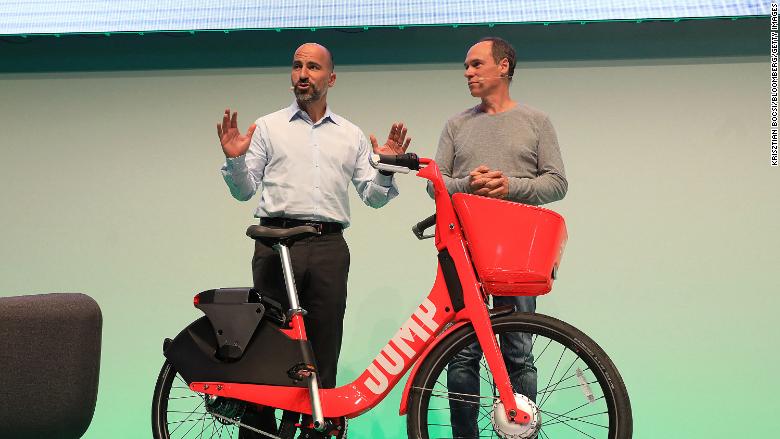
That last answer would be the right one, sort of.  Dara Khosrowshahi is the CEO of the company that acquired bike-share startup Jump Bikes.

And that company is...Uber.  Yes, the ride-share company:   one of the companies responsible for clogging the streets of cities like New York with drivers who pull over, seemingly without warning or regard for pedestrians or cyclists.  (I've had a couple of near-misses with Uber drivers who were looking at their screens instead of what (or who) was outside of their windows.)  Believe it or not, they're not only getting into bike share, they will soon offer electric scooters in San Francisco and other cities.

So, what brought about Mr. Khosrowshahi's seeming apostasy?  As he told The Financial Times, "There's a $6 trillion mobility market, and no one product is going to be serving that whole market."  So, while shifting some of the company's resources from drivers to cycling or scooters may hurt profits for a little while, it will pay off in the long run by giving people more options.

Uber electric bikes 0827 RESTRICTED
Uber CEO Dara Khosrowshahi presenting Jump Bicycles in Berlin, Germany.

Interestingly, he says some Uber drivers are even embracing the idea.  The reason, he says, is that bicycles would reduce the demand for short rides and leave drivers to complete longer, more lucrative runs, such as rides to airports.

And, unlike yellow cabs, Uber drivers don't make money if they're stuck in traffic:  Usually, they are paid a fixed or agreed-upon amount of money for a trip, regardless of whether it takes 10 minutes or an hour.  Yellow cabs, on the other hand, have meters that continue to run whether the car is zipping down a side street or idling on the Long Island Expressway. (How can it be an "expressway" if the traffic isn't moving?  Its acronym, the LIE, is more apt.)

So, as Khosrowshahi says, driving a tonne of metal ten blocks isn't a very efficient way to transport one passenger--from a transportation, environmental or economic standpoint. Ultimately, it doesn't even help the drivers' bottom lines.  More bikes, fewer cars, less congestion and pollution...because of Uber?  Who knew?

26 August 2018

Which Do You Lock First?

During my recent trip to Cambodia and Laos, I saw some heartbreaking poverty.  Still, there seemed to be little or no theft:  People left all sorts of items, including bicycles, out in the open, unsecured.  

And, as in other parts of the world, people leave their shoes at the door before entering their homes or, sometimes, even places of work or business.  That makes sense when so many streets, even in the middle of a city like Siem Reap, are wholly or partially dirt--which, of course, becomes mud when it rains--and dogs, cats and sometimes other animals roam freely on them.

Still, I had to wonder whether anyone had ever lost his or her shoes after leaving them by the door. (That didn't stop me, though, from following the local custom.)  Or a bicycle, for that matter.


This photo wasn't taken in any place I visited, as far as I know.  Having seen it, though, I have to wonder:  Is there a place where you're more likely to have your shoes than your bike stolen?

25 August 2018

Officer, I Was Just Helping A Friend Clean Up!

I once moved my possessions from one apartment to another--on my bicycle.

Granted, I didn't have much at the time.  Still, I take pride in having changed residences without the aid of trucks, vans or moving companies.  For me, the experience affirms what someone--an old riding buddy, if I recall correctly--once told me:  You can carry anything on a bicycle.  It's just a matter of loading and packing it.


A fellow in Oxford, Ohio apparently followed that advice.  He transported a mini-refrigerator and full-length mirror aboard a pink Mongoose bicycle.  


Of course, Stephen Moster didn't have those items on his back or shoulders, or strapped to a Blackburn rear carrier, as he pedaled along. For that matter, he wasn't hauling a modern bike trailer or even a vintage Cannondale bugger.  Instead, he was pushing a shopping cart loaded with the refrigerator and mirror.


I would have respect and even admiration for him:  After all, it takes a certain amount of ingenuity to conceive of such a system, and a certain level of skill to ride while pushing a cart.  And, yes, he showed that something could be done without a motor vehicle when most people would have assumed that one was necessary.


I would have respect for him...if the refrigerator and mirror were his, or he were transporting them for a friend--or even if someone was paying him to move them.   Or if his story--that two men invited him to "take whatever I want" from a house they were cleaning up--were true.


You know where this is going:  He burgled that house.  In fact, the two men were cleaning up from a previous burglary and talking with an insurance representative when they were startled by sounds.  They went to a neighbor's porch, where they watched Moster take the refrigerator and mirror.  Realizing he couldn't carry them on his bike, he left and then returned with a Kroger's grocery cart.


(This is how he should have done it!)


Hmm...The refrigerator and mirror were burgled and the cart was "appropriated".  It makes me wonder how he acquired the bicycle.

I still must say that I sort of admire his ingenuity.  But I would offer him this bit of advice: If you're going to abscond with other people's property, don't do it on a pink bike!

24 August 2018

Oh, Deer--In The Bronx!

Yesterday, I took another ride to Connecticut.  The day could hardly have been better:  neither the warmth nor sunlight were oppressive, and only a few high, wispy clouds floated across the sky.  I pedaled into a fairly brisk wind most of the way up--which meant, of course, it blew me back to Astoria.

And nearly into the path of a deer.  I was gliding through a turn on the Pelham Bay Park path, just before it crosses an entrance to the New England Thruway.  Trees cover one side of the path and line the other; just beyond that line is a marsh, with the hulking structures of Co-op City in sight.


I missed that deer by about five meters or so.  But I think I was more surprised than startled:  After all, I was in The Bronx.  Yes, you read that right.  It's one thing to see Bambi's wild cousin dart in front of you when you're barreling down a road in rural Pennsylvania, or a mountain goat bolt across the road you're thumping along with a flat tire at 90 KPH in the Alps.  You can talk about such things and, whatever judgments people are making, they believe you.

But a deer in the Bronx?  I'm still having trouble believing it--even though I saw it.  If only I could have taken a photo!

23 August 2018

What If?: SunTour "Click Shift" And Freehubs?

Captain Ahab had Moby Dick.  Others have spent years, decades, even lifetimes hunting down one obsession or another.

Now, the "target" I'm about to discuss didn't do anything to harm me.  In fact, other products made by the company that manufactured my Loch Ness monster, or whatever you want to call it, have actually brought me pleasure, at least while cycling.

The company in question is SunTour.  For a time, I didn't want to use derailleurs or freewheels made by any other company.  And I once dreamed of building a track bike from Superbe Pro components, which I thought were even better (or at least more beautiful) than even Campagnolo's fixed-gear offerings.

The object of my obsession are really objects, plural.  They are parts of a system SunTour introduced in 1969 and, apparently, manufactured only during that year.  I have seen references to them in a number of sources, but have never seen the parts in person.  In fact, I had never seen images of them--until yesterday.

Well, I came across one component, anyway, on--where else!--eBay:


These "click shift" levers were part of an indexed shifting system SunTour made that year.  From the accounts I've read, it worked well, though it didn't sell well and no manufacturer outfitted a new bike with it as original equipment.  Although SunTour had patented its slant-pantogram derailleur five years earlier, it did not begin to export its wares until the year before the "click shift" system came out.


Interestingly, SunTour also introduced an hub with an integrated freewheel mechanism--much like today's cassette freehubs--in that same year.  It, too, worked well and,like other SunTour products, was well-made.  Like the click-shift system, it seems not to have been produced after 1969.


The simple explanation for the "freehub"s or "click shift"s lack of commercial success is that the market wasn't ready to depart from traditional screw-on freewheels or friction shifters.  But another reason why those items didn't make much headway is that they predated the '70's North American Bike Boom by a couple of years.  As Frank Berto has pointed out in "Sunset for SunTour," Shimano entered the American market in the late 1960s when low-priced American bikes like  AMF, Huffy and Murray (which were sold mainly in department stores) were outfitted with Lark and Eagle derailleurs.   On the other hand, Sun Tour derailleurs had to wait a few more years,  until Japanese bicycle manufacturers like Fuji, Bridgestone and Miyata--adorned with SunTour components--developed an export market in the US and, later, in other countries.  By the time those bikes, and lightweight bicycles in general, caught on with American adults, "Click shift" and the intergrated hub were several years out of production.


Ironically, Shimano's appropriation of those innovations--and SunTour's slant parallelogram design (for which the patent expired in 1984)-- would lead to SunTour's demise a decade later.  SunTour, in desperation, tried to develop competing systems.  But the indexed systems SunTour introduced in 1986 did not work as well as Shimano's and, worse, companies like Schwinn used their old stocks of freewheels, chains and cables, which didn't work very well with SunTour's indexed systems.

One can only wonder how things might be different had all of those Fujis, Miyatas, Nishikis, Panasonics, Centurions and other Japanese bikes  had been equipped with SunTour's "Click Shift" and integrated hubs.  Or, for that matter,what about those Schwinns, Raleighs, Motobecanes and other bikes that, a few years later, would be sold in the US with SunTour derailleurs and freewheels as original equipment.  What if they had "click shift" and integrated hubs?  Would those parts have become the de facto standards?   Would SunTour have come to dominate the components market the way Shimano has for the past three decades?  

(At the time Shimano introduced its SIS and freehub systems, the company was an afterthought in all but the lower price ranges, and their stuff was rarely, if ever, bought as replacement equipment, let alone after-market upgrades.)

Finally, I have to wonder what "retro" and "L'eroica" would mean today. After all, they are both defined, at least in part, by non-indexed shifting systems and screw-on freewheels.  Would the concepts of "retro" and "L'eroica" even exist?

Well, I know one thing:  I wouldn't have this obsession over parts SunTour made for only one year, in 1969.

22 August 2018

Not The Way Across!

I have pedaled through lanes of traffic with motorized vehicles practically against my shoulders.  I have also ridden through hairpin turns with nothing where a gust at my side, a rock against my tire could have sent me tumbling a few hundred meters down.

Still, there are some places I would never, ever ride.  Among them are the vehicle lanes of most bridges, especially if they are long, high bridges--like the San Francisco-Oakland Bay Bridge:


I recall reading, some time ago, that more people have committed suicide on the nearby Golden Gate Bridge than anyplace else in the world.  (It seems that Nanjing Yangtze River Bridge in China has "overtaken" the Golden Gate in that category.)  One can only wonder if the woman in the video was trying to end her life on the Bay's "other" bridge.