In the middle of the journey of my life, I am--as always--a woman on a bike. Although I do not know where this road will lead, the way is not lost, for I have arrived here. And I am on my bicycle, again.
Right now, Wisconsin is in the news for mainly for the violence in Kenosha, and the possibilty of the President inflaming tensions with his scheduled visit. I have never been to Wisconsin, so I know nothing about the state, or Kenosha, but what I've seen and heard in the meidia. (It's a Rust Belt city with widening gaps between rich and poor, black and white, etc.) If I were to visit the Badger State, I imagine that I would want to go to Kenosha because the events there will be an important part of this country's history. But, I'm sure there is more that I'd want to see. One thing I'd want to do is cycle from Lake Michigan to the Mississippi River. Now it's possible to do just that on a cross-state bicycle route just approved by the American Association of State Highway and Transportation Officials.
Like other long bicycle routes (like the East Coast Greenway), the US Bicycle Route 30 was created by linking existing state and county bike trails, local roads and bike paths and state and county highways. In the middle of the state, there is a spur--US Bicycle Route 230--for use when the Merrimac Ferry, which crosses the Wisconsin River, is not available. Creating good bicycle routes is a laborious feat. Is it any more difficult than getting the Cheeto In Chief to ride on them?
Late today, I took Negrosa, my black Mercian Olympic, on a no-planned-destination ride. After zigzagging through some industrial areas and blocks of brick rowhouses, I descended the long hill from Ridgewood, Queens to Cypress Hills, Brooklyn. After some more zigging and zagging along and around the Brooklyn-Queens border, I found myself in a place I hadn't visited in a while.
"The Hole," which I've mentioned in earlier posts, is an alternative universe between Brooklyn and Queens, near the South Shore of both boroughs. The land--and incongruously-named streets (Ruby, Sapphire, Amber)--drop suddenly behind a shopping center and a row of doctors office-type buildings on Linden Boulevard. Not much seems to have changed since the last time I visited:
My guess is that those who live and work--legitimately or not--in the area want to keep it that way. Why else would they stay in a place that practically forces them to live and work like Okies or folks in rural Appalachia before World War II? I mean, it's still not hooked up to the city's sewer systems and some aren't even on the electrical grid. Oh, and I can't think of any place else in this city where a yard can fill with junked cars or school buses without attracting the attention of the Health Department. A couple of guys, who were working on a truck, noticed me and nodded. As obvious an outsider as I am, I guess they didn't see me as a threat. I am a cyclist, after all.
Other languages have wonderful expressions that don't quite translate into English, but are vivid nonetheless. One, from French, is pedaler dans la choucroute.
Pedaling through sauerkraut? Avec ou sans la moutarde?
Yesterday I contrasted the anniversary of Martin Luther King Jr.'s "I Have A Dream" with the speeches of the Republican National Convention, which ended the night before. Speaking of dreams: One of mine has long been to have indoor, or at least protected, bicycle parking at museums. Well, that dream has just come true--for a while, and at one institution, anyway.
Today the Metropolitan Museum of Art is, like the Statue of Liberty* and a few other New York City museums and landmarks, re-opening to the public. Visitors must purchase tickets and schedule their visits in advance. Upon arrival, their temperatures will be checked and anyone who is 38C (100.4 F) or higher will be asked to visit on another day. Some visitors, however, will be treated like VIPs. From today until 27 September, "the Met" is offering valet bicycle parking at its Fifth Avenue plaza, just north of the steps to its main entrance. An initiative by Kenneth Weine, the museum's vice president of external affairs, resulted in a partnership with Transportation Alternatives that brought about the parking arrangement. Weine, who describes himself as an "avid biker," routinely rides from his Brooklyn home to work. The museum has tripled bike parking capacity for staff in an effort to encourage more cycling to work. Weine lauds the city for developing more bike lanes and says that "if we can be one extra link in that chain" by "offering an additional way for people to come to the museum, we're happy to do it." In other posts on this blog, I have said that cycling enhances my perceptions of art, and that some art should be seen only after riding a bicycle to reach it. I wonder whether Weine, or other museum administrators or curators, feel the same way.
Today is the anniversary of Martin Luther King's Jr.'s "I Have A Dream" speech.
It's a sad irony (How many times have I used this phrase in the past three years?) that it comes the day after what seemed like a bad drug trip that lasted four nights. I'm talking about the Republican National Convention, which featured more gaslighting than Angela Lansbury's first film.* Dreaming--more precisely, exhorting your audience to envision and follow your dream--is an invitation to a journey toward a better place. What happened at the convention is the exact opposite: Speakers imputed sinister motives, words and actions to their enemies and hellish conditions to places that had been doing well (or, at least, improving) until the COVID-19 epidemic.
I guess I shouldn't be surprised at the tone of the convention, given that Trump has not only vowed not to ride a bike, but has jeered cyclists. On the other hand, MLK was known to take a spin. And, like Einstein, he looked so happy in the saddle!
*--Like many people, I thought Gaslight was a Hitchcock film until I saw it. George Cukor, in fact, directed it.
If every nation in the world decided to ban nuclear weapons and abandon nuclear energy, would scientists continue their work on understanding and harnessing the power of the atom? Of course they would. They're scientists: They want to know what's possible and knowable. Likewise, if some ruler decided to model his or her country after Plato's Republic, poets would be banned. But would they stop writing or chanting? Of course not. At least, no real poets would. Following this thread of logic, doesn't it make sense that just because the Union Cycliste Internationale (UCI) won't allow road bicycles lighter than 6.8 kilograms (14.9 pounds) in sanctioned races, someone won't restrain him- or her- self from creating an even lighter bike? Of course it does. And that is exactly what Canyon, the largest direct-to[consumer bicycle company, has done. Two weeks ago, it released the Canyon Factory Racing (CFR) version of its "Ultimate" road bike.
It weighs a wispy 6.2 kilos, or 13 pounds, 11 ounces. Now, it may not appear in the Tour or Giro or Vuelta, whenever they resume--unless, of course, the UCI changes its rules. But I am sure that someone out there simply must have it. Hal Ruzal, the recently-retired maven of Bicycle Habitat, once told me that whenever the lightest bikes from Specialized (S-Works) or Cannondale or whomever came to his shop, people with fat enough wallets (or high enough credit cards limit) bought them. "They think those bikes are going to get them over the hill in Central Park," he quipped. Still, though, I don't mind that someone is trying to make ever-lighter bikes, even if they're not allowed in races--or if I don't intend to buy one myself, even if I get rich.
Donald Trump has pledged to never, ever ride a bike again. I don't think he'll break that promise, especially now that we've seen how Joe Biden could "smoke" a lot of young whippersnappers. To tell you the truth, I don't think I'd be too unhappy if El Cheeto Grande never mounted two wheels. I don't feel that way about very many people. On the other hand, I might actually like seeing Heloise on a bike. I have absolutely no idea of what she's like as a person (or if she's even real). But at least she is trying to help people become something Trumplethinskin never is: civil. In one of her recent "Hints" columns, she answered a letter from someone who complained about scofflaw cyclists and wondered whether we should follow the same rules of the road as drivers and other vehicle operators.
"Heloise"
Most of Heloise's answer comes from the League of American Bicyclists' guide. It's stuff we've all seen and heard before, and makes sense, as far as it goes. But I don't get the sense she's on a bike since she was a kid, if she ever rode. If she were to take to the streets, it would be interesting if she could encounter the recently-departed John Forester.
OK, I'll confess: I'm listening to the Republican convention. My rationale could be something like the one I offered for practically memorizing Das Kapital when I fancied myself an acolyte of Ayn Rand and St. Paul: I was learning how and what "the other side" thinks. Oh, I offered a similar explanation, if only to myself, when I used to go shopping with girlfriends and female friends when I was in my boy-drag. Everyone from Kimberly Guilfoyle to Nikki Haley, when they're not accusing Trump's predecessor of leading us into an abyss to which his opponent will return us, are touting all of the wonderful things the The Orange One has supposedly done. I want to hear what he'll promise next. One of his most recent pledges, made last week, is to never, ever ride a bicycle again. Actually, he promised not to get hurt on a bike: a jab at John Kerry, who crashed in the French Alps, where he was negotiating with Iran's foreign minister. He plans to avoid Kerry's mishap in the easiest way possible: He won't ride a bike. Ever. Kerry took his tumble five years ago. Trump picked on him because he couldn't throw shade on Joe Biden who, on a ride near Valley Forge, zipped past a Fox News reporter. Trump's anti-cycling rant is ironic considering that, for two years, he sponsored what was arguably the most important bicycle race in the United States. It's fitting, I think, that one of the participating teams, Sauna Diana, was sponsored by a Dutch brothel. Somehow I get the feeling Joe Biden, even at his age, might be too fast for them.
I try not to ride with a backpack. When I must use one, I try not to carry more than, say, a few things from the market, a camera or smartphone and a notebook.
Of course, if I carry a backpack, I can blame it for slowing me down!
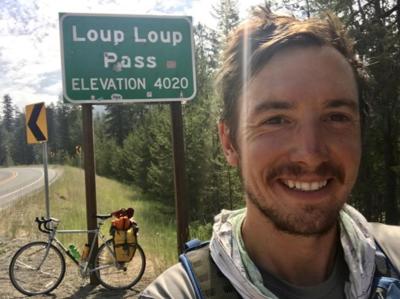
Some of my best memories from my bicycle tours are the conversations and other interactions I had with local people. I'm thinking now of the old couple living by the point where the Garonne bends and begins its opening to the sea. They took great pride in knowing the exact moments, twice a day, when the tide rolled in. I'm also recalling my ride with You Sert, a PURE guide, that took us to Cambodian farms where one woman practiced traditional healing and her kids and their cat played with me, and another where a woman guided me through weaving grass for a roof. These encounters might be different from the ones that await Nate Hegyi. I feel confident, however, that whomever he meets and whatever he shares with them will be interesting. A Public Radio-affiliated reporter in Boise, Idaho, Hegyi is embarking on a 900-mile bicycle trip along the Continental Divide. He plans to visit eastern Idaho's ranching towns; Missoula, Montana; Wyoming's oil and gas areas and the mountainous country of northern Colorado before ending his trip in Greeley. Along the way he plans to file radio stories, post to an online blog and, in late October, release a podcast he will produce.
"It's been a tumultuous year," Hegyi said. "A pandemic grips the region and the economy is in freefall. But the voices of folks in the Mountain West's small towns and rural communities are often unheard in regional and national media outlets." One purpose of the trip, he explained, is to "learn more about the area's residents and hear their stories." I am sure that whatever stories he hears aren't the ones one can hear from a car, tour bus or resort hotel!