28 November 2021

Clothes Make The---Cyclist?

While I disagree with Grant Petersen, the force behind Rivendell Bikes (and, before that, Bridgestone bikes) on matters of bike fit and, sometimes, design, I wholeheartedly agree with him on other things.  Among them is cycling attire:  Reading his blog convinced me that I didn't have to wear team kit--or anything else made of lycra--in order to ride and, more important, enjoy riding.

So I think he would appreciate this:


27 November 2021

Maybe They'll Get It Right...Some Day

I think it was Winston Churchill who said that Americans will do the right thing after they've exhausted all other possibilities.

Sometimes I think he was an optimist, at least when it comes to laws and polices regarding bicycles.  In my own humble (OK, I gotta say that:  I know I'm right because...well, I'm so damn smart and I've been riding for almost half a century!) opinion, no vehicle--whether it has one, two, three, four or more wheels--with a motor should be allowed in any lane designated for pedestrians, pedaled bicycles or any vehicle that doesn't have a motor.

I've presented my wisdom, I mean, opinion to everyone from the folks at Transportation Alternatives (of which I'm a member) to City Hall.  The response is almost always the same: "You're right. But how could it be enforced?"

So, we have to contend with "rocket" scooters, e-bikes with boosters, and hand-throttle e-bikes in bike lanes that are six feet wide--for bike traffic in both directions.  Or, in some places, we and pedestrians are "protected" by wrongheaded regulations.

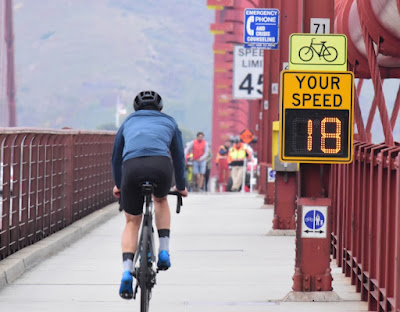
The new year will begin with such a policy for folks who cross the Golden Gate Bridge.  Starting on 1 January, there will be a one-size-fits-all 15 MPH speed limit in the bike/pedestrian lane.  Currently, bridge-crossers are "advised" to remain within that limit.


Photo by Sherry LaVars, for the Marin Independent Journal


While I understand the concerns of pedestrians (having walked across a number of bridges, including the Triborough/RFK and Queensborough/59th Street, in bike-ped lanes), I can also say that most cyclists who are going more than 15 MPH have a commensurate level of handling skills.  The same cannot be said, I believe, for folks riding e-bikes and motorized bikes and scooters at 25 or 30 MPH.  Plus, a motorized bike (which, as often as not, is really just a scaled-down motorcycle) can inflict more serious injury or damage than a pedaled bicycle at any given speed.

My hope is that Churchill will be proven right and whoever came up with the new Golden Gate Bridge regulation will realize the error of it and come up with something more sensible--like, say, banning anything with a motor from the pedestrian/bike lane. 

26 November 2021

I Wouldn't Be Caught Dead In...

 The '80s brought us "fade" paint jobs.

The '90s--oh, where do I begin?  It was (mostly) a great time for me personally (including as a cyclist), but there was all manner of insanity in the bike world.  As someone who was both a road and off-road (mainly the former) cyclist for most of the decade, I can say I'm unbiased in laying much of the blame on mountain bikes, which brought us bar ends in weird shapes, wheels with spokes that looked like the twist-ties from bags of bread and anything that could be made in a neon color.

This century/millenium has also brought its share of unfortunate trends.  Some of them start off as sensible, even laudable ideas, like bike garments designed to make us more visible to motorists (and, sometimes, each other).  But they end up in absurdity or just sheer tackiness:


I mean, why do you need an emoji to be seen?

25 November 2021

A Fowl Holiday

 The other day, my friend Beverly told me she's going to spend today with her kids and grandkids on Staten Island.  I'm going "with bird in tow," she said.

I asked whether she'd planned to use a tow truck to drag a turkey across the Verrazano Bridge.  "That sounds cruel!" exclaimed.

Plus, it would definitely lead his fellow feathered friends in a fowl mood. (I couldn't resist that one!)


Happy Thanksgiving!

24 November 2021

They See You While You're Shopping

Tomorrow is Thanksgiving Day--and, unofficially, the beginning of the "holiday season"--here in the US.

Although this time is festive for some, it comes with increased dangers.  Among them are "crimes of opportunity," especially in shopping and touristic areas.  Such incidents include car break-ins, purse snatchings, other kinds of theft and sexual harassment and assault.  As one shopper pointed out, a woman alone in a parking lot is especially vulnerable at this time of year, as darkness arrives earlier in the day.

Knowing that, police departments typically increase their presence in such places at this time of year.  Typically, constables pass by in patrol cars; sometimes cops do their work on foot.  But at least one police department has figured out that sending officers to such areas on bicycle is perhaps the most effective means of fighting and deterring crime.

That is what the Kyle, Texas police department will be doing for the fourth year.  The Austin-area city's department specially trains officers for bike duty.  One benefit, according to officer James Plant, is that "we can get into areas that police cars can't." Moreover, he says, bikes are quiet, which allows officers to "be stealthy" and "sneak up on the criminal."

The real value, he says, of the bike patrols is not so much in busting criminals but in deterring them.  The officers on bikes, he explains, are "an extra set of eyes and ears in the community."

And, it seems, people like the bike patrols.  "We get a lot of thumbs-up," Plant says.


23 November 2021

Black Cyclone Coming

There are a number of athletes I admire for their accomplishments in their sports.  But there is a much smaller number whom I respect equally, or even more, as human beings.  They include Jackie Robinson, Billie Jean King, Muhammad Ali, Colin Kaerpernick, Simone Biles--and Marshall Walter "Major" Taylor.

Some day, I'm sure, a documentary or biopic will be made about Ms. Biles.  Films have already been made from the triumphs and struggles of Robinson and Ali.  Five years ago, "Battle of the Sexes" focused on King's 1973 match--which she won--against Bobby Riggs.  While it was a good film, I think it also helped to reinforce the tendency to think of Ms. King only in terms of that, and not on, not only of the way she dominated her game as Martina Navratilova and Serena Williams would later on, but also of her advocacy for women and LGBTQ folks. 

But, to my knowledge, Major Taylor hasn't received cinematic canonization.  One reason for that may be that there isn't anybody alive who saw him ride or can even remember how he dominated bike racing to the same degree as the other athletes I've mentioned towered over their sports.  Thus, most people who aren't familiar with the history of cycling or African Americans don't realize that he was the first African American champion of any sport half a century before Robinson set foot on a Major League baseball field.


Clement Virgo (l) and "Major" Taylor


It seems that situation is about to change.  Canadian director Clement Virgo, who also helmed feature films "Rude" and "Lie With Me" as well as the six-part miniseries "The Book of Negroes," has been tapped to direct "Black Cyclone."  The title comes from one of the more flattering nicknames given to Taylor. (As a black man in the late 19th and early 20th Centuries, he also was called names that I, someone who isn't exactly profanity-adverse, won't repeat.)  John Howard, a three-time Olympic and four-time U.S. Road Champion cyclist (who also set a land speed record that stood for a decade) will serve as a consultant on the project.

Production is set to begin next year.   

22 November 2021

A Signal--Of What?

 Friday afternoon, I pedaled along the North Shore--into the wind most of the way out, with it on the way back.

On my way back, I stopped in Fort Totten.  As its name implies, it was an active military base.  Now one section of it is used for Army Reserve training exercises; the New York Fire Department uses another.  The rest is a park with some great views of Long Island Sound and, on a clear day, the New York skyline.

When I stopped, I chanced upon this:


I got to thinking, ironically, about a long-ago conversation with an Italian olive grower.  The trees take 100 years to bear fruit, he told me.  So, he said, I am not planting a tree for me, for my children, or their grandchildren.  Rather, he is planting for their grandchildren.

A few weeks after that trip--during which I pedaled from Rome to Avignon and took the TGV (still pretty new then) to Paris--I went to  to see my brother in SoCal, with a stop in NoCal.  I took time from doing all of the things that could have gotten me into trouble (yes, even in San Francisco) to see the millenia-old trees on the other side of the bridge.  Later, I would try to write about how it felt to look at living things--olive, sequoia and other trees--that were older than any other living thing I'd seen, and any civilization or race I'd ever read about.  They were, it seemed, almost as old as the earth itself.


Here in NY, the trees aren't quite that old.  But at least a few have been around for a century or more and have weathered all manner of natural cataclysms and human-made traumas.  But this year proved to be too much for some that fell or broke, like the one in the photo.

Somehow it made the mostly-clear sky even more stark and a harbinger of winter.  Or, could it be a signal to some other direction we (or at least I) cannot yet discern?  Was it directing me to some place I haven't seen or imagined?


I'll spare you any comparisons to the green light in the Great Gatsby!

21 November 2021

Good Neighbors Make Good…

 Just as, at my age, I don’t have to be told to slow down, there are many other things no one has to remind me not to do:


From a Reddit thread


20 November 2021

How I Could Have Become One Of The Remembered


Today is Transgender Day of Remembrance. All over the world, people will read the names of trans people who have been murdered during the previous year.  Such observances began on this date in 1999, one year after trans woman Rita Hester was found barely alive in her apartment.  She had been stabbed 20 times and died upon arrival at the hospital.

As brutal as her murder was,  it wasn't unusual for trans or non-binary people.  It seems that haters have a particular penchant for spewing their bile on those of us who don't, in one way or another, conform to the norms of whichever sex we were assigned at birth.  And living as the people we are seems to bring out the lawlessness of too many law enforcement officials.

I could have been one of their victims--and, possibly, one of the names read at the commemorations.  One hot day early in my gender-affirmation process, I was riding my Dahon Vitesse home work.  I didn't like the bike much but its flat-black finish garnered a lot of compliments.  One of them came through the window of a van whose rear windows were blacked out.  "Nice bike," the passenger commented.  I nodded in thanks.

The driver slowed that van down.  I rode past and thought nothing of it until it pulled up alongside me again and the same passenger yelled, "Nice legs, honey."  I was wearing a skirt that day and my legs are often complimented, or at least noticed.  So I thought nothing of it until the guy repeated himself, louder, "Nice legs!"  I paid no mind.  Then the guy bellowed, "Stop!"

Of course, I didn't.  But, as it turned out, it was a situation of "damned if I do, damned if I don't."  Again, the van slowed down, let me pull ahead, then caught up to me.  The passenger side flung open.  "When we say STOP, you STOP!"

"Why?"

"We're cops!"

"Show me your badges."

"Shut up!," the driver yelled.  "Shut up and do what we tell you!"

"But if you're a cop, you have to have reason to stop me."

"What were you doing in the projects?"

"First of all, I wasn't there.  I wasn't anywhere near there." That was true which, I think, pissed off those cops even more. "Just shut up and do what we tell you."

At that moment, I was picturing myself in the back of that van and ending up in the river that night.  So, when the passenger demanded to see my ID, I opened my bag. Fortunately for me, the ID I carried had an old address:  I had moved recently and was waiting for my updated state ID card.  

"Where are you going?"

"Home."

"Where's that?"

"The address on the card"--which was a few blocks away.

"OK," hissed the driver. "Just remember--when a cop tells you to do something, you do it," the passenger bellowed.

"You can go now," said the driver.

As it was early in my gender affirmation process, I couldn't help but to think those cops--if they were indeed cops--were "curious" about me.  Or perhaps they were looking for a victim "nobody will miss." 

That incident went down not long after I had gone through a process of wondering whether my cycling would survive my gender affirmation process.  I had made up my mind to continue riding, but I have to admit that I wondered about my decision.

Fortunately, there are more transgender or gender non-conforming cyclists than there were back then, in 2005.  Or, at least, more of us are "out."  I've met a few and have made contact with others, including Molly Cameron and the wonderful Coline in Scotland.  And, of course, there is another Scot:   the incomparable Philippa York, nee Robert Millar, the first anglophone rider to win the polka dot jersey (for the best climber) in the Tour de France.

While cycling has become more inclusive--when I first started became a dedicated rider, nearly half a century ago, almost everyone who rode more than a few kilometers was male--we still need to work toward greater inclusion and safety, of, for and in our own selves.  That is our real journey, however and wherever we ride.


19 November 2021

We May Not Be Able To Follow The Dutch, But We Can Get To Where They Are (More Or Less)

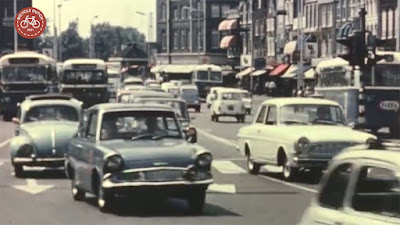
A few days ago, Mark Wagenbuur re-posted an early post on his excellent blog, Bicycle Dutch.  In it, he outlines the developments that led to the Netherlands' much-lauded bicycle infrastructure and culture.  


Utrecht city center in 1929...


Perhaps most important, he shows that his country wasn't always the cyclists' paradise one encounters today.  Before World War II, bicycles were the main mode of transportation for many Dutch people.  Photos show streets relatively free of cars and cyclists riding among, but not competing with, trams.  After World War II, however, increasing affluence led people to foresake two wheels for four.  Another photo from 1968 shows a street as clogged with motor traffic as any in an American city (though, it's hard not to notice, the vehicles are smaller).  It was during the 1970s, he says, that the movements that led to today's system of bike lanes and other facilities began.


..

...and in 1968


Activists and planners of that time also advocated for changes in city planning to encourage motor-free transportation and recreation.  He shows motor vehicle-free central business districts, some in centuries-old areas of cities.  As he points out--in contrast to the arguments of their American counterparts--business owners report increased business because a cyclist or pedestrian is more likely to stop by whereas a driver might pass by if they can't find a parking space.

But his post also points to another parallel with the US that might help to explain why such developments are slower in coming to America. For one, he mentions that in recent years, the amount of cycling in the Netherlands has stabilized--which isn't surprising when you realize that bicycles have outnumbered people for some time. (They do in my apartment, too!)  Those statistics, though, have layers, and if you peel off one of them, you find that cycling has increased in urban areas but decreased in the countryside has decreased.  I don't know what the numbers are for the US, but I suspect that there is a similar situation at work--or that, at any rate, most of the increase in American cycling has come in or near urban areas.

For another, he talks about the resistance to making city centers more auto-friendly. (One of the images is a rendition of a proposed highway that looks alarmingly like the ones in areas like Southern California and other auto-centric areas. Thankfully, it was never built.)  While cycling declined for a couple of decades after World War II, remaining cyclists fought to make their country safer for riding.  Also, making some city centers more auto-friendly meant, not only removing bike lanes or streets that were safe for cycling, but also some beloved buildings, some of them centuries old. When some of those structures were lost, people thought that perhaps the price of "progress" wasn't worth it.

While there is some interest in preserving historic structures in some American cities, on the whole the environment in the US is more amenable to large-scale development.  Some of that has to do with citizens who still see building bigger buildings as "progress," but I suspect that it has at least as much to do with the fact that mega-developers have more influence on politics and the media, at the local as well as the national level, in the US.  

Also, business and commercial districts in some American cities, especially the newer ones in the South and West, are auto-centric by design.  In contrast, the older Dutch (and other European) city centers, with their narrower streets and smaller plazas, were created long before automobiles came along.  So, I would suspect, making them more bicycle- and pedestrian-friendly would mean, at least to some degree, returning them to their original state.  Or, at least, making them bicycle- and pedestrian- friendly doesn't require as much of a radical redesign as would be required in most American cities.

Finally, there is the matter of geography.  The Netherlands is a much smaller country, and places are closer together.  So people need less convincing to see that bicycling is a practical way to get to where they need to go--and that riding is simply fun.  If someone lives 100 kilometers away from work, as many Americans do, no bike lane is going to convince them not to drive.  At best, such a commuter might be enticed to ride his or her bike to a train or bus station--if indeed there are safe and secure parking facilities at the station. Or if there is a train or bus line at all.  That is another area in which Dutch and other European people are better-served than Americans.


So, Mark Wagenbuur has done a service by showing that his country wasn't always the cycling Nirvana we see today.  More important, he shows that it was once before a country of cyclists, but planners and ordinary citizens learned from their mistakes in emulating American transportation and city planning.  Perhaps we can learn from our own mistakes and, although we can't go about it in the same way as the Dutch (or Danes or other Europeans), we can make this country more amenable for cyclists and pedestrians.  It's one of the steps we need to take in order to keep from cooking ourselves (and most other life) on this planet!