20 May 2017

Escape From The Sunshine State

People move from one state to another for all sorts of reasons.  Chief among them, I suppose, are jobs, family and schooling.  Then there are those who have a warrant out for them in the state they left (One of the great things about getting older is that the statute of limitations runs out!  You didn't hear that from me!) or are simply running away from any number of things.  I fit into that category when I left New Jersey:  Although my childhood wasn't Dickensian (It was more like Everybody Loves Raymond), a day came when I didn't want to be around my family or anybody or anything I knew.

Back then,  I said I'd "escaped" from New Jersey.  Other people, I'm sure, see their exits from one locale or another that way.  And that is how Alan Snel regards quitting Florida and going back to Nevada.

"Ghost Bike" dedicated to Johnny Jones in Jacksonville, Florida


As he reminds Governor Rick Scott in his open letter, posted on his blog Bicycle Stories, the Sunshine State leads the nation in cycling fatalities.  Given that it is the fourth most-populous state, it's not surprising that it also has the highest number of fatalities per million people.  What's most shocking, though is that no other state comes close, with almost twice as many deaths per million as second-place Louisiana and in absolute numbers, it edges out California, which has nearly double the population.

Two months ago, Alan Snel nearly became one of those statistics. He pointed that out in his letter to the Governor, in which he makes this judgment:  "You have showed no political leadership to try and reduce [the number of cycling fatalities] and you and the political leaders just don't care enough to do anything about keeping cyclists alive in your state."

Now I'll admit that my experiences of cycling in Florida are limited to a week or so I spend there every year.  And while there are great beaches and scenery, and it's nice to ride in shorts and T-shirts in December or January, I have even less of a sense that whoever makes decisions there knows or cares even less about cycling than in other places.  That is particularly troubling when you realize how many people ride.  

I always had the sense that, more than in anyplace else I've ridden, planners seem to think that throwing a bone to cyclists by painting a lane here or there is "policy".  And on Florida roads, you're more likely to encounter motorists driving way over the speed limit while under the influence of some substance or another--or are simply ignorant of, or hostile to, cyclists--than you are in, say, Portland--or even New York.

So...Although I usually enjoy the time I spend in Florida, I have no plans to move there.  And I understand why Alan Snel is moving out of it.

19 May 2017

Why I've Stripped Helene

The weather has been hot, particularly for this time of year.  But that's not the reason Helene is stripped.

I confess:  I stripped her.  

Why would I do such a thing to a pretty Miss Mercian?  It's not for maintenance:  I haven't been riding her lately.  

Actually, I took off all of her parts for that very reason:  I haven't been riding her.  But don't worry:  I'm not leaving her exposed.

She's getting ready for a journey.  

First I have to put her in a box.  Then she'll be on her way.

A year after I acquired Helene (in the photos below), I found Vera, my other (green, twin-tube) Miss Mercian.  I've been riding that one quite a bit, as you know if you've been reading this blog a while.


So...Helene, it's nothing personal.  You're a great bike.  But you shouldn't have to compete with Vera or any of my other bikes--or anyone or anything else (all right, except for Max and Marlee).  So, I'm sending you off to someone who will give you the attention and good times you deserve.

Yes, I've sold her.  I'd been thinking about doing that for a while. Finally, I found someone who will appreciate her and understands why I'm selling her.


Actually, the fact that I hadn't been riding her isn't the only reason I've sold her.  I'll soon tell you another reason why.

18 May 2017

This Bike Sucks. And That's A Good Thing.

How many times have we heard, or said, that the more people we get to ride bicycles, the cleaner our air will be.

But, you know, that's just one step.  Some of us--especially those of us who live in the major cities--are sucking up the very smog we're trying to combat.  We're not trees:  We can't just inhale the stuff tailpipes and smokestacks belch and exhale air that's as pure as the driven snow.

So what can we do?  Well, since people have used pedal power to sharpen knives, grind grain and generate power for everything from hair dryers to computers, Dan Roosegaarde figured that he could use a bicycle to clean the air.  

Yes, you read that right.  This bike has a mechanism that sucks in dirty air, filters it and lets out fresh air as the cyclist pedals down traffic-clogged streets.  Roosegaarde, a Dutch (what else?) artist and inventor, has designed a series of innovation to help curb air pollution, including a series of 23-foot high towers that essentially act as a massive air purifier.  


The Chinese government is supporting the development of the Smog Free Bicycle.  That makes sense when you realize China has both the largest and fastest-growing urban areas and bike-share programs in the world.  Two decades ago, the bicycle was practically a symbol of China; two-wheelers clogged the streets as impenetrably as cars and trucks clot those same thoroughfares, and those of large metropoli in other countries, today.

Roosegaarde says he wants to "bring back the bicycle, not only as a cultural icon of China, but also as the next step towards smog-free cities".

17 May 2017

A Libertarian Argument To Subsidize Cycling?

Like many bookish young people of my generation, I had my "Ayn Rand phase."  I actually believed (or, at least, thought I believed) that if you want something, you should pay for it and you should only get what you pay for.  If you can't afford more, I believed, it was your own damned fault.

Of course, to libertarians--a very loose term that is normally used to describe Randians--taxes are anathema. But most see them as, if not a necessary evil, then at least as a reality:  after all, we're not likely to privatize roads, bridges and such any time soon.  To the extent that they're willing to tolerate having their money "confiscated" by the government, they believe that people should get only what they pay for.


Every once in a while, I encounter that line of thinking when some driver swears at me or anyone else, upon learning I'm a cyclist, lapses into an anti-bike rant.  Every single time some motorist vented his or her rage at me for taking up space in "his" or "her" roadway--or at having part of it "taken away" by a bike lane--or questioned my patriotism or simply expressed disdain of me because I choose two wheels instead of four--he or she said something along the lines of, "Well, you don't pay taxes!"

As I have pointed out to more than one such driver--and in this blog--the only taxes that they pay and we don't are the ones added to the price of gasoline.  If anything, we might be paying higher proportions of our incomes in taxes, because drivers--especially if they are salespeople, contractors or work in other auto-dependent endeavors--can write off much of the expense of driving and maintaining their cars.  Moreover, they make heavier use of the infrastructure we and they pay for.

Even if they are misinformed about who pays and how much, most people with whom I've gotten into arguments or discussions about bike vs car taxes are pretty consistent in their beliefs about taxation.  Also, they seem to agree with me on this:  Taxation is an effective way to regulate behavior.  That is why people (some, anyway) donate to charities:  It lowers their tax bills.  In my city and other jurisdictions, it's also helped to reduce smoking, among other things.


If we follow this line of reasoning, one might expect that tax policy could not only entice more people ride bikes to work, it could also encourage employers to encourage their employees to pedal to the office or factory or studio or wherever they work.

Well, there is evidence that such policies actually work.  In 2003, Her Majesty's Revenue & Customs (Think of a British IRS.) enacted a regulation (EIM 21664), commonly known as "The Cycle to Work Scheme".  It allows employers to provide bicycles to their employees tax-free.  That is, tax-free for both the employers and employees, who do not have to declare them as part for their employment tax or as part of their taxable income, respectively.


Of course, certain conditions have to be met.  You don't get to deduct your custom Mercian or Bob Jackson--unless, of course, you are using it mainly for job-related travel and your employer provides it for that purpose.  HMRC doesn't expect employees to provide detailed records of how they use their bikes "unless there is clear evidence to suggest that less than half of the use of the cycle or equipment is on qualifying journeys."  Now, I'm no expert on US, let alone British, tax law, but I imagine (from my reading of the policy) that taking the bike on a charity ride or some other such event every now and again wouldn't disqualify the bike or the rider.

Notice the word "equipment" is included. It includes helmets that conform to European standard EN-1078, child seats, lights (including dynamos), bells and bulb horns, reflective clothing and front, rear and spoke reflectors. So it won't pay for your lycra "Sky Team" kit, cycle computers or training.


According to a study the Institute for Employment Studies released last year, there have been more than a million successful applications for Cycle to Work since 2007.  According to a survey of 13,000 users, nine percent were non-cyclists before they became part of the "scheme", and respondents, on average, said they are now cycling more than twice as many miles as they pedaled before the scheme.  Even among already-committed cyclists, about two-thirds said they'd increased the amount of riding they did before they entered the program.


The IES said that even if five percent of participants--9200 people--cycled 30 minutes a day as a result of their involvement in the program, their reduced absenteeism and increased fitness saved 72 million GBP a year.  That's 7826 GBP (10173 USD at current exchange rates).  How many programs, in any country, save that much money per person?


Ironically, that is the most palatable argument you can make about taxes to a libertarian (or my younger Ayn Randian self):  Something saves tax money, and reduces the tax burden on people.

Now, about a single-payer national health care system....

16 May 2017

Keeping Up With The Kardashians

Perhaps it won't surprise you to know that I've never watched any of the Kardashians' TV shows.  Part of the reason, I confess, is that I haven't looked at TV in a few years--except for the times I've watched reruns of The Golden Girls and Everybody Loves Raymond with my mother.  I haven't even owned a television set in about four years.

But even when I still had a television set, I wasn't spending my time with shows like The Kardashian Family.  I simply don't care about their antics.  I hear about some of them--the marriages, the divorces and such--from other people or during radio newscasts.  And whatever capacity I might have for schadenfreude isn't even stoked by events like Kim getting tied up and robbed of $10 million in jewelry in Paris.  


I must admit, though, that I got a laugh out of this:


For one thing, the sight of anyone over the age of four riding a bike in a furry pink jacket is just over-the-top hilarious.  For that matter, seeing someone who's supposed to be a fashion icon in such a jacket--on a bright red bicycle, no less--is comical.  

At least Kendall Jenner seems to have a sense of humor about herself.  As falls flat on her face, her glasses fall off her nose and her legs go up in the air.  If anything, I think she was happy about that last part:  She probably has more followers, on Twitter, Instagram and  TV, when her legs are up--though, perhaps, not as many as her half-sister got for being tied up.

15 May 2017

The Last Miles, The Longest Miles

Paris and Los Angeles are "the last cities standing", if you will, in the contest to host the 2024 Olympics.

Upon visiting each city, Olympic Committee members noted that the City of Light and La-La Land both had, among other things, already-existing venues for hosting events.  So, while hosting the Games won't be cheap, it won't be quite as expensive as it would be in some other cities.  In other places, the need to construct everything from new stadiums to housing for athletes has spawned opposition from citizens who believe the money could be better spent on, say, hospitals or schools.  Thus, everyday people as well as high public officials in the home of Impressionism and the kingdom of the silver screen support their hometowns' bids for the 2024 Games.

The Olympic Committee, of course, also found vast differences between Paris and Los Angeles.  One of them is the distances athletes, spectators and others would have to travel to and from events.  Although its officials are making efforts to develop a real mass transportation system and to make their town more bike-friendly, L.A. is still considered the capital of car-centered culture.  The City of Angels was founded in 1781, but it didn't become one of the major cities of the United States until about World War I--which, of course, is the time the automobile literally changed the region's, and the nation's, landscape.

Paris, on the other hand, is a pretty compact city.  It's almost exactly the same size as the Bronx (with nearly three times the population).  Thus, most people can walk, cycle or take take mass transit to work, shop or do almost anything they need to do, and arrive in their destinations within minutes.  Paris, of course, has one of the largest bike-share programs in the world, and no point in "Paname" is more than 500 meters from a Metro (subway) station.

That difference is emblematic, not only of the two cities, but also (to a large degree) the countries of which they are part. You probably wish, as I do, that more people would ride bikes to work.  In fact, you might wish that you were one of the people who rides to work.  If you are, you have a lot of company:  In various surveys, people have said they would bike to work if they lived closer and there were facilities like secure parking and places where they could wash up and change clothes.

The fact that this country depends on the internal combustion engine more than almost any other is what has led people to live further from their workplaces than their peers in just about every other nation.  (The Tri-State area has now become the Quad-State Area, and Las Vegas has become a de facto suburb of L.A.)  Let's face it:  Someone who lives 200 kilometers away from his or her job isn't going to ride a bike to work, even if he or she were capable of doing so.  

The fact that this country and culture are so auto-dependent has led to what is one of the most vexing ironies of transportation.  It can be expressed thusly:  "The last miles are the longest."  So, as an example, it could take someone an hour to go the 30 miles from home to work in his or her car.  But the last three or four miles might take up half of that commuter's time.

The reason is that the last part of the commute is usually the most congested part.  Even if someone commutes on a bus or train, that last part is the longest, especially if the commuter is headed for a large terminal like New York's Penn Station or Port Authority Bus Terminal--and has to take a local bus or train from there.


Longtime New York Times fashion photographer Bill Cunningham rides to work in 2010.


Some folks in Bedford, Massachusetts are aware of this phenomenon.  So, they came up with an idea to encourage more of their town's workforce to ride their bikes to their jobs:  They designated parking spaces near the town line for people who would, after parking their cars, pedal the rest of the way.  

A year after this program's implementation, more people are riding to work. Still, Selectmen Margot Fleischman would like to see more people avail themselves to the option of pedaling from the town line to its center, which takes less time than driving.  While she is thinking of the benefits (and possibly pleasures) of cycling, she is also thinking about traffic congestion in the town's center.

If more people are willing to follow the lead of those who park and pedal, the last few miles of a commute will still be the longest only because of the anticipation and dread of facing bosses, customers or whom- or whatever the workday might bring!

14 May 2017

Happy Mother's Day!

Here in the US, it's Mother's Day.

I've had a good relationship with my mother, so I am happy to send her flowers and a card.  Even so, I can't get over how sappy and sentimental some cards are.  I think only Valentine's Day brings out more of the music-box mindset than this day.


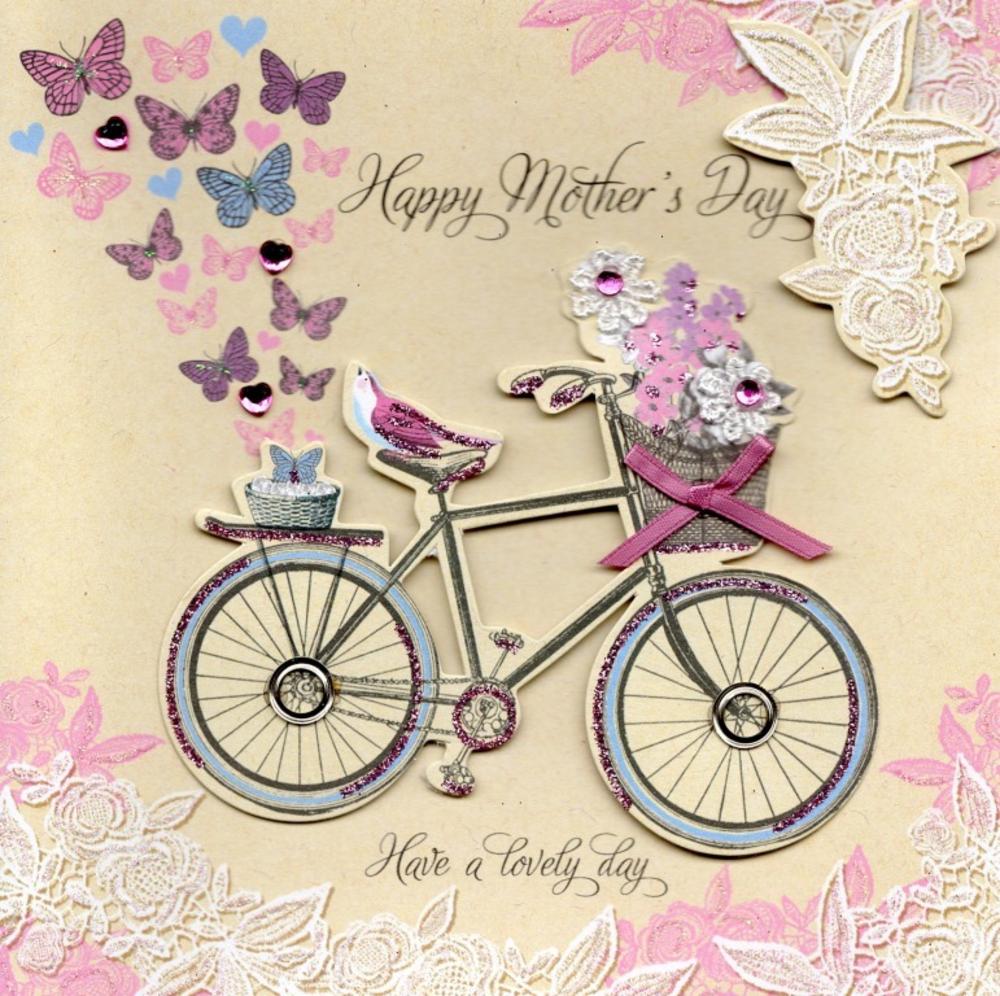
I found this card just a moment ago.  I like it, not only because it has a bicycle, butterflies and my favorite colors on it.  It might be a tad sentimental, but it's pretty and rather tasteful.  Had I found it sooner, I would have sent .  Sending an image of a card via e-mail just isn't the same; my mother doesn't do e-mail, anyway.  (In fact, she's never used a computer.)  But, maybe next year.

In any event, I wish all of you who are or have been mothers--whether biologically or in spirit--a Happy Mother's Day.  And to you too, Mom, just in case you happen to see this!

13 May 2017

A New Weave?

Carbon fiber bikes first appeared about four decades ago.  For two decades, they were mainly curiosities or status symbols; they were ridden (if they were ridden) mainly for record attempts or by those who simply had to have the latest equipment.


When Trek and other companies started to make carbon fiber bikes priced within range of the best steel and aluminum bikes, parts and accessories with the "carbon weave" pattern became as fashionable as snakeskin or leopard often are among the haute couture crowd. I remember seeing handlebar tape, saddles and even tires with the "carbon basket", as some of us called it.


Well, it turns out that carbon fiber isn't the only material that's woven when used in bicycle frames.  Interestingly, this material has many of the same qualities that doomed the early carbon fiber frames but make them attractive (not just in visual ways) to many cyclists today:  It is strong but still flexible, which allows it to be shaped in a variety of ways.  But it is also brittle, and--like early carbon fiber materials--needs to be supported by other materials.


The material in question is bamboo.  Industrial designer Lance Rake (You've gotta love that name!) realized that to make bamboo stiff enough, he had to cut it into thin strips, weave it and  laminate it to another material.  This is more or less how early carbon fiber frames were made:  They fibers were wrapped around, and bonded to another material, usually aluminum. 


Now, you're never going to believe what Rake is laminating his bamboo fiber to.  Wait for it:  carbon fiber.  In another interesting parallel with early carbon fiber-frames, Rake's bamboo-laminate tubes are joined into carbon fiber lugs.  Most of the early carbon-fiber frames were bonded into aluminum lugs.  


The bike Rake is holding in his hands is fitted with mid-level components and weighs about 19 pounds--more or less what a similarly-equipped carbon fiber bike would weigh.

Will the new "must have" bike accessories have a bamboo-weave pattern?  Depending on the accessory, it might actually look good.  

12 May 2017

No Idaho Stop In California--For Now, Anyway

Which is worse:

  • a stupid, misguided, useless or pointless law that is passed by a legislative body
or

  • a well-informed and well-conceived law that a legislative body votes against?

Yesterday's post concerned a mandate that may fit into the former category.  Today, unfortunately, I'm going to write about the latter.

As I've mentioned in an earlier post, way back in 1982, Idaho passed a law allowing cyclists to roll through an intersection at a red light if there is no cross-traffic.  Since then, no other US state has enacted similar legislation , though in 2011 a few Colorado municipalities adopted policies that allow cyclists to, in effect, treat "Stop" signs as "Yield" signs.  And the city of Paris, France has a statute allowing cyclists to do the same as long as they're making right turns, or going straight, through "T" junctions.

From the Portland Mercury


The so-called Idaho stop makes perfect sense because it allows cyclists to get out ahead of traffic and therefore be better seen by motorists, particularly those who are making right turns.  Even the policies of Paris and those Colorado communities are better than most others.

Recently, a bill that, if passed, would have given California cylists the same right that their peers in Idaho have enjoyed for more than three decades came up for a vote in the Golden State's Assembly.  After some intense lobbying (by, I think it's fair to assume, people who don't ride bikes), the bill was tabled.  Assembly member Jay Obernolte said the bill was being held up until the next legislative session so that "concerns" can be "worked out."

The one legitimate "concern" he mentioned came from groups representing the visually impaired, who say that people with vision problems could have difficulty hearing cyclists "whizzing by", as Sacrament Bee reporter Alexei Koseff put it.

That, in spite of researchers in the US and UK, working independently of each other and several years apart, coming to the conclusion that cyclists as well as motorists are safer when the "Idaho stop" is allowed.  Part of their research, of course, included a survey of Idaho's experience with its law.

11 May 2017

Is This California Law A Lemon In Orange County?

Back in October,  a North Carolina law went into effect that, among other things, requires drivers in the Tar Heel State to give cyclists at least four feet of space while passing them.  At the time, both cyclists and motorists praised that provision of the law (House Bill 959), as well as another that allows drivers to cross the center line to pass a cyclist as long as there's "an assured clear distance" ahead and no oncoming traffic.

I have not seen any reports as to the effect the law is, or isn't, having on cyclists' safety.  To be fair, it may be too early to gauge because a change over the course of a few months in either direction could be just a statistical "blip".


Perhaps one could also say it's too early to tell whether a similar law the California Legislature passed in 2014 is having its desired effect.  That law, however, mandates only three feet when a motorist passes a cyclist.  Before the North Carolina's policy went into effect last fall, drivers were only required to give two feet.


I would like to hear what the folks in North Carolina say about their law next year.  If nothing else, it will be interesting whether they recount different experiences from what David Whiting, an Orange County Register columnist, reported after reviewing the coroner's records in his county.


A group of cyclists ride south along Pacific Coast Highway in Newport Beach on Tuesday morning, May 9, 2017. Orange County continues to kill an average of one cyclist a month despite a new California law that requires vehicles to stay 3 feet from bicycles when passing. Newport Beach has the most deaths. (Photo by Mark Rightmire,Orange County Register/SCNG)
Cyclists in the bike lane of the Pacific Coast Highway in Newport Beach, CA on 9 May.  From the Orange County Register.


Whiting, who says he has cycled roads in his area "for decades", writes that the past decade has averaged one cyclist killed by a motorist every month in Orange County.  That rate has been pretty consistent; so far this year, three cyclists have met their fates at the hands of motorists on Orange County roads.

For the purposes of his report, Whiting counted only those cyclists who were killed in encounters with motorized vehicles and not the ones (smaller in number) who were killed on trails, from falls or when they crashed into parked cars or other vehicles or objects--or the one who was run over by a train.  That makes sense:  Such deaths could not have been prevented by a two-, three- or four-foot, or any other distance, rule.


However, it also makes sense (or seems to) that such rules, whatever the correct or optimal distance may be, might prevent a few motorists from running down cyclists.  It is also fair to ask whether such rules actually work.


If Whiting's conclusion that the law is having little or no effect in Orange County is valid--which, I believe, may be the case--then I think it's necessary to ask why.  


Cyclist and advocate Bill Sellin, who has worked with the Orange County Transportation Authority, says the law has been good for "raising bicycling awareness" but otherwise "ineffective".  One problem, as he sees it, is that the penalties for passing cyclists close enough to scrape off their jerseys are lighter than those for littering.  Another problem, he says, is drunk and otherwise impaired driving.  But even more important, he says, is "addiction to cellphones".  Too many people, he explains, "are no longer paying attention to driving, but paying attention to a device".  


Sellin makes a lot of sense.  Perhaps a three- or four-foot rule, by itself, will not make cyclists safer.  However, if other laws are passed and, more important, enforced in tandem with it, we could see safer roads for both cyclists and motorists.  


Here in New York, we have a law against talking on cellphones while driving that is simply not enforced.  Some, especially among law enforcement in this city, argue that it's unenforceable or that there are "other priorities".  That, I don't understand:  A distracted driver is just as much of a danger, not only to cyclists, but to public safety in general, whether on city streets or rural highways.  


So is one who is intoxicated or under the influence, or with abilities impaired (which, by the way, are not the same thing). While local law enforcement officials and newspapers like to trumpet how many arrests they make, or summonses they give, for such violations, offenders too often get off with light penalties or, if they lose their licenses after repeat offenses, get back their driving privileges in relatively short order.


Whiting, for his part, makes points that make a lot of sense. One of them is that rules requiring motorists to maintain a certain distance won't, by themselves, make cyclists or motorists safer.  Only, as he points out,  more courteous behavior between cyclists and, as Sellin maintains, enforcement of rules against impaired and distracted driving, will make a three-, four- or x number-feet rule meaningful.

10 May 2017

Drones And Crits Don't Mix

When riding in the city, a cyclist has to be aware of--in addition to motor vehicles and their drivers--pedestrians.  All it takes is one darting across the street at mid-block, or someone ambling through an intersection while looking at an iPhone screen, to send a cyclist tumbling to the pavement.  

In fact, I have incurred two falls--one on Broadway in SoHo, the other in Coney Island--caused by pedestrians who barrelled across a street without looking in the direction of the approaching traffic (which included me).  In the SoHo incident, said pedestrian--who was shopping with a friend--at least stopped and apologized. In the other mishap, the boy who plowed into me--who appeared to be about 14 or 15 years old--simply kept on going.  


I wasn't hurt in either incident, but things could have been worse.  Even scarier, though, were two instances in which I didn't actually crash, but could easily have taken a hit and a tumble.  Both happened when I was riding down mountains and an animal crossed my path:  a deer in Pennsylvania; an Alpine Ibex just after I crossed the border from France into Switzerland.  


During my brief career as an amateur racer, I went down once and had a near-miss.  Both were the result of other riders who jackknifed in front of me.  In the crash, I wrecked an expensive front wheel but, fortunately, not the bike--or me.  In the near-miss, another rider incurred similar damage when he and a couple of other riders hit the pavement a bit further back in the pack from where I'd been riding.


Now it seems there's a new hazard that can take a racer out of the game, or leave a rider with  road rash or worse:


It almost sounds like one of those excuses I'd hear from a student who didn't show up for class the day a term paper was due.  (That's happening to me this week!)  "I got hit by a drone".  At least, that's now more plausible than "My drone ate it!"


Seriously, though:  We have to watch for low-flying or falling drones.  Imagine if one caused a pileup in, say, the Tour, Giro or Vuelta!

09 May 2017

How To Corrupt The Young: Let Their Teachers Ride Bikes To School

According to today's Google Doodle (Can you beat it as a source?), today is Teachers' Day.


As it happens, I teach in a college.  So, people often conflate me with teachers, especially when they complain about the inadequate skills and manners of young people today.   And they assume that I am on the same schedule as their local schools, or ask me questions about tests, programs and other things of which I am completely unfamilar.


 I am not ashamed to be associated with pedagogues in high schools, middle schools and elementary schools, and I feel the best of them are criminally underpaid.  Also, I feel they are unfairly blamed for much of what is "wrong" with "society".  There are bad ones, to be sure.  But the majority I've known are smart, hardworking people who are doing the best they can with limited resources, clueless or hostile administrators, mandates that have nothing to do with educating young people and with students who, perhaps, didn't get enough food, sleep or good parenting.


How educators influence young people can be debated, but their influence cannot be denied.  Thus, school boards have codes of conduct or behavior for their teachers.  Of course, what is considered "proper" or "moral" has changed over the past century.

For example, during the first Bike Boom of the 1890s. some feared that the sight of women on bicycles would corrupt young people.  There are folks (men, mainly) who still believe such things:  one of my colleagues, who hails from Ethiopia, has never ridden a bicycle because girls and females were kept away from them.  The reason, she said, is that the sight of a woman pumping her legs is seen as "provocative."


But, back in 1895, people didn't have to come from conservative religious societies in order to harbor such notions.  Although most of Long Island was still rural, it was hardly comparable to, say, Saudi Arabia.  Even so, in June of that year, the Long Island School Board issued a stern directive to its female teachers:  Stop Riding Bicycles.  As Board member William Sutter explained to the New York Sun:

   We as the trustees are responsible to the public for the conduct of the schools [and] the morals of the pupils.  I consider that for our boys and girls to see their women teachers ride up to the school door every day and dismount from a bicycle is conducive to the creation of immoral thoughts."

Hmm...Some of my students have seen me ride to school.  I wonder what "immoral thoughts" are fermenting in their heads.  Maybe I'm corrupting young people in ways I never realized!

08 May 2017

France Wins--Or, At Least, Survives

La France Survit!  La France Survit!

That's more or less what my French friends and I have been exclaiming to each other.  Yes, France survives!  Emanuel Macron won the presidential election over Donald Trump-in-a-dress-who-speaks-French.

It's really appropriate that his victory came the day before V-E (Victory In Europe) Day.  More than one commentator has said that Macron's ascent is not just a victory for France, but for all of Europe.

I am inclined to agree, though I admit I'm far from being an expert on such things.  I am just happy that enough people didn't fall for the nonsense about making their country "great" again or "bringing back" jobs that were lost to automation rather than outsourcing.

For now, I am willing to take victory wherever I can find it--and celebrate.  Vincenzo Nibali has the right idea:


07 May 2017

Yes, You Should Wear A Helmet. Really!

As you probably know (at least, if you read this blog), I wear a helmet when I ride.  Well, most of the time:  Once in a great while, I forget my helmet when I leave my apartment. And, I'll admit, while riding in Paris, Montreal and Prague, the denizens of those fair cities got to see the full, blazing glory of my hair in the wind when I pedaled up and down their boulevards and alleys.  For that matter, I let the sun and wind play with my mane while riding during visits with my parents in Florida.

So, although I encourage people to wear helmets, I don't excoriate people for not wearing them.  If nothing else, I try not to be a hypocrite!

Also, I think about all of the years I rode without a helmet. During my childhood, bike helmets were unheard-of.  When I first became a dedicated cyclist, as a teenager, the only helmets were those "leather hairnets" you sometimes see in old photos.  I figured they would be about as useful in accidents as nail clippers are for cutting diamonds.    

Yes, I survived, bareheaded, through all of those years and all of those miles.  So did lots of other people.  That is the argument some still make against helmet wearing.  Another is that helmets "can't protect you against everything".  To anyone who says that, I say, "You've got a point."  To which Groucho Marx might add, "You should put a hat over it."  Or a helmet?

Anyway, helmets certainly offer protection.  To wit:


06 May 2017

They Didn't Catch A Bike Thief. But They Helped A Victim.

When bicycles were stolen from me, I imagined the ways in which I'd punish the thief.  Some of them came out of Dante's Inferno; others came from my own fertile (if I say so myself) imagination. 

Since I never got to face the human-shaped creatures who took my bikes, I don't know whether or not I would have meted out "frontier justice".  The one time I ever saw someone in the act of trying to steal a bike, I approached him from behind and tapped him on the shoulder.  In those days, I was younger, leaner, more muscular and angrier.  Of course, seeing that lowlife got me even more riled up.

Being a cyclist, I understand how it feels to lose a bike.  And, because I made my living on a bike for a year, I know that losing one's wheels could be disastrous.  So, you might say that I take it personally when someone steals someone's bike.

Although the sorts of crimes people commit really haven't changed much throughout history, there are still some that shock us.  Sometimes it has to do with the brutality or intensity of the act, or the brazenness or depravity of the criminal.  Other times, the vulnerability of the victim causes us to react in ways that we don't when we hear about other crimes.

Brennan Miller was one such victim.  The 12-year-old resident of Toledo, Ohio had his bike taken from him at knifepoint.  Now, when I hear of such things, I expect the perp to be one of his peers, or someone not much older.  Part of the reason for that is my own experience:  Years ago, I was mugged by two young men close to my age.  And, in most of the stories I heard about kids getting "jumped", the antagonists were young people not much different from the ones they attacked.

But Miller's attacker was an adult who fled.  Now, I think Dante should have had a particular spot deep in Hell for adults who victimize children in any way.  And, yes, that goes for whoever took Brennan's bike.


James Izbinski, manager of Reggie's Bike Shop in West Toledo, Ohio, presents Brendan Miller with a new bike.


I guess what keeps me from becoming completely cynical is that for all of the thugs, punks and pure-and-simple crooks in this world, there are many others who are benevolent or simply practice acts of kindness.  James Izbinski is one such person.  He manages a business where seemingly like-minded folks work:  Reggie's Bike Shop, in West Toledo.

They gave him a new BMX bike that, according to Izbinski, is "the BMW of bicycles".  As sad as he was to lose his old bike, Miller agreed that his new bike is a fine machine, even nicer than the one he lost.  He says he had no idea that he was getting the bike and, in thanking shop employees, he said he feels they're "part of my family now."

Along with the bike, Miller received a new, programmable bike lock and some advice from Izbinski:  "Try to be aware of what's going on around you so it won't happen again!"

05 May 2017

Bikes Will Eat Cars

Bikes will eat cars.

No, I am not using, uh, herbal remedies for non-medicinal purposes.  I haven't done that or used any other illicit substances in so long that I'm covered by the statute of limitations. (That is one thing to look forward to as you get older!)  In fact, the four words that opened this post aren't even mine.

They were uttered by Horace Dediu.  Who is he?, you ask.

I confess:  I didn't know who he is until I came across an article in, of all places, CNN Money.  There, he is described as a "prominent analyst of disruptive technologies."  That title alone makes him sound like he has an IQ that's even higher than my weight (in pounds, which is saying something!)

The way he sees it, bikes have all sorts of advantages over cars.  We are already familiar with some of them:  They're a lot easier to park and store, they cost less both to buy and maintain, and in many large cities, it's possible to get from point A to point B in less time one a bike than in a car, bus or, sometimes, even by rail.  

He also sees other advantages, which have only become apparent with the growth of bike-share programs.  One is, of course, the fact that bike share programs are relatively easy for cities to implement.  But another has to do with the sensors found in the bikes of some share programs.  At the moment, they're used to track the location of bikes so that they can be retrieved, especially in the newer programs that don't use ports or docks.  They also, of course, make it more difficult to steal the bikes.

Horace Dediu:  "Bikes will eat cars."

But the way Dediu sees it, that technology could develop into cameras that are placed in the bikes.  They, and other kinds of sensors, could record potholes and other real-time information that could be transmitted to city authorities.  They could even provide data on traffic and other street activity that could make Google Street View seem as antiquated as maps inked on parchment.

If you were to tell your non-cycling acquaintances what I've recounted, they'd object that bikes won't displace, much less "eat", cars for the same reasons they don't ride:  They're afraid of traffic, road conditions are bad and, oh, what do you do when it rains or snows?

Dediu has thought about those objections.  To address them, he describes the way infrastructure evolved around the automobile.  When the first motorized cars were created, there were far fewer paved roads, even in the most developed areas, and even the best roads were pretty rough.  Also, early cars were open-air.  It only took a generation or so for the landscape to be transformed by the infrastructure created for automobiles--which, by that time, were enclosed.

He sees a similar "evolution" for bicycles.  He thinks shells or other enclosures will become widespread, and that cities and other jurisdictions will develop bike lanes and other thoroughfares specifically for cyclists.

Finally, I must point out that when he says "bicycle", he isn't talking only about the kinds we pedal. He believes that electric bikes will also be part of the change he envisions.  Evidence for that, he explains, can be seen not only in the "explosive" growth in sales of e-bikes, but also in the fact that a few cities are introducing e-bikes to their share programs.  Some people who would be hesitant about trading their cars for pedaled bicycles could be enticed to ride e-bikes.  Also, the advantage in speed the bicycle offers in cities like New York could spread to areas further from urban centers.

One other obstacle--which, according to Dediu, must and will be overcome--to bikes displacing cars is the lack of availability of share bikes.  New York and San Francisco have the largest bike share programs in the US, at 12,000 and 7,000 bikes, respectively.  On the other hand, Beijing has 650,000 share bikes, all of which have hit that city's streets within the past nine months.

Horace Dediu says "Bikes will eat cars."  Whatever wastes they emit after their repast can't be nearly as toxic as what vehicles with internal combustion engines belch into the air we breathe!


04 May 2017

They Can Ride, They Can Shine

One day an elderly woman wheeled her husband into the shop.  Neither of them had been on a bicycle in decades, she explained, but she wanted to buy bicycles for him and herself. 

Turns out, he'd had a stroke and, at that moment, couldn't speak.  In fact, his facial movements were constricted.  But I could sense, in his eyes, that he was at least curious about the bicycles.  If I could notice that, I thought, she certainly must have known that he was interested in riding.  Then I wondered whether he had expressed interest before his stroke, or whether that interest was somehow communicated in one of those ways couples sometimes develop.

Whatever the case, she knew what she was doing when she brought him to the shop.  I saw them ride just about every day that spring and summer and fall, sometimes on my way to the shop, sometimes on my way home or out for a ride of my own.  I saw, almost immediately, in his facial expressions (limited as they were) and body language, that she wasn't "dragging" him; he was riding voluntarily, behind her.  Within a few weeks, he was leading her, and looked as if he'd initiated their rides--even though he still couldn't speak (though his grunts and groans became more intelligible).  And she was encouraging him.

They also came to the shop regularly.  First it was to adjust the things that normally need adjustment (cables and such) as a bike "breaks in", but as they rode more, we tweaked the handlebar and saddle positions, and changed things like the grips.  He was attracted to the bright, shiny things--reflectors, bells and other accessories with a bright finish. One day, though, he pointed to the Huret Multito cyclometer (Cyclo-computers were still new.) on another customer's bike and pointed to it.  He had his curious expression again.  Not quite sure of how to explain it to him, I explained it to his wife.  

"He understood you," she said.  "He can understand much more now that we've been riding," she explained.  "Sometimes it almost sounds as if he's making words, not just sounds."

That fall--just before I stopped working in the shop--he had, in fact, regained his power of speech and was reading the newspaper.    Later, I heard he'd progressed to books and was writing cute notes to his wife.

Today I thought about that couple for the first time in years when I learned about a cycling camp for disabled children.  It's going to be held in Oklahoma City during the last five days of June.


That camp is one of a series--called "iCan Bike"--that's been been held in various locales throughout the USA since 2007.  iCan Bike camps are run by the nonprofit organization iCan Shine, which began under the name "Lose Your Training Wheels" in 2007.  One of the stated goals of the program is for children with physical, intellectual and emotional disabilities to ride a bicycle independently, which iCan Bike defines as 75 feet with no assistance.   According to iCan, 80 percent of kids who participate in the program reach this goal, even though they attend training sessions for only 75 minutes on each day of the program. The remaining 20 percent of kids leave the program with parents, siblings or other people who are trained as "spotters" and can continue the work of the camp.

When I recall how cycling helped the recovery of the old man whose wife wheeled him into the shop where I worked, I am sure that it must be great for kids who don't have the kinds of skills that man had before his stroke!