21 August 2018

What's In Your Support Van?

In a post I wrote last week, a rabbi and native American guide gave Abigail Pogrebin the same advice a Zen master probably would give to cyclists:  Look ahead.  Of course, they are as likely to be giving that advice about living as about riding.

In response, Leo--a frequent and favorite commenter--pointed out that the surest way to hit a piece of glass on the road is to be nervous about it and stare at it.

They are all correct:  Whatever journey you take--on a bicycle or by some other means--you should keep your sight focused in front of you.  The only way to reach your destination is to look ahead to it, not under you at the road (or path) you're traveling.

One group of cyclists has had their sights set on San Diego, which they hope to reach during the first week of September, since setting out from Seattle three weeks ago. They have not been deterred by the usual obstacles--weather, terrain and, in a few cases, lack of previous experience with long rides.  But they can be forgiven for looking over their shoulders every now and again--especially as they near San Diego.

You see, they came to the US as children--with parents who entered this country illegally.  At least one member of the group has Deferred Action for Childhood Arrivals (DACA) status and is a graduate student.  Most of the others, however, do not and could be subject to being stopped--especially on the roads approaching San Diego, which are full of immigration checkpoints.


The purpose of their ride, known as the Journey to Justice, is, not surprisingly, to call attention to people with plights like theirs and to persuade Congress to pass--and the President to sign--the so-called DREAM (Development, Relief and Education for Alien Minors) Act, which has been introduced and reintroduced in Congress since 2001.  Some of the riders had previously participated in a weeks-long vigil in front of the White House.  If nothing else, the riders said, pedaling 1300 miles is better exercise than hunkering down on the sidewalk.

The Journey to Justice is notable for one other reason. Other rides like it have support vans, which are stocked with energy bars, fruit, water and first aid items.  On the other hand, JtJ's vehicle has bears something else its riders may need:  a lawyer. 

20 August 2018

Will She Ride Home?

Today I read a news story that made me think of someone about whom I wrote two years ago.

Then I opened my page for this blog and found that someone had left a new comment on that post.

The subject of that post was Mary Jane "Miji" Reoch, arguably the first of a generation of American female cyclists that would dominate their field during the 1970s and 1980s--and put the US on the world's racing map for the first time since the era of the six-day races.

So what brought her to mind?  Well, it was something a political figure in New Zealand did four decades after "Miji."

Well, they've both won races. Except that the ones Julie Anne Genter weren't in the peloton, or on the track or singletrack.  Rather, the races she won were decided in voting booths and ballot boxes.

Now, when I say "won", I don't mean it in the way one wins a head-to-head election in the US.  Instead, as I understand, in New Zealand's system, members of parliament are elected from lists of candidates and the ones with the most votes gain parliamentary seats.  Some of them, anyway:  Some seats are awarded proportionally by parties (New Zealanders get two votes, one for a candidate and one for a party.) and a few seats are reserved for Maori residents.

So, you can say that she won the right to become a member of Parliament, a post she holds along with those of Minister for Women as well as Associate Minister for Health and Associate Minister for Transport. All of that, one imagines, wouldn't leave her much time to train. But, still, she cycles---which brings me to what she has in common with Miji.

Well, they both continued to ride during their pregnancies.  In Miji's time, doctors were still counseling pregnant women to forego all physical activity, so continuing her training regimen was still fairly radical in the 1970s.  Today, of course, doctors are more likely to encourage pregnant women to exercise as much as they can, even if they have to modify whatever regiments they followed before.

Which brings me to something that was considered really "far-out" (to use a '70's expression) in Miji's time, and is still seen as fairly unusual today: Both women rode their bikes to the hospital where they would deliver their newborns. Yesterday, Julie Anne, who is 42 weeks pregnant, arrived at the Auckland hospital where she will be induced.  Once her child arrives, she will become the second New Zealand government official to give birth this year, following Prime Minister Jacinda Ardern in June.


Oh, I can offer one other cycling-related connection between Miji and Julie Anne:  They were both modest about cycling to their deliveries.  The New Zealander demurred that her route was "mostly downhill."  Donald Huschle, who left the comment on my post about Miji, recalled that, whenever anyone mentioned her ride to the delivery room, she would point out, "Well, I didn't ride home."

Now, if Julie Anne Genter--who was born and raised in the USA--can ride home, she'll've done something neither Miji nor Jacinda did.  As if she hasn't already done enough things that most people don't do!

18 August 2018

Biking While Black

I read Huey Newton's Revolutionary Suicide many years ago.  As I recall, it recounts, among other things, his and his peers' often-tense interactions with the police of his native Oakland.  Many of the incidents would today be called Driving (or Walking, Barbecuing, Reading or Fill-in-the-Activity of Your Choice) While Black.

Frustration over such incidents inspired him and his friends to start the Black Panther Party.   Whether or not you agree with his way of dealing with the poverty, racism and violence that defined life on the mean streets where he grew up, it's hard to argue against his observations and analysis.  After all, so much of what he described could have happened yesterday.

As a matter of fact, it did--or, two weeks ago, anyway.  On 3 August, Najari "Naj" Smith was leading a group of 40 young cyclists through the streets of Oakland on a regularly-scheduled First Friday ride.  You guessed it:  He and most of those cyclists are black.  

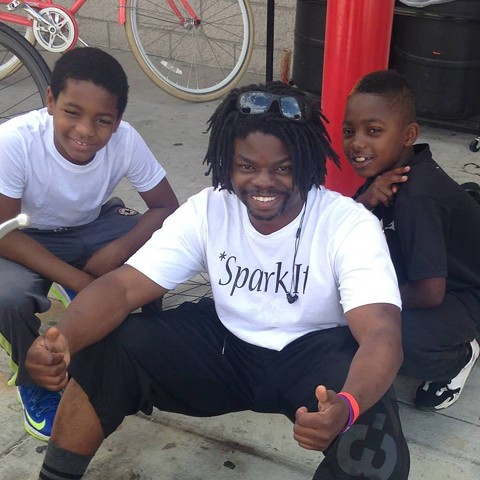
They all belong to organizations that consist mainly of African-American members.  One of those organizations, Rich City Rides, was founded and is led by "Naj" himself in the nearby city of Richmond.  RCR teaches young people bicycle mechanics and gives them opportunities to work for their own bicycles.  It also offers guidance on healthy lifestyles and positive social interactions through group rides, public path maintenance and civic advocacy on transportation issues.  

It should be noted here that Richmond today, in many ways, parallels the Oakland of Huey Newton:  It is darker (in skin tone) and poorer than surrounding Bay Area communities.  It also, until recently, had one of the highest violent crime rates in the nation, and many residents feel they are always "under suspicion" by the police.  Oakland, on the other hand, is quickly gentrifying as even well-paid professionals find themselves priced out of San Francisco and other communities on the west side of the Bay.  This has exacerbated tensions between the remaining African-Americans and the Oakland Police Department (which disproportionately stops and arrests African-Americans) not to mention the white gentrifiers who too often call the police when black people simply live their lives in public.

Najari “Naj” Smith was leading a group of about 40 young riders when he was arrested by Oakland police.
Najari "Naj" Smith

Such was the case two weeks ago, when someone apparently complained about Naj and the other riders when they formed a "bonding and healing circle".  A police officer broke into it without warning and grabbed Naj's handlebars.  

The officer explained that Naj was being detained for "excessive noise" coming from a stereo on a trailer behind his bike.  Smith says he immediately complied with the officer's request and turned off the stereo.  The officer told him to "stay put" and momentarily walked away.  Smith thought the officer was going to write him a citation.  Instead, the cop handcuffed him, confiscated his bicycle and stereo equipment and whisked him off to the Santa Rita Jail, where he spent the weekend.   Smith made his $5000 bail and has  a court date for the 31st of this month.


"I cooperated with the officer as much as possible," Smith said. Members of the group were upset and he was "trying to put the best example forward" so the incident "wouldn't turn into a mess."


It seems, though, that no amount of compliance is any match for police officers who make up the rules as they go along.  According to Oakland PD spokesperson Felicia Aisthorpe, Smith was detained for "interfering with traffic and playing music too loudly."  Moreover, she said, he did not have proper identification. (Italics mine.)

The officer who stopped me in Harrison two years ago was looking to make the same charge against me.  As it happened, I had my New York State non-drivers' ID with me.  He tried to claim that he could arrest me for not having "official" ID; I countered that the document was issued by the New York State Department of Motor Vehicles and is therefore official.  He wasn't too pleased with that; so he wrote a citation with the largest fine he could get away with.  

Since then, I've checked with a number of reputable sources, all of whom confirmed what I'd already known:  that there is no law in New York State (Harrison is in Westchester County) or anywhere in the US that requires people to carry ID or to show it to police officers. But I carry mine with me anyway for situations like the one I've described.

Whether or not "Naj" Smith had his ID on him or needed it probably isn't the real issue, as far as Ms. Aisthorpe and the arresting officer are concerned.  He is from Richmond and he was in Oakland, cycling while black.  

17 August 2018

Why We Need Her: Aretha Franklin

Spoiler Alert:  Today's post is on a non-cycling topic.

The other day, the Andrew Cuomo said something that will probably haunt him for the rest of his days:  "America was never that great."


Now, I just happen to think that Cuomo wasn't expressing a lack of patriotism.  Rather, I think the utterance shows, more than anything, that he doesn't quite share his father's intelligence or eloquence.


I'm guessing that he was trying to refute Trump's oft-echoed mantra:  Make America Great Again.  If anything, I would say that America was never great (rather than "not that great") because no nation in the history of this world has ever been great.  Some nations have been powerful, have been mighty.  Others have been prosperous; still others, influential.  A few nations have combined more than one of those qualities.


But no nation* has ever been great, including my own.


To me, the proof is this:  Aretha Franklin.  No one ever would have sounded the way she did had her nation, or any other, had been great.  In fact, nobody ever could have sounded like that, like her.


If any nation in history had ever been great, there never would have been any need for someone to sound like her.  And that's why, to me, almost all of her work is art of the highest order.


Yes, I said art.  I see no contradiction between it and popular music or other entertainments.  Shakespeare was popular in his own time; so were any number of painters and sculptors who received commissions from wealthy patrons and whose works we gaze at, with awe, in museums and galleries today.


Of course, we've all heard Natural Woman and RespectIn those songs, she combines vulnerability and strength, anger and empathy, joy and grief, need and the yearning for freedom, the need to sing and the urge to fly, better than just about anyone who's ever sung.  In other words, she captures the complexity--and the fearsome complications--of our existence.


For my money, though, her best expression of the gifts only she could bring us was on I Never Loved A ManOn the surface, it seems like just a song that expresses--if you'll pardon my appropriating the title of an '80s self-help book--the dilemma of a woman who loves too much, or at least seems to love the wrong man.  But, to me, it's really about being beaten down and beaten up by, not only another person, but by life itself--and realizing that the only choice is to move forward. The world is excruciating, people are mean, and her man is cruel--but she cannot do anything but love:  love him, love the world.  I think it's what W.H. Auden meant when he wrote, "We must love one another or die."


That song alone would place her in my pantheon of great American artists.  To me, it's worthy of Leaves of Grass, Their Eyes Were Watching God, Kind of Blue,Christina's WorldThe Great Gatsby Citizen Kane, Blue and Green Music, the first Godfather film and Rhapsody in Blue.


Now Aretha Franklin is gone.  Well, she--her body--has left us.  But not the body of her work.  As long as there are no great nations, we'll need it.  And if there ever is a great nation, we'll have the luxury of simply savoring it.


*--By "nation", I mean geo-political entities, which are not to be confused with the cultures or peoples contained within them, which often are great.

16 August 2018

What Did It Cost?

Whenever anyone asks what my bikes cost, I find a way not to answer.  Muttering "none of your business" is a sure signal that it's expensive; so is replying with "Why do you ask?"

Then again, I am a New Yorker who lived in the Big Apple during the '80's and early '90's, when crime of all kinds was rampant.  I remember pre-hipster Williamsburg and when the Lower East Side really was "lower" in more ways than one.  Each of those neighborhoods bookends the Williamsburg Bridge which, even before the bike lane was reconstructed, was the best way to cross the East River by bicycle.

Apparently, some criminals knew as much.  Or, at least, they knew that in-the-know cyclists preferred (and still prefer) "Billyburg" to the Brooklyn, Manhattan or Queesnboro (59th Street) Bridges.  And, they knew that in-the-know cyclists were riding the most valuable bikes.  

You can guess what happened:  A few cyclists I knew, and quite a few more I didn't know, were attacked for their bikes on either side of the bridge.  In fact, an employee of one shop I frequented had his machine stolen just days after he bought it--and that after working more than a year to save up for it. 

Somehow I don't think those riders told anyone--certainly, not random strangers-- what their bikes cost. But then again, they didn't have to:  Such information is easy enough to find.

This leads me to wonder whether the advice given by police in Roodespoort, South Africa will be helpful to the bike shop owners who received it--or, more important, customers of said establishments.

The gendarmes told the pedal purveyors--you guessed it--not to disclose the prices of their most expensive bikes with the media.   They shared their sage wisdom after a cyclist was robbed and shot for his bike in the Kromdraai area of the city.  

Medics carrying the injured cyclist.


That cyclist is alive only because of the efforts of a Good Samaritan who heard his cries for help and stopped.  "They had shot him twice in the leg and in the back," said Jon-Jon Pietersen who had only a rubber glove, a towel and box tape.  

Fortunately for the cyclist, more people stopped by and helped until the ambulance arrived, 20 minutes later.


15 August 2018

Is A Picture Worth A Thousand Words When It Gives Us Two?

As The World's Only Transgender Bike Blogger (at least, the only one I know about!), you can understand why this got my attention:


From bikechaser


Well, all right, the colors are hard to miss.   But the design is not exactly to my taste (at least, not anything I'd wear).  What piqued my interest were the words:  "Femme" (woman) on the jersey, "Homme" (man) on the shorts.

Hmm....

14 August 2018

At Least He Survived--We Hope

Some stories bring me no joy.  But sometimes I feel the need to tell them, if only because they hit close to home.

At least this one hasn't ended in tragedy...so far.


A few days ago, I wrote about Madison Jane Lyden, the Australian tourist run down by an inebriated garbage truck driver as she cycled up Central Park West.  Well, I've gotten word of another cyclist struck by a motorist on a route I ride frequently.


Just before  8 pm yesterday, an 11-year-old boy (whose name hasn't been released) was riding his bike in Far Rockaway, in an area I pass through when I ride to Point Lookout or other points on Long Island's South Shore.  Occasionally, "Far Rock" is even my destination, especially when I'm trying to get a ride in during an abbreviated winter day.  


Anyway, a black sedan slammed into him--and kept going.  The impact sent him airborne for several car lengths. He landed in the hospital with internal injuries, but he is expected to survive.

At least, according to the NYPD, the driver of that car--41-year-old Aghostinho Sinclair--has been arrested.  Needless to say he's in a heap of trouble: The charges against him include reckless endangerment, leaving the scene of an accident--and driving without a license. (The latter charge is called "aggravated unlicensed operation".)  I wonder whether "endangering the welfare of a child" or some similar charge can be added to the list. 


13 August 2018

Judaism And The Art Of Bicycle Riding

If you're of a certain age, as we say, there's a good chance you've read Zen and the Art of Motorcycle Maintenance.  Some English classes--including a few at the college I attended--actually assigned it.  I escaped that fate:  I didn't have to take the English classes that assigned it because, when I entered my college, the person (or folks) in charge of placement decided that I was a better writer than I actually was, based on an essay I wrote as part of my entrance exam.  

I did, however, read Zen on my own.  I didn't expect to learn how to fix motorcycles or about Zen.  If I recall correctly, the book's author, Robert Pirsig, included a disclaimer advising readers not to have such expectations.  Even if he'd intended to instruct his readers on how to wrench their rice rockets (That was a term for Japanese motorcycles, which were much lighter than Harleys.) or meditate, I'm not sure of what I might've learned because, really, I had little idea about motorcycles except that my uncle rode one or about Buddhism save for guys in orange robes.

I'm not sure of what, if anything, I learned from the book.  That's not to say it wasn't worth reading:  At that point in my life, I was a sucker for stories about folks who left jobs, families and other bourgeois expectations behind, even if only for a time, to traverse the country or world, mainly because--you guessed it--I wanted to do something like that.  

Pirsig's prose had little, if any, stylistic grace.  He probably wouldn't have wanted to have any--which, I believe, was part of the appeal of his book.  You don't quote him the way you would, say, Thoreau, let alone Virginia Woolf or Shakespeare. (About my friend Bill:  I remember reading that some researcher found that the average English speaker quotes him at least 20 times a day, mostly without realizing  he or she has done so!)  But I remember this:  "The real motorcycle you're working on is yourself."  Or something like that.

So, what aphorisms can one glean from an experience of Judiasm and the Art of Bicycle Riding?  It's hard not to think that Abigail Pogrebin, the author of an article by that name, didn't read, or at least hear of, Pirsig's volume.  And she indeed reveals a thing or two she learned about herself from riding a mountain bike through Arizona brush--with a Native American guide named George. And, oh, her rabbi.

The irony is, as she says, that George imparted so much Jewish wisdom.  In particular, he offered this nugget that could have come straight from Moses (who, in my mind, always looks and sounds like Charlton Heston):

Always look way ahead of you.  Never look down.  As soon as you look down, you will hesitate, overthink, negotiate, get stuck.  Always be moving into the future. Bike into the future.

The last two sentences, she admits, can sound pretty corny, but, as Ms. Pogebrin points out, "How many times does our tradition ask us to 'go forth'? How many times in our history have we had to keep going despite what's thrown in our way?"  There is no other choice, really:  By definition, we can only move toward the future.  Living in what I call the Eternal Present--and I've known lots of people who've done, and who do, exactly that--is a pretty good definition of a living death.


But, of course, George wasn't trying to be rabbinical.  As Pogrebin learned, his admonitions were entirely literal:  "Once we were out on the trails, as soon as we looked down, we were screwed--the bike suddenly spun out of control, stalled in a mud crevice or jammed its tires between rocks."  When her rabbi and two other cyclists who accompanied them--a couple of guys from San Francisco--navigated a stretch on which she stumbled, George bellowed "GO BACK AND DO IT AGAIN, ABBY!"  But then he imparted what was probably the most important lesson of all, at least for her:

You're too clenched, too focused on getting it right.  You're not trusting the bike or the path.  Keep your eyes ahead and trust that you'll get where you need to go.  Breathe all the way there.

"Breathe all the way there."  Funny, how Zen that sounds to me. But it probably could have come from her rabbi--or anyone who understands that it's all a journey, and the bike is the vehicle.  That, as I recall, is also one of the messages of Zen and the Art of Motorcycle Maintenance.

(If Abigail Pogrebin's name looks familiar to you, it means one of two things:  You watched Ed Bradlees 60 Minutes segments, for which she was a writer and producer. Or, you read Ms. magazine, of which her mother, Letty was a founder and editor.  I'm guilty on both counts.)

12 August 2018

Keeping It Light

Today I am going to pose a question that never, ever would have occurred to me had I not seen the photo in this post.

And you probably never would have asked had I not mentioned it.

Here goes:  Do emperors take vacations?

From Freaking News


I haven't been to Elba, but I hear the beaches are really nice there.  So are the ones on Corisca!


11 August 2018

Her Last Ride

While riding here in New York City, I avoid curbside bicycle lanes.  I especially avoid them if they are alongside parks where motor vehicles aren't allowed. A terrible incident that occurred yesterday reminded me of why.

Madison Jane Lyden, 23 years old, was visiting from Australia.  She rode a rented bicycle in the lane on Central Park West just south of West 66th Street.  A livery cab pulled into it, in front of her.  She swerved to avoid it.  

A private sanitation truck rumbled up behind her.

Madison Jane Lyden isn't going home.  

When I lived in Manhattan, I cycled up Central Park West often.  That was in pre-bike lane days.  I always knew that the intersection with 66th Street was hazardous.  It's the where the southernmost traverse across Central Park enters regular New York City traffic.  Often, drivers are lulled after driving across that traverse, where they don't have to contend with the vagaries of Manhattan street traffic and are thus not ready for a change in traffic signals, pedestrians crossing--or cyclists.


Traffic is further congested when there is a performance at Lincoln Center, three blocks to the west, or in any of the other nearby performance and exhibition venues such as the West Side Y.

I am guessing that Ms. Lyden would not have been familiar with those traffic patterns.  Even if she were, I don't think she would have been prepared for a livery cab pulling into the bike lane--or for a private sanitation truck barreling behind her.

Let alone a garbage truck operated by an intoxicated driver.  

Madison Jane Lyden so enjoyed riding downtown that she decided to do some exploring.  She pedaled uptown.  It shouldn't have been her last ride.

10 August 2018

(Almost) Empty Box Dog Bikes

There was a time when a robbery or burglary seemed to be a rite of passage for an urban bike shop in the US.  

I can say, without being hyperbolic, that every New York shop in which I worked or bought anything from the late '70's to the early '90's was victimized by crooks.  Sometimes the perp walked in and demanded whatever cash was on hand, and whoever happened to be at the counter would hand it over.  Other times, a thief would flee with a bike or two or whatever parts or accessories he or she could carry.  

In one of the shops in which I worked, the robbers actually tied up the owner and employees in the basement and made off with expensive bikes and parts. (Fortunately for me, I wasn't working that day!)  Other shops experienced similar crimes. More than one such incident ended tragically:  In particular, I recall that a robbery in Frenchie's Cycle World, a favorite of Brooklyn cyclists, ended in a gunfight that left a robber and a police officer dead.

(The robber killed in Frenchie's was a 30-year-old man.  He persuaded his two teenage nephews and teenage friend to help him.  They were captured thanks to a ruse by one of the shop's employees.)

And then there were burglaries like the ones  that finally drove Tom Avenia out of New York City. From what I heard--whether from Tom himself or others, I forget--his windows, doors and gates were all broken or ripped out so that someone could have unpaid access to his Frejus, Legnano and other Italian bikes, as well as Campagnolo equipment.  Then, one night--again, this is an account I've heard--some thief or thieves actually cut a hole in the roof of his store and helped themselves to much of his merchandise.

I was reminded of Tom, Frenchie's and the other thefts I've mentioned when I heard about what happened in San Francisco the other night.

Box Dog Bikes is a worker-owned shop in the city's Mission district.  In the wee hours of yesterday morning, Geoffrey Colburn, one of the owners, got a call from the police department after they were called by a neighbor.  


What he and the cops found were a hole--just big enough to squeeze bikes through--in the metal gate, and a shattered tempered-glass window behind it.  Inside: empty bike racks.


In all, 21 bikes--most of the shop's inventory--were taken.  They were all listed on the shop's Instagram account.  Included is a plea to call 911 for anyone who sees the bikes, along with an admonition not to fight anyone who has the bikes.  "Most of these bikes don't have pedals, so it's gonna be hard to ride them."

If that doesn't stop the thieves, I hope something else will.

09 August 2018

A Buddy Bike For Disabled Kids

Back in the day, I served as a "captain" on tandem rides for The Lighthouse.  That meant I would  pedal and steer on the front of a tandem, while a blind or visually impaired person would be the "stoker" on the back seat.

And, yes, I followed all of the rules of being a gentleman cyclist--including that one.

I've heard that similar rides have been offered for deaf or audially-impaired folks.  That makes sense for the same reasons that tandem rides for the blind are a good idea:  It allows them to share in the joy we feel when we ride.  Also, it shows that people who partially or completely lack vision or hearing can do just about anything the rest of us can do. 

(One of the best and most creative florists I ever encountered was legally blind.  He could see colors, forms and arrangements, but had no peripheral visions.  Thus, while people and organizations called on him for weddings, banquets and other occasions, he couldn't drive!)

From The East Side Riders Bike Club website


Now the East Side Riders Bike Club (ESRBC) of Los Angeles is trying to provide a similar service for another group of people who have been, too often, deprived of the opportunity to ride and do much else we take for granted.  They work to help the Watts neighborhood (site of the 1965 riots) with bike programs and other charitable work to help keep kids out of gangs and other criminal activities.  

As it happens, communities like Watts have disproportionate numbers of developmentally-disabled children.  (When I worked as a writer-in-residence in New York City schools, I was struck by how many of the "special education" or "special needs" kids with whom I sometimes worked were residents of the projects or other poverty pockets.)  So, the good folks of the ESRBC saw another opportunity to help:  Getting kids with disabilities on bikes.

To that end, they appealed to Buddy Bikes, a Florida-based company that offers "adaptive" bikes.  Buddy Bikes is raising money so that ESRBC can get one of their machines--which cost $1500-$2000--at a reduced price.

The "Buddy Bike" that ESRBC would receive is like a tandem in reverse:  The "captain" pedals from the rear seat, while the disabled kid spins his or her feet from the front  What that means, of course, is that the Buddy Bike has a more complex steering system than what is normally found on traditional tandems.

The sad irony of this, though, is that Buddy Bikes is making their offer just as they are closing shop.  Their website says they will stay in business long enough to sell off their remaining inventory, and that they will keep their website up for another three years after.

We can only hope that the ESRBC continues their work!


08 August 2018

So Glad To Be Back That I Want To Go Back

It's been two weeks since my trip to Cambodia and Laos.  Everyone to whom I've mentioned it is convinced that I will go back.  So am I.  Any experience that brings me tears of both joy and sadness is worth repeating.  Of course, I wouldn't try to replicate the trip I just took:  That wouldn't be possIible.  But I could return, I believe, to what made the trip so memorable.

First among them is the people.  I already missed them during my flights home.  When I visit my friends in France, I miss them when I leave.  But I can't miss the familiar in the same way I miss the people I just met because, I guess, re-connecting with those you know can't change your perspective in quite the same way as people who allowed you into their lives,even if only for a moment, the first time you met them.  Plus, the only people I've ever met in the US who can match the vitality--who, purely and simply, have the heart and soul, for lack of better terms--are either African-American, immigrants or very old.  People in southeast Asia--especially Cambodia--have survived going to hell and back.  


I thought about that, again, the other day as I was riding back from Connecticut.  The temperature reached 34-36 Celsius (92-96F), and the humidity ranged from 80 to 90 percent.  Just before I crossed the Randalls Island Connector, I rode through the South Bronx.  Three of its ZIP codes--including 10451, where I work-- are the poorest in the United States.  Many residents indeed live in conditions most Americans--certainly those of my race and educational background--will never even have to imagine.  I know: some of those people are my students.  But even they have, if not luxuries, then amenities, that are completely out of reach for most Cambodian peasants and even city dwellers like Champa, the young woman who works at the guest house or  Sopheak, the tuk-tuk driver who took me around when I wasn't cycling.  As an example, the young woman told me she can't even stay in touch with me by e-mail because she doesn't have a device of her own, and she can't send personal messages on the guest house's internet system. 

Of course, you might say they were warm and friendly to me because I'm a tourist and they wanted me to spend money. But I experienced all sorts of helpfulness and friendliness--and a cheerfulness that's not of the American "it gets better" or "when one door closes, another opens," variety.  Perhaps the best expression of it came from a young woman at a gas station, where I stopped to ask for directions. "We are here," she said.  "We are alive.  We have today."

Then, of course, there are the things I saw.  While the Angkor Wat was the main reason I took the trip, and I spent about three full days in it, I could just as easily go back for Bayon or Banteay Srei--which, I admit, is my favorite temple--or to walk along the river junction or side streets of Luang Prabang.  And, naturally, eat the food--though I won't order a fruit shake, delicious as it was, again:  I think the ice used in it came from tap water, which unsettled my stomach on my penultimate night in Cambodia.


I must say, though, that I am glad to be riding my own Mercians again.  And, as hot and humid as it during my Connecticut ride, or on the Point Lookout ride I took yesterday, I wasn't nearly as tired because, in spite of the heat, the sun is much less intense.  And the road conditions are better, even in places like the South Bronx and Far Rockaway.

Hmm...Maybe, next time I go to Southeast Asia, I have to bring one of my own bikes--though, I must say, riding local bikes made me feel a bit more "native", if only for a few hours!

07 August 2018

The Bike I Should Have Given Her?

Today is my mother's birthday.

One year, I gave her a new bicycle.  She'd been pedaling an hour or so every day on an exercise bike.  At the time, she was relatively young (and I wasn't relatively young: I was pure-and-simple young) and I figured she could transition from indoor to outdoor cycling.

It didn't work that way and the bike was sold or given away (I forget which) when my parents moved to Florida.  She apologized for that, adding that "it was a nice bike."

It was actually a halfway decent machine:  a Peugeot mixte in a burgundy color with sunset orange graphics.  My mother even thought it was "pretty" and that giving it was "a nice thought" on my part.  Oh well.

Now, you might say I should have given her an even better bike.  I probably would have, if I knew she'd have ridden it.  

Actually, maybe I should have given her a more unique bike.  At least, when I went to visit her and saw the bike hanging in the garage, it might have been more interesting to see something like this:


The Velocino is handmade in Italy. (Remember when Colnagos, De Rosas, and all of those racing bikes were?) According to the Abici family, who make them, the "unique artisanal bike includes a "braze welded frame with three coats of paint" as well as Michelin tires and a Brooks B17 saddle. (Maybe I could ride it after all!)  It costs $980, plus $300 to ship it to the US.  The bike "ships in 1-2 weeks".  Hmm...Maybe she won't mind a belated gift.  It does look good, after all!

06 August 2018

Oregon Handmade Show Cancelled: Will Portland Remain "Bicycle City?"

In January, I wrote about an Ohio town that was best known for the bicycle company that, from 1925 to 1953, manufactured its wares right in its center.  The Shelby Bicycle Historical Society was recently formed to commemorate the role bicycle-manufacturing played in Shelby, about 150 kilometers southwest of Cleveland.

Other communities have been defined by bicycle manufacturing.  Although Raleigh is associated with Nottingham, the center of the British bicycle industry was Birmingham, where a company bearing its name--Birmingham Small Arms, or BSA--made the most sought-after componentry in the peloton, as well as some fine racing bikes.  

Likewise, for most of the 20th Century, the nexus of France's bicycle industry was St. Etienne, a gritty industrial city about 50 kilometers from Lyon.  Many editions of the Tour de France have included a stage that began, ended or passed through the city, and a French rider winning such a stage is a point of pride for the nation.

For much of the time Birmingham and St. Etienne dominated their respective country's bicycle industries, a certain bike-maker was a major employer on the South Side of Chicago.  I am referring to Schwinn which, as Sheldon Brown pointed out, was the only American brand with even a pretense of quality during the "Dark Ages" of cycling in the US.

Chicago, Birmingham, Saint Etienne and Shelby all had their heydays as centers of bicycle (and, in the cases of Birmingham and Saint Etienne, component) making.  But, like empires, those enterprises fell.  Cheaper imports, mainly from Asia, are often blamed (less so for Shelby than the others).  But the biggest reasons for their demise are their failures to keep up with changes in demand as well as innovations.  Schwinn, like other companies, sponsored racing teams, but limited their efforts almost entirely to the US, until it was too late.  So, the Paramount line, begun in 1938, was, by the 1960s, a dinosaur (its fine craftsmanship notwithstanding) compared to racing bikes from Europe.

More recently, the US city most commonly associated with bike-making has been Portland, Oregon.  One difference, however, is that in the Rosebud City's bike-building scene has more closely paralleled its "craft" beer milieu than it has reflected trends and practices in mass-production bicycles.  During Portland's frame-building heyday, from about 2005 to 2010, it was claimed that over a hundred builders practiced their craft in a city of about 600,000 residents.  

It was during that time that the Oregon Handmade Bicycle Show began as an annual event in 2007.  Builders enthusiastically set up booths to show their creations to ever-appreciative audiences.  How much those exhibits translate into orders is, however, a topic of debate:  Many people go to "ooh" and "aah" at frames they will never be able to afford, or simply don't feel a need to order, their fine artistry not withstanding.  


Framebuilder Joseph Ahearne at the 2017 Oregon Handmade Bicycle Show


The phenomena I've described are being blamed for the cancellation of this year's show.  Some builders said it simply wasn't worth the time and money it took to, not only create and set up an exhibit, but to actually get to the show.  Portland and Oregon are more spread out than, say, San Francisco or any number of East Coast cities one can name. That means it's harder to entice people to attend when an event is scheduled to be  held in an out-of-the-way place, as this year's show was.

But other factors were chipping away at enthusiasm for the show.  One is that more people are buying bikes and equipment online.  Another, though, is the builders themselves:  Some have had to scale down their operations, move or simply leave the business altogether.  While the bicycle industry is trending larger--think bigger conglomerates selling more and more merchandise at lower prices--builders who make their frames by hand work in the opposite direction:  They sell less, and for higher prices.

What that means is that in spite of the high price tags for such frames, most builders don't get rich.  In fact, many barely make a living at all.  All it takes is a major rent increase in their workspace to put them out of business:  Building bikes requires a lot of space, and if builders are forced out of their loft or wherever they're working, they have can have a very difficult time finding a comparable amount of space for a rent they can afford.  

Especially if the city is gentrifying, as Portland is.  The things that made it so appealing--its roots as a blue-collar town, its scenery and its edgy arts and social scene--are attracting trust fund kids and other people with money.  It's more or less what happened to places like Williamsburg, Brooklyn, which is now just as expensive as Manhattan but now manages to be as much a theme park as Las Vegas but with all of the character of Davenport, Iowa.

Now, I've never been to Portland, so I can't say whether it's becoming as dispiriting as Williamsburg is to me now.  (A few years ago, I felt differently.)  But from what I'm reading, the city sorts of folks depicted in "Portlandia" are changing their careers or lifestyles, or moving out.  So are the kinds of unique and unusual businesses--including custom frame building--associated with the city?

Could it be that Portland is ceding its place as the bicycle capital of the United States?  If it is, perhaps the change was inevitable: Small, labor-intensive enterprises with niche audiences generally don't last when the real estate becomes expensive.  How many bike shops, craft beer breweries, fabric weavers or tatoo artists are on 57th Street in Manhattan?


05 August 2018

Helmet? Pads? Who Needs 'Em?

Next time you ride, make sure your front wheel is fastened good and tight:


Of course, that lesson might be lost on him.  After all, when we're kids, if we walk away from something--or, at least, we get up--we think, "It wasn't that bad!"

04 August 2018

How Many Ways Can He Say, "Everybody Else Did it?"

It was like being ready for a knife fight, but everybody had guns.

I have to admit, it's a pretty good turn of phrase.  Still, the intent of the person who uttered it is suspect, at least in my mind.

Lance Armstrong (You just knew it was him, didn't you?) was talking about embarking on his career as a professional racing cyclist.  Now, if he'd been talking about how his competition was much better than he'd imagined--something many an athlete, or person in any number of areas of endeavor, experiences upon becoming a professional--I'd've enjoyed the description.

Instead, it was a rationale for why he took drugs and did all of the other unsavory things he did en route to seven Tour de France victories.  He says, in essence, that he didn't start out with the intention of doping but soon discovered that just about everyone else in the peloton was "juicing".

Stephen Dubner, who interviewed him for the National Public Radio program "Freakonomics" asked him whether he could have won those Tours without the wonders of modern pharmacology.  "Well, it depends on the other 199 (Tour de France riders) were doing."  When Dubner pressed him further, he confessed, "Zero percent chance."

Now, Dubner admitted to his sympathies, which came through in the interview:  He was willing to give Lance the benefit of the doubt until he finally confessed.  Even then, Dubner wasn't ready to villify Lance completely:  For one thing, even the most ardent cycling fans have acknowledged, for decades, that riders were taking one thing or another to shave of seconds on a mountain climb.  Also, Dubner seems willing to cut Lance a break or two for his efforts to "move ahead."

Hear the interview here.


That's more or less how I feel.  I, too, bought into the cancer-survivor-hero narrative, and one of the high points of a 2001 tour I took through the Alps (and in which I pedaled up l'Alpe d'Huez and other Tour climbs) was leaning over the police line and snapping a photo of Lance climbing during the time trial on Chamrousse. (One day, perhaps, I will digitize and post it.) Whatever he might have ingested with his breakfast that day, his ride was awe-inspiring.

I must say, though, that something still bothers me about Lance.  At no time during the interview--or in the more than five years since he "confessed" to Oprah--did he express any sort of contrition for the careers and lives he ruined, not only through his doping, but from his threats and intimidation--which were not limited only to his rivals and teammates, but extended to their spouses and other family members.

03 August 2018

King James' Promise To Kids In His Hometown

Just after he died, I wrote about the role Muhammad Ali's bicycle played in his life. More precisely, losing his bike launched him on his path to becoming "The Greatest".  When he went to the police station to report his bicycle stolen, he exclaimed that he would "whup" the thief.  The sergeant who took his report, who just happened to be a boxing trainer on the side, suggested that the young Ali--then known as Cassius Clay--should learn how to fight before taking on bicycle thieves.

Fortunately for LeBron James, he didn't have to lose his bicycle to become "The Greatest", as he has been proclaimed, in his sport.  In fact, his bicycle got him to safe places after school in a tough Akron, Ohio neighborhood.  Among those safe places were community centers--and, yes, basketball courts.  The exercise he got along the way certainly helped keep him in condition to play basketball.

Although he continues to cycle, by choice, in those days he rode because his poor family didn't have a car.  He recognizes that some kids today are in situations similar to the one in which he grew up.


That is why he teamed up with the school board in his hometown to start the I Promise School for at-risk kids, whether their struggles are at home, in school or elsewhere.  The school offers a variety of services to meet the students' needs.  It also gives each kid a bike and helmet, as well as instruction in bike safety.  In addition, I Promise School has made arrangements with two local bike shops for repairs and maintenance.

Maybe one of those kids will grow up to be "The Greatest"--whether in a sport, or in some other  endeavor.