24 April 2019

Will The Idaho Stop Come To Oregon?

Until recently, I was a disciple of John Forester's "bicycle as vehicle" philosophy.  It's explicated in his "Effective Cycling" book, which--along with the C.O.N.I. manual (which has, possibly, the most beautiful cover illustration of any cycling book)--were my touchstones for cycling.

I haven't looked at the C.O.N.I. manual in a long time.  I'm sure it's still valuable, though some of its specifics might be dated. (To my knowledge, no new edition of the book, at least in English, was published after 1972.)  But I still check out Forester's book on occasion.  Some of its information is dated. That is inevitable, of course:  The book came out about 40 years ago, and, for example, much of the equipment he mentions is no longer made.  But I think his notions about how to cycle in traffic are just as dated.

But they were needed at the time.  As I've related in other posts, many was my commute or training ride in which I would not encounter another cyclist.  Most motorists--which is almost the same thing as saying most adults, as defined by law--didn't ride and regarded the bicycle as a kid's toy.  And if they saw an adult riding, they thought it must be for a bad reason, such as loss of driver's license or inability to afford a car.  The "car is king" attitude was, I believe, even more prevalent than it was now.  Forester was, I think, trying to establish the bicycle as a viable and valid means of transportation for grown-ups in the US.  Four decades ago, that meant cyclists asserting themselves themselves on the road and behaving exactly like drivers in the ways we took lanes, made turns and such.

Image result for cyclists at stop sign


The conditions at the time also meant that almost no policy-makers were cyclists.  So, whatever laws and policies were created in the name of "safety" were wrongheaded, if not flat-out malicious.  Thus, while folks like Forester advocated for more enlightened rules, they knew that they would be a long time a'coming, if they ever came at all.  Cyclists asserting their rights as operators of vehicles therefore seemed like the best way to "establish" cycling, if you will, in the US.

Now, I'm not sure that drivers' attitudes toward cyclists have changed much.  If anything, I think some have grown more hostile becuase they feel bike lanes are taking away "their" traffic lanes, and because they have the misinformed notion that we use roadways and other infrastructure without paying for it. In fact, a driver parking in Brooklyn (at the formoer site of the library I frequented in my childhood, no less!) made that accusation as he shouted other fallacies and epithets at me.  I waited for him; he probably expected me to punch him in the nose.  But I calmly informed him that the only tax he pays that I don't pay is on gasoline.  I don't know whether he was more surprised by what I said or my demeanor.

Anyway, while drivers might be hostile for different reasons than they were four decades ago, there are some changes in the wind.  There are, at least in a few places, a few policymakers who cycle to their offices, and perhaps elsewhere.  And at least a few of the drivers I encounter have ridden a bike, say, within the last month.  So there is a small, but growing recognition, that while bicycles aren't the lawless hooligans some believe us to be, we also can't behave exactly like motor vehicles and live to tell about it.

That bikes aren't the same as cars is a point made by Jonathan Maus, the editor/publisher of Bike PortlandIn an excelllent article he published the other day, he uses that point to advocate for something that has become one of my pet causes, if you will, as a cyclist:  the Idaho Stop.

As I've mentioned in other posts, the Idaho Stop is when you treat a red signal as a "stop" sign and a "stop" sign as a "yield" sign.  In essence, it means that you don't have to come to a complete stop at an intersection unless traffic is crossing. That improves our safety immensely because if we can cross before the light turns green, we get out in front of whatever traffic might approach from behind us, as well as oncoming traffic--which keeps us from being hit by a turning vehicle.

Maus wrote his article because a similar law is up for vote in the Oregon state senate.  Governor Asa Hutchinson recently signed a similar law in Arkansas, and Utah is considering something like it.  A few municipalities in the US as well as the city of Paris have enacted similar policies during the past decade.  But it's called "The Idaho Stop" because the Gem State has had it on the books since 1982, and for about a quarter-century, it was the only such law in the United States.

Let's hope that Jonathan Maus's words move the legislators of Oregon.  Let's also hope that as Oregon goes, so go New York, Connecticut, New Jersey, Pennsylvania, Florida and...well, you get the idea.

23 April 2019

Tunnel Vision

We’ve had a lot of rain during the past few days.  It is April, after all!

I’ve gotten in a bit of cycling, though not as much as I had been doing.  Now I’ll confess that I actually took the subway yesterday.  My excuses:  The  curtain of rain precluded visibility, and I was carrying something that, perhaps, I could’ve hauled on my bike.


Heading home, I entered the York Street station in DUMBO. (I remember when the neighborhood was, well, not a neighborhood:  All of those self-consciously trendy cafes were warehouses and factories!). There, I remembered why I so prefer cycling!


22 April 2019

Not Offensive. Really!

In the times and places in which I've lived, saying that something is "completely inoffensive" is not a compliment.  I mean, what would you think if you'd heard it in CBGB back in the day, or during a ride with the sorts of guys who used to add gin to their water bottles?

Anyway, I have used that phrase only rarely (which itself sounds rather unflattering) in my current life.  Most recently, I uttered it when someone asked me what I thought of Taylor Swift.

I am no fan of hers, but I still don't get that so many people hate her, or say they do.  I mean, really, do you hate a marshmallow?  I may not get excited about them, or eat them very often.  But what is there to hate about something that's overly gooey and sweet?

Anyway, I may have to say something slightly more complimentary about her. (If I actually start listening to her music, check my vital signs!)  What I never knew, until the other day, is that her preferred mode of transportation is cycling.

And she posted this on Instagram:


It's not offensive at all.  Which is not the same as "completely inoffensive."


20 April 2019

Tour de Flashback?

Do you ever feel as if you're having a flashback?

I did, when I saw an announcement for a ride.  "The Inaugural Tour de" was followed by "Trump."  Or so I thought, for a moment.


There was indeed a "Tour de Trump."  The first of two editions ran thirty years ago next month.  Six more editions ran, from 1991 to 1996, re-branded as the Tour du Pont after financial troubles forced The Orange One to withdraw his support.


(Could it be that the race was doomed by the winner of its last two editions?  His initials are LA.)


Turns out, I wasn't having a flashback--at least, not in the strictest sense of the word. The promo I saw announced the "Tour de Troup," named for the county in Georgia where it will be held.


The county, whose seat is LaGrange, is named for George Troup, Georgia's 32nd Governor.  He is considered a sort of patron saint for today's nationalists and state's rights advocates:  He was a firm believer in Manifest Destiny and supported "Indian Removal" (a.k.a., the slaughter of people who were living here for thousands of years) as well as slavery.

Perhaps it's not a surprise that he was a plantation owner who was born to plantation owners.


Hmm...Maybe I wasn't having a flashback after all!


19 April 2019

A Baltimore Bike Lane That "Caused Problems"

A researcher cuts off a gazelle's leg.  The gazelle can't run.  The researcher then summarizes his findings: "Gazelles can't run."

I don't remember where I read or heard that story. Whether or not it's true, it's a pretty good metaphor for the way policy-makers make decisions about bicycle infrastructure.

To such policy-makers, bicycle infrastructure can be defined in two words:  bike lanes.  And, to them, a bike line is anything so marked in paint on the side of a road.

As often as not, one of the following happens:


  • A cyclist is hit by a motor vehicle that pulls in or out of the bike lane.  The policy-makers conclude, correctly, that the bike lane isn't safe, but makes the faulty inference that all bike lanes are unsafe.
  • Altercations between motorists and cyclists ensue.  This leads policy-makers to conclude that bike lanes are inherently a bad idea.
  • Cyclists don't use the lane because it's inherently unsafe or poorly maintained.
Any of these scenarios can, and often does, lead to the decision to get rid of the bike lane--and, sometimes, for policy-makers to decide that bike lanes are generally a lousy idea.

One problem is, of course, that a couple of lines of paint does not a bike lane make.  

Another, more important, problem is that bicycle infrastructure is more than just bike lanes.  


That is evident at the Roland Avenue bike lane in Baltimore, which is about to be removed for "causing problems."  Of course, the real problems aren't being addressed, one being that the lane is delineated by nothing more than paint stripes.  

Another is that there are bus stops in the bike lane. Too often, bus drivers simply don't see cyclists and veer into them.  Also, like too many other curbside bike lanes, the one on Roland Avenue ends at the corner and resumes across the intersection.  What that means is that cyclists crossing the intersection enter it from a "blind" spot, especially if they are following the traffic signals and regulations.  I recall at least a couple of occasions when I could have easily been struck by a right-turning driver while entering an intersection from a bike lane.

City officials say that the bike lanes caused "problems," which they mis-identify.  Sadly, other municipalities act in much the same way.  So, the Roland Avenue bike lane in Baltimore is not the first, nor will it be the last, such lane to be borne of misguided notions about bicycle safety and infrastructure, and to be scrapped because it "causes problems" or cyclists don't use it.

18 April 2019

What You Can Carry Isn't Necessarily What You Can Stash

Many of us ride with cute little "bike purses" tucked under, or between, the rails of our saddles.  In them, we might carry a spare inner tube, patches, a small multi-tool and, depending on the size of the "purse", a mini-pump and/or cell phone and/or wallet. 

There are larger versions of such "purses", including "banana" bags of the kind popularized by Gilles Berthoud and others, and small versions of boxier saddle bags, like the X-Small Saddle Sack from Rivendell.


And, of course there are larger saddle bags like those from Carradice made in sizes to carry what you need for a day or weekend trip, or even camping gear. Carradice's Camper Longflap almost seems to have been an exercise in carrying as much as possible without using panniers and an expedition-style rack.


Of course, when some people ponder the question of "how much" they can carry under their saddles, they are not talking about volume in liters or cubic inches or whatever.  Instead, they are talking about "street value."


At least, that seemed to be the case for  37-year-old  Mohamed Mohmoud Charara, who lived with his parents in  Windsor, Ontario, Canada.  He kept his bike in a common stairwell area where other residents of his building kept their bikes.  It seems, though, that he wasn't using his wheels to get around the city just across the river from Detroit.  He wasn't even using it to conduct business. Instead, he serviced his clients from a black Escalade SUV parked outside the building. The bike was just for storage.

And what did he keep under the seat?  Well, when he was busted, city constables found 24.7 grams of crack cocaine and 13.2 grams of powder cocaine. Together, they had a street value of almost $3800.


The cops also seized a few things Charara couldn't keep under his bike seat, like a digital scale, other drug paraphenalia, an iPhone (well, with the right bag, he could have kept it on his bike) and $1695 cash.

What if he'd tried to use that bike as a getaway vehicle?  Would he have ended up like this guy?


17 April 2019

What Gears Are Turning In His Mind?

Some time in your childhood, you probably had, at least once, the sort of teacher who punished everyone in your class for something one kid did.  

That, I believe, is the sort of teacher Donald Trump would have been had he pursued the life of an educator.

At least, that is what I believe after seeing one of his latest threats. If he acts on it, some $11.5 billion in goods from the EU could be subject to retaliatory tariffs.  Among those items are hubs and sprockets.


So why does El Cheeto Grande want to slap punitive taxes on wheel goods and gears?  Well, he rationalizes this threat with a World Trade Organization ruling from last May, which found that Airbus had received illegal subsidies from European countries and gave the US the right to impose retaliatory tariffs.

What he didn't mention, however, is a more recent WTO ruling, specifically from last month:  Boeing, which just happens to be Airbus's main rival, received similarly illegal tax breaks in the US.  Thus, said the WTO, the EU can impose sanctions on imports from the US.

Now, I thought really hard about why freewheels, cassettes and hubs for bicycles--or motorcycle hubs or sprockets--are targeted for tariffs that are supposed to punish Europeans for supporting their aerospace industry.  All I could come up was this:  Aircraft have wheels, which use hubs.  And their engines use gears, i.e., sprockets.  So, perhaps, anything that could potentially help an A-380 take off, fly or land is fair game for new taxes.

Hmm...I'm not sure that works.  I must say I tried, really tried, to understand the logic of the threat. But then I remembered:  This is Donald Trump we're talking about.  

16 April 2019

Taxes Were The Least of It

Yesterday was Tax Day in the US.  Except for those who are getting big refunds, nobody was happy.

Some of us look for good news on the day.  Alas, not much was to be found.  Two items made the woes of owing (and, yes, I was one of the people who owed--thank you, Donald!) trivial in comparison.


One of those stories is happening here in the US.  "Retrogrouch" confirmed rumors that I'd heard for some time:  Rebecca Twigg, one of the greatest American female cyclists--actually, one of the greatest American cyclists--is homeless.  She doesn't even have a bicycle anymore.


Of course, it's tragic for anyone to live on the streets, with only ragged blankets, large garbage bags and, if he or she is lucky, a refrigerator box, to protect him or her from cold, wind and rain, along with the dirt and other hazards imposed by other humans.  And Rebecca is not the first elite athlete or other celebrity to end up with nothing of her own and nowhere home.  But her story is especially disturbing because, if you were around during the '80's and '90's, you recall her as someone who "had everything going for her".  Her Olympic medals and other victories brought her endorsement contracts; her looks generated modeling gigs and her intelligence (and hard work) got her into college at age 14.


From the moment she got on a bike as a toddler, she says, she knew she was "born to" ride.  And she exercised that birthright, if you will, to its fullest:  She was as fiercely competitive as she is talented.  Most of us envy people who find their "calling", if you will, before they can even call it that:  the painter who knew he would be creating his life on canvas at age 5; the teacher who knew she'd spend her life in the classroom when she was even younger than the kids she's teaching now; the doctor whose vocation was revealed to him not long after he learned how to read.  


I have known that painter and doctor, both of whom are gone now, and the teacher is a friend who just happens to be granddaughter of my friend Mildred.  Having such a clear vision of their lives at such an early age helped all of them:  They knew what they needed to do and focused on it. 


One difference between them and Rebecca, though, is that they found themselves in professions they could practice for their entire working lives (or, in the case of the painter, his entire life).  None of them (except for the teacher, if she decides to change careers) will ever have to experience something Rebecca, and many other professional athletes, had to endure:  a transition from a life of days structured around sport to the daily routines of a "normal" job or career.


In Rebecca's case, that career was in Information Technology.  She studied it (Computer Science) at Colman College after earning a bachelor's degree in Biology at the University of Washington.  There are people who love that kind of work; others, like Stuart--the Australian fellow with whom I rode in Cambodia--hated it.  I don't know whether Rebecca disliked the work per se or whether she simply couldn't abide being in an office and at a desk. In any case, in spite of her talent and hard work, she seemed to have difficulty in holding down jobs.  Or, perhaps, her trouble came because of her talent and hard work:  She may have simply felt that there was no "victory" at the end of it.


The prospect of not "winning" may also be a reason why she finds it so difficult to accept help.  Perhaps doing so would be an admission of defeat for her.  Also, bicycle racers tend to be rather solitary figures, and even in that world, racers like Rebecca are rather like monks:  Her best event, after all, was the 3000 meter individual pursuit race.


Anyway, I hope her story turns into something better.  I hope the same for la Cathedrale de Notre Dame in Paris.  At least the people in charge of it are already getting, and accepting help in rebuilding after the awful fire it incurred yesterday.  


My friend Michele and I exchanged e-mails about the news. Les francaises sont tres choques--The French are very shocked, she wrote.  To which I replied:  Tout le monde est choqueLa cathedrale est un tresor du monde--The whole world is shocked. The cathedral is a treasure of the world.


I mean, what building besides the Eiffel Tower and, perhaps, the Sacre Coeur de Montmartre, is more embematic of the City of Light?  I still recall, during my second day in Paris (more years ago than I'll admit), sitting in the square by the Notre Dame and listening to the bell on a warm June day.  I felt like I'd become, at that moment, part of a city that has become so much a part of me:  New York is the only city I know better.  


At least it seems that more of the cathedral can be saved than officials originally thought.  President Macron has vowed to rebuild it, and wealthy magnates as well as more anonymous citizens are already donating money.  However the work is done, the real restoration will not be on the structures themselves:  Rather, it will be a healing of the minds and spirits that have been so moved by its grandeur, the light coruscating through its stained-glass windows or the views from its towers--or simply by images of those towers, windows and the spire.  


Sir Kenneth Clark, often called the high priest of Art History, once said that he could not define "civilization" in abstract terms.  But, as he turned to the Notre Dame in his famous "Civilization" series, he declared, "I know I'm looking at it."


For me, a non-religious person, that's reason enough to care about the Notre Dame.   Taxes are just a pimple on the face of my life, which is part of the multitude which, I hope, have helped to contribute in whatever small ways to civilization or "the human project" or whatever you want to call it.


15 April 2019

When You Can't Look Out

The past couple of mornings began with mist that turned to fog at the ocean.


I don't know whether this is what the Ramones had in mind when they sang about Rockaway Beach.  I like it, actually:  The shadowy figures on the jetty were as clear to me as a dream, and I felt myself opening like a leaf on a bush that would soon flower.


The weather and traffic reports warned of poor visibility.  But I had no trouble seeing.


Well, I could see clearly enough to know that Point Lookout would not live up to its name:  It wasn't possible to look out very far from there.


But I could still see clearly, the way we can on an invigorating ride. 


14 April 2019

When You Come To A Fork In The Road

Having worked as a bike mechanic, I know the importance of having the right tool for the job.

There are some situations, though, when you just don't have it.  So what do you do?


13 April 2019

A Scooter In Any Other Bill

When is an e-scooter a bike?

For the moment, it isn't.  But if a few US statehouses have their way, the two could be, for all intents and purposes, equal.

Most cycling advocates and bicycle industry insiders don't have a problem with e-scooters per se.  Like e-bikes, they are seen as quiet and less-polluting alternatives to automobiles, especially in urban areas.  In fact, some electric scooter-sharing companies also run bike-sharing systems and are members of the People for Bikes Coalition.

Here's the rub:  Bills on the table in 27 states seek to provide a legal footing for e-scooter rental and use, which is still illegal in many areas.  The problem, according to Morgan Lommele, is that those basically seek to provide legal parity between bicycles, e-bikes and e-scooters.  That leads to situations like the one called for in California's bill:  Scooter- and bike-share systems would be required to maintain general-liability insurance.  

That requirement would be especially onerous for non-profit bike-share systems or small bike-rental companies, which usually require riders to sign a waiver when they hop on a bike. The California bill, Lommele says, "implicates bikes and lumps bike share with scooter share."  In other words, bicyclists would bear the blame for the high cost of sharing or renting a scooter.

Spin e-scooter share system, Jefferson City, Missouri.  Photo by Tony Webster


As bad as California's bill is, one in Florida is even worse:  it would lump "motorized bicycles" into the same category as "micromobility devices" for the purpose of regulating electric scooter-share systems.  Lommele wants "motorized bicycles removed from that definition" to "avoid any negative consequences for bike-share operators in the state.

Of course, it's hard not to imagine that the consequences of Florida's bill, if passed, could be as bad for bike-share programs as the potential outcomes of California's bill--and similar legislative proposals in other states.  One reason why they are even being discussed is something I didn't realize until yesterday:  The scooter-share companies are "massive multi-billion dollar operations, heavily backed by venture capital," according to Lommele.  They are "aggressively seeking market share" from bicycles and e-bikes.

12 April 2019

Crossing That Bridge--If You Can Get To It

Two years ago, the new Kosciuszko Bridge opened between Queens and Brooklyn.  While I didn't dislike the look of the old span, industrial and utilitarian as it is, I think the new one is much more pleasing to look at, especially at night.

One thing that neither span had, though, is access for cyclists or pedestrians.  Even though I subscribe to John Forester's idea of "cycles as vehicles", at least to a point, there was no way I would have ridden across either span, even if it were permitted.  There are simply too many vehicles driven by impatient people across a roadway that, in spots, has rather poor sight lines.  And while I normally feel confident about truck drivers, too many rigs cross the bridge on any given day, which is to be expected when industrial areas line the shores of Newtown Creek, the body of sludge and slicks spanned by the bridge.


The new span is really one of two that was planned.  The other is set to open later this year and include a  20-foot-wide path for cyclists and pedestrians in either direction.  That sounds good, right?

Well, it is, except for one thing:  How do you get to the bridge?  I have ridden the streets that lead to it many times, as they are only about 5 kilometers from my apartment.  I actually like some of those streets, as they wind through a patchwork of old industrial sites, graveyards, disused railroad tracks and the turbid creek. But other streets are simply narrow and warren-like conduits for short-tempered drivers.

That is why I have mixed feelings about the New York City Department of Transportation's plans to build a network of bicycle and pedestrian access lanes on the streets that approach the bridge.  The DOT's reports say that some of the streets are "overly wide".  They are indeed wider than other city streets.  But when you consider that much of the traffic consists of trucks, it's actually a tighter squeeze than people realize.  And there are places, like this stretch of 43rd Street in Queens, where there is "no way out":


I actually have ridden there, with caution.  A "lane" separated from motor traffic by only lines of paint would actually put cyclists in greater danger, as such lanes seem to engender a false sense of safety in cyclists and encourage more aggressive behavior on the part of motorists. And the "sidewalk" on the left side leads from a lane of traffic to an entrance of the Queens-Midtown Expressway. I know:  I took it by mistake!

And I am not impressed with the DOT's plans for other streets in the area.  Given the agency's track record, I don't expect that the "network" they plan will provide safe, meaningful connections from residential areas, schools and workplaces clustered just below Queens Boulevard.  Unless there is a network of paths that is as well-planned as the motor vehicle routes to the bridge, I don't think this new network will encourage anyone to ride for transportation:  People who aren't already regular riders simply won't feel safe, with good reason.


11 April 2019

For The Skyway, Higher Goals Than For The High Line, I Hope

There are many definitions of a "true New Yorker."

Here's one:  We don't go to the Statue of Liberty, and we wouldn't be caught dead in Times Square (at least in its current iteration)--or on the High Line.


I took a walk up on the High Line once, shortly after it opened.  At the time, I was recovering from my surgery and couldn't ride my bicycle.  I liked the idea of taking an old industrial railroad viaduct and turning it into a venue lined with art, plants and unusual buildings, from which one could take in some stunning views of the skyline and even the sky itself.


The next time I went, a few months later, I was on my bicycle.  I knew riding wasn't allowed, but I discovered that you couldn't even bring your bike onto the High Line.  And I wasn't about to lock it up on the street.


So I returned another day, sans bike.  I found myself hating the place, but not only because I couldn't ride my bike.  What I realized is that the High Line is just another tourist trap offering a sanitized view of the city--except, of course, for the part where you get to see inside the apartments that line part of the High Line.  I'm long past being titillated by what people do in their own rooms, on their own time!


Anyway, other cities are starting to think about ways they could use abandoned or disused railroad trestles, elevated highways and other kinds of viaducts.  One of those cities is at the other end of New York State: Buffalo.


Like other industrial towns in the "Rust Belt", the Nickel City has gone through some very hard times.  That has left abandoned and seemingly-obsolete structures.  They won't lure young people with education or money back into town unless they're used in appealing ways.


One such structure is the city's Skyway.  Slated for demolition, it's now the subject of a $100,000 contest for alternative ideas.  One such idea is to turn the old highway into an urban linear park for "use by bicycles and pedestrians, like the High Line."

The local news media report, of course, has misconceptions about the High Line.  Now, if they actually allow bicyclists on the Skyway and make it truly pedestrian-friendly--unlike the High Line, which is clogged with herds of tourists that move at an amoebic pace and stop for sunbathing and "selfies"--they might have something that could help turn Buffalo into a livable, sustainable city.


Fleeing: Speed Without Skill

A rush of adrenaline might make you stronger and faster, or at least feel as if you are.  It does not, however, improve your cycling skills.

Raymond Rodriguez of Roseburg, Oregon discovered that the hard way.  Around 3:50 this past Saturday morning, a police officer tried to stop him.  He took off--and crashed.


It's not the first time I've heard of someone crashing while trying to flee on bicycle.  My guess is that Rodriguez, like most criminals, is not an experienced cyclist--or, at least, he was riding under greater stress than normal. 

Anyway, after crashing, he did what almost all would-be fugitives do in such a situation:  He tried to continue on foot.  And he met the same fate as those others:  He was caught in short order.   And arrested.

While in custody, cops found methamphetamine on him.  He was jailed for that, and interfering with police, but has since been released.  

Maybe now he can work on his high-speed cycling skills.

10 April 2019

This Bicycle Plan May Be Exceptional

One of my graduate school classmates described Cambridge, Massachusetts--his hometown--as "Paradise."  That was some years ago, but from what I hear, it's still a nice, albeit expensive place to live.

It's been a while since I've been there, but I do recall some nice bike riding--and lots of cyclists-- in the town.  The number of riders, I suppose, shouldn't have surprised me, given the number of college campuses in and around the city.

One thing that my former classmate probably liked about his native burg is this:  It's a nice place that tries to improve itself.  At least, that seems to be true when it comes to cyclability.

The Cycling Safety Ordinance requires the city to add permanent separated bike lanes when doing reconstruction of certain roads.
Photo by David L.Ryan of the Boston Globe staff

The 2015 Cambridge Bicycle Plan is more extensive and better thought-out than most other municipal bicycle plans. It calls for, among other things, a 20-mile network of protected bike lanes.  That, in itself, is impressive for a city that's about a quarter of the size of Manhattan, and a population of 113,630. What makes this plan all the more impressive is that it identifies particular streets and roads that need such lanes, and calls for them to be physically separated by more than lines painted on the street.

Now the plan is getting "teeth," according to Sam Feigenbaum, a volunteer with Cambridge Bicycle Safety, a local advocacy group.  The other day, a new Cycling Safety Ordinance was passed, mandating that the city add permanent protected bike lanes when doing reconstruction on any roads identified in the Safety Plan. "The intent of the Ordinance," according to Feigenbaum, is that if "the bike plan says a street needs a protected lane, that street will get a protected lane."  

Mayor Marc McGovern says that prior to passing the law, a lot of time was spent debating whether the roads under construction would have bike infrastructure. While there will be opportunities for community input, he explains, "people can expect that the city is moving in this direction."

While the plan allows the City Manager--Louis dePasquale--to nix a particular lane based on a street's physical features, the use of the road or financial constraints, he would have to provide a written analysis of why the lane couldn't be built.  But, he says, those instances should be "rare in a layman's sense of the word" as well as in the context of the Ordinance, meaning something that is "infrequent, irregular and exceptional."

Actually, those three words can describe most bicycle-related policy in most US jurisdictions--when it exists at all.  But, for its newly-passed Ordinance, Cambridge is indeed exceptional, whether or not it's the "paradise" my old classmate described.


09 April 2019

Change of Scenery

When I cycle to work, I follow the same basic route on most days.  Sometimes I'm detoured.  For example, about three years ago, the RFK Memorial Bridge was closed, so I had to go through the East Side of Manhattan rather than Randall's Island.  At other times, however, I take short side-trips that more or less parallel my normal commute.


This morning was one of those times.  For some reason, when I got to the Bronx side of the Randall's Island Connector, I decided to turn right rather than left on 133rd Street.  Then I took a left onto Walnut Avenue, which cuts through the industrial heart of Port Morris and ends at 141st Street.  Normally, I would take Willow Avenue, which parallels Walnut but ends at 138th Street.  


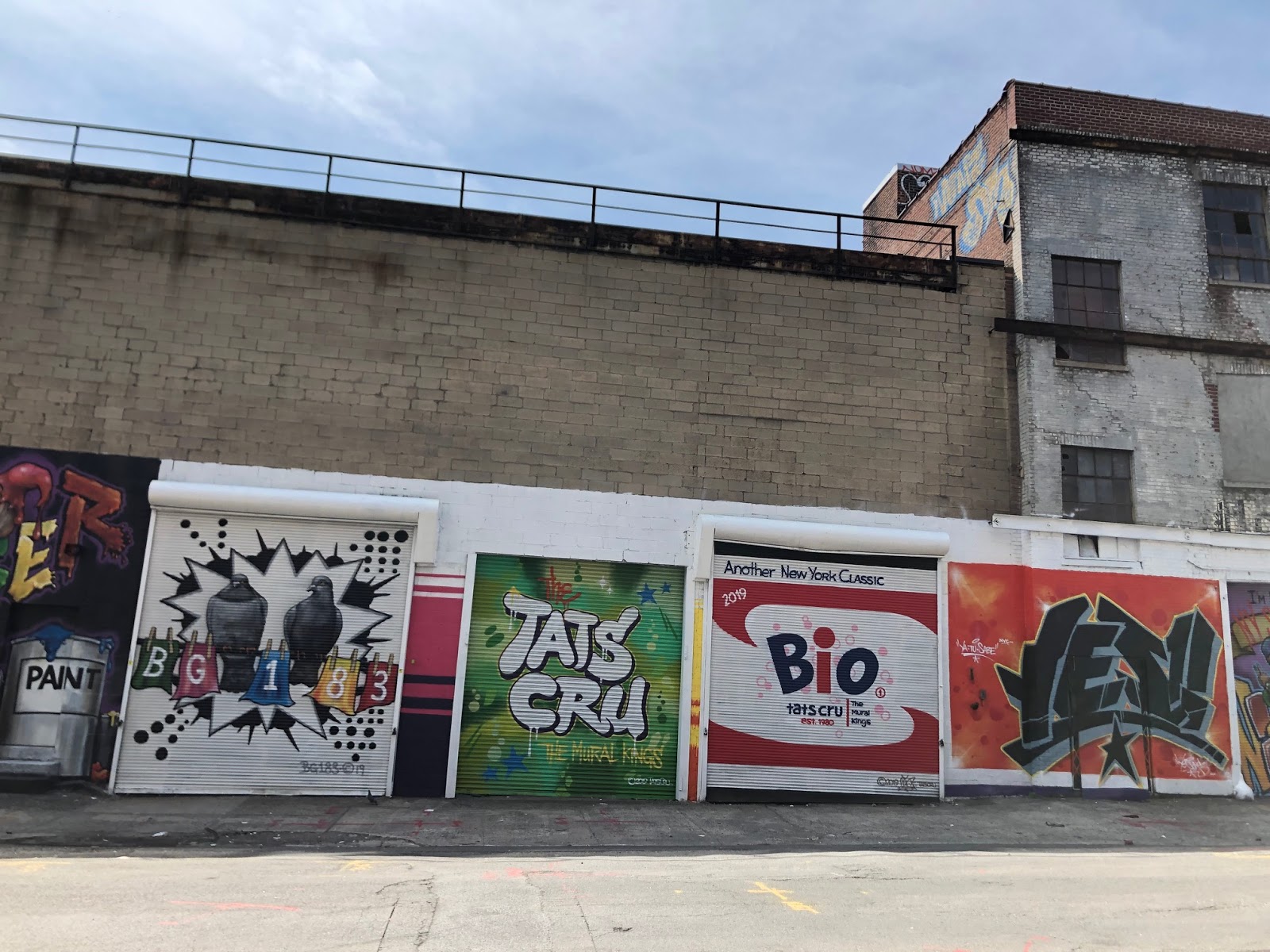
Along Willow Avenue, I pass a great piece of street art.  But on 141st, where I rode this morning, I encountered an even grander (OK, the artists themselves probably wouldn't use such a term!) urban artscape:


Tats Cru is a group of graffiti artists who have become muralists.  Depending on who you ask, they "evolved", "went mainstream" or "sold out".  I suspect that when they reached an age at which they had to support themselves, and possibly others, they took whatever someone was willing to pay for their work.  I can't say I blame them.


What it means is that some of their work, at least, will survive.  And so will they.  I am happy for that.  So many people and things haven't--except in the memories of people who've lived, and cycled, in this city.


08 April 2019

Bicycle Ambulances In Uganda Are FABIO!

There are some places that can't be reached easily, or at all, with cars or trucks.  In some places, like rural Uganda, that can be a matter of life and death. 


Uganda's infant, newborn and maternal mortality rates are among the highest in the world.   The harsh terrain spreads between the vast distances pregnant women often must traverse in order to get care for themselves or their newborns.  As an example, early in her pregnancy, Sandra Naigaga had to walk more than four kilometers (2.5 miles) to access antenatal care in Kibibi.  Later in her pregnancy, that distance may as well have been the distance to the moon.


Fortunately for her, the First African Bicycle Information Organization (FABIO:  Could you ask for a better acronym?)  introduced bicycle ambulance service to her region's two major health centers late last year.  FABIO has been offering similar services, ferrying pregnant women as well as other people needing medical care, in other parts of Uganda since 2006.


Sandra Naigaga (R) after arriving at the antenatal care centre in Kibibi


Aside from the services it provides, another thing that's great about FABIO is that it tries to maintain an environmentally sustainable system that can be easily maintained by local people using local materials from local sources.  So, the ambulances are built around basic black bicycles for which spare parts are readily available, even in such a remote region. And the carts that are attached to those bicycles are made from locally-sourced materials.  FABIO's ambulances are thus "African solutions to African problems," in the words of field officer Jeremiah Brian Nkuutu.  

Jeremiah Brian Nkuuti welding a carriage for a FABIO bicycle ambulance.


While most of the bicycle ambulances are of the pedaled, mechanical kind, FABIO also has ambulances towed by rechargeable e-bicycles.  These are used in hilly areas and, like the bicycles, are chosen for their reliability and the local availability of spare parts.


07 April 2019

What They Notice

Years ago, I would attract attention while riding my bike.  In many communities, people stopped riding bicycles as soon as they were old enough to drive--if, indeed, they ever rode bicycles in the first place.  Seeing an adult on two wheels instead of four, and pedaling instead of stepping on a gas pedal, was strange for many people.  

And, in my workplaces, I was "the one who rides a bike."  I didn't mind the appelation:  I simply wished others would ride.

Apparently, it's still possible to get attention simply by riding a bicycle: