14 July 2018

Seeing A Thousand Faces Of Buddha

Bike shops need a lot of space.  At least, that's what the prevailing wisdom says.  Many shops in cities like New York have gone out of business or moved because they couldn't afford or find the amount of space they needed.

So, folks in the bike business pride themselves on their creative use of space.  Most of them, though, have nothing on this shop I passed yesterday:


The place is located in a stall along one the main streets--National Highway Number 6--in the town where I woke up yesterday morning.  In a way, Route 6 is a bit like US 1 on the East Coast of the US:  It passes through a number of cities and towns, and takes on different street names.  Some of those streets are, or were, the main commercial strips of their communities.

And so it is here.  That shop is in a stall nestled among others selling everything from fried chicken to cell phones.  One of them is even a mini-bank, complete with a currency exchange.


All right.  So now you know I'm not in the USA.  The funny thing is, when I arrived, I exchanged some greenbacks for the local money but I didn't need to.

No, I am not in a Mexican border town.  In fact, I'm not anywhere in the Americas


or, as you've probably gathered by now, in Europe.  I haven't done any bike riding yet, but I have been transported by someone else on two wheels.  And I was riding on two.


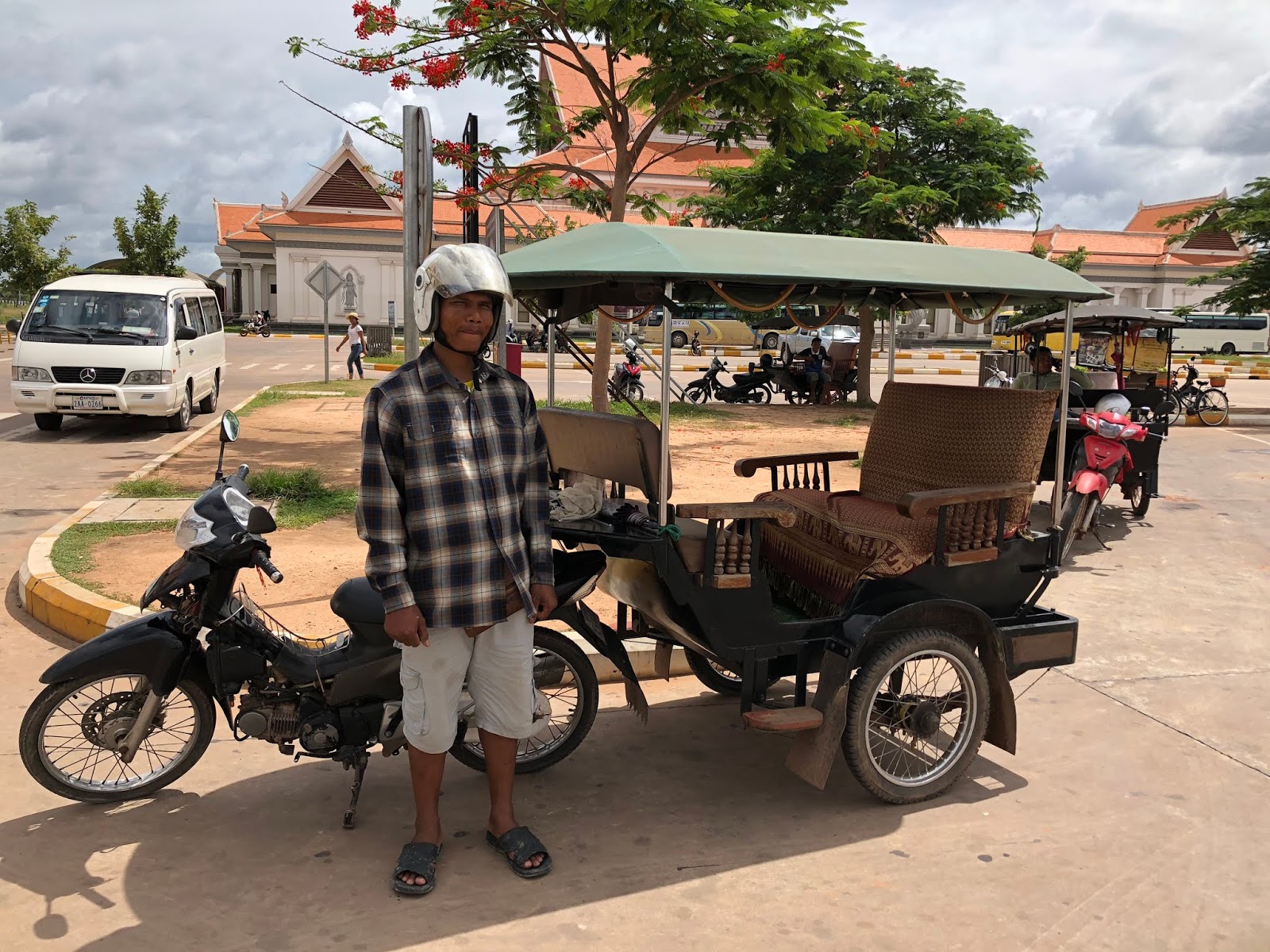
I was brought to the museum by a tuk-tuk driver.  A tuk-tuk is an inimitable form of transportation that provides natural air conditioning but absolutely no cushioning from bumpy roads, which are the majority of byways in this place. Think of a pedicab towed by a motorcycle.

The Museum provides, among other things, detailed information about the history and formation of this area's most famous landmark--one that's been called the "eighth wonder of the world."  It also has exhibits of the people's history, culture and religions, all in halls arranged around a lily pool.


Now if that all doesn't scream "Southeast Asia," I don't know what does.  I am indeed in the heart of it:  Siem Reap, Cambodia.  In the coming days, I will be visiting the landmark--Angkor Wat--as part of a bicycle tour.  I'm sure it won't be my only visit there.  But I'm glad i took the advice of a young woman at the guest house and went to the museum--the Angkor National Museum--first.


This room contains "1000 Faces of Buddha"


I "went native", sort of:  I had noodle soup and a small fruit salad (actually, a few slices of banana and jackfruit) for breakfast.  The  guest house offered that, as well as the "continental breakfast" served by seemingly every other hotel in the world.  The soup actually tasted fresh and succulent with chunks of chicken, broccoli and other vegetables.  I could make a habit of starting my days with it!

Hmm...Might I develop other new habits in this place?

13 July 2018

Where Is She Now?

I've arrived!  

Well, at least I'm at my destination, for now.  I'm still napping on and off, so I have only seen a little--and done no bike riding--so far.

I'll give you some clues as to where I am.  Part of my trip involved riding this:


And I entered this land through a portal:


Along the way, I saw this:


Well, all right, that doesn't tell you much.  I did push the green button:  the bathroom was one of the cleanest I've seen in a public place!

Everything that follows will be more interesting, I assure you!

12 July 2018

On My Way, Again

Well, I'm off to another adventure.  You'll soon hear about it.  I may not make daily posts because I don't know how good the Internet connections are where I'm going.  Also, I might just be too busy riding, walking and taking in the sights, sounds and other sensory details to spend much time in front of a screen!

All I'll say is that it's very far from any place I've never been before and that the people's first language is one I don't speak.  You might say that this trip is my other "big" gift (along with Dee-Lilah, my new custom Mercian Vincitore Special and the yet-unnamed vintage Mercian I just bought) to myself for my round-number birthday.


I hope you'll accompany me!


11 July 2018

What Does He Think Of His "Bicycle Friendly" City?

This is a question I've asked, sometimes rhetorically, on and off this blog:  What, exactly, does it mean to be a bicycle-friendly city.

In the immortal words of one Dr. Tom Hammett of Chattanooga, Tennessee, his city's boast of "Bicycle Friendly" status is "mere bull droppings."  In a letter he wrote to his local newspaper, he writes of the hazards that still exist for cyclists, including those too often imposed, wittingly or unwittingly, by law enforcement officials.  One of them, he says, nearly killed him.

You might disagree with his politics, but he does make a valid point:  that in most cities, even the so-called bicycle-friendly ones, safe facilities for cyclists are "limited and do not serve the entire city," as Dr. Hammett complains.  "In general, our transportation grid is lousy," he points out.  Which brings me to another point: You can't have a bicycle-friendly city unless the whole transportation grid--including that for motor vehicles, not to mention public transportation--is well-designed.  Few cities, at least here in the US, have those things. Simply having a car-free commercial strip downtown doesn't cut it.

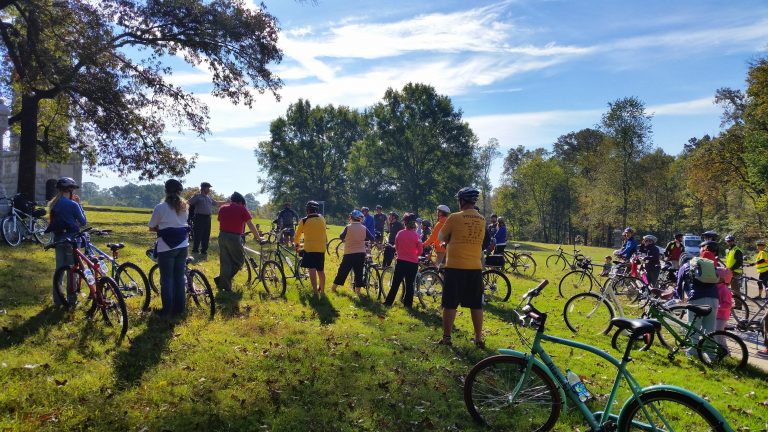
Cyclists at the Chickamauga Battlefield, Chattanooga, TN. From Outdoor Chattanooga.


What's really interesting is that Dr. Hammett isn't some hipster who moved into the city because he wanted to walk to his favorite bar and pedal to work.  He is a retired physician who says he "loves" Chattanooga--where, apparently, he spent his professional, if not his entire, life.  And he recognizes that his, and other people's (whether or not they're cyclists) quality of life in that city is intertwined with making it truly "bicycle friendly."

10 July 2018

Chasing Storms, And History

When I was a student, one of my classmates said he wanted to become an agricultural metorologist.  Naturally, being a city girl (well, guy in those days), I didn't know such a job existed.  So he furthered my education.

Anyway, he once said only half-jokingly that his studies and an internship in a weather station actually made him a worse forecaster.  Growing up on a farm, he said, you read almanacs and learn how to read the sky, the wind and other parts of your surroundings.  Studying meteorology, he said, "takes you away from that" because "it's all about technology" which, he claimed, "destroy your intuition and common sense."


William Minor probably would agree with him.  He left a 30-year career as a news reporter for the Miami Herald and moved to Pennsylvania, where he lives a plain and simple life among the Amish.  But unlike the Amish, he spends a lot of time away from home, chasing storms--or, more precisely, weather.  On his bicycle.


William Minor, center, with biologist Jan Goodson and NC State College intern Austin Mueller.


Since he is a volunteer firefighter (at age 75!) in his new home, he also uses his work to help raise awareness of volunteer fire departments, which he says are vital to the fabric of America.  Wherever he goes, he checks with a state trooper or other law enforcement official to help him find a local fire station and make contact with its chief.  Once he finds them, he asks whether he can stay.  They usually oblige him but, as he says, he promises to keep out of the way and spends time helping to clean them and with other tasks.  

In away, those two pursuits--weather and fire departments--aren't so disparate.  Going around the country by bicycle helps Minor to see them close up and document how they are changing--and how they, in turn, can change the country.

Wherever he goes on his bicycle, he tows a trailer full of equipment that he uses to take soil samples, record cloud patterns and gather other data.  He emphasizes that he is not a meteorologist; rather, he is a researcher, just as he was when he was writing about Watergate or his travels with Jacques Cousteau.  

He does, however, offer some warnings.  "The earth is in for a major weather cycle," he declares, and all of it--at least on the East Coast of North America--has Hurricane Matthew as its precursor.  "We fail because we don't pay attention to history," he warns.

He believes that he is recording that history from his on-the-ground data.  We had better weather forecasting forty years ago, he explains, "when there were only two weather satellites.  Now there are 19-plus" but people don't pay attention to what's going on around them and notice the patterns, he says.

Hmm...I wonder what that old classmate of mine is up to.  If he's a meteorologist, agricultural or otherwise, perhaps he should get on a bicycle and follow William Minor.  The firefighters would probably welcome him.


09 July 2018

A Ride That Leaves Nobody Behind

People have gone on bicycle rides to support all kinds of causes,from veterans' affairs to peace, from liberating people to conquering diseases, and everything in between.  I've participated in a few myself.  The great thing is that most cyclists ride for causes I support.

That includes Gennadiy Mokhnenko.  He's a pastor who directs the Pilgrim Republic Children's Home in his native Ukraine.  Its focus is on orphans and other "vulnerable children"--of which the Ukraine, like many other countries experiencing upheval and poverty, has many.


In fact, one of those children became one of 32 childen Mohnenko and his wife, Lena, have adopted.  Andrey Dudin was the first of them, in 1999, when he was 12 years old.  He'd been homeless for six years when the Mohnenkos took him in.  Now he is accompanying Gennaidy on the US leg of his World Without Orphans bicycle tour, which began in 2011.


They ride every summer and the US leg of their ride is being supported by Serving Orphans Worldwide, a nonprofit organization based in Bristol, Tennessee.  Its work complements that of the Pilgrim Republic Children's Home, in that it rescues, trains and supports struggling childrens' homes worldwide.  Both organizations want to dispel some of the myths about adoptive children:  namely, that they can't be loved as much as biological children and that if their biological parents were addicted to drugs or alcohol, they will end up the same way.  "It's a stupid idea," says Mokhnenko.  He uses himself as an example:  "I grew up in an alcohol addicted family and I'm a pastor of 27 years."


As of this writing, he, his adoptive son and other cyclists are riding through Tennessee. They began this part of the tour in Los Angeles in May and will end in about three weeks, he says, when they reach Miami, Florida after "pedaling 60 to 80 miles a day."


08 July 2018

Which Way Will You Go?

During my childhood, it seemed that every bike manufacturer was trying to appeal to boys' fantasies of driving "muscle" cars down endless stretches of highway. Examples include Schwinn's "Krate" line,and Raleigh's "Chopper."

I was reminded of those bikes when I came across this:


Keep your eyes on the road and your hands on the wheel!

07 July 2018

What If George Mount Had Gone To Moscow?

If you are "of a certain age," as I am, you might remember a recurring Saturday Night Live sketch called "What If?". It was a sendup of talk shows that presented counterfactual historical events.  Perhaps the most famous of them was "What If Eleanor Roosevelt Could Fly?"

Since then, the internet has opened the door to all manner of "alternative history" sites and discussion boards.  Some are, of course as far-fetched (in some instances, without trying to be) as SNL's segments.  But others pose some really serious and interesting questions. For example:  What this country (and world)  be like had Franklin Delano Roosevelt had kept Henry Wallace as his Vice President in 1944 and not allowed Democratic party bosses throw him under the bus in favor of Harry Truman?

Now, this post is not going to ponder anything quite as earth-shattering as that.  Instead, I am going to pose a question that entered my mind after reading an excerpt from Daniel de Vise's The Comeback:  Greg LeMond, the True King of American Cycling, and a Legendary Tour de France.  In it, de Vise discusses the racing scene that developed in and around Berkeley, California in the late 1950s and early 1960s, when cycling was a fringe activity in the US.

A decade later, one of the first world-class male American riders since World War I would emerge from that milieu.  He would finish his career with 200 victories in amateur and professional races. But it was a sixth-place finish that really set the stage for the generation of American riders--which included LeMond--that would follow.

When George Mount finished three places behind the medal-winners in the 1976 Olympic road race, it was by far the best showing by an American rider since Carl Schutte won the Individual Time Trial bronze medal (and the US team won the bronze for the Team Time Trial) in 1912.  In the six-plus decades since Schutte and his teammates ascended the podium, no American rider or team had placed in the top 60 in any Olympic competition.

George Mount, circa 1974


Mount's ride in Montreal was broadcast all over the world.  It was the first time in decades significant numbers of Americans paid attention to bike racing.    Some European scouts took notice of him, too, and soon he found himself racing with an Italian club.  In his early 20s at the time, he seemed destined for greater successes--including a medal at the 1980 Olympics, held in Moscow.

Except that he didn't get the chance to go to Russia.  In response to the Soviet Union's December 1979 invasion of Afghanistan, US President Jimmy Carter declared a boycott of the Games.  Other countries would also decide not to send their athletes to Moscow that year, though some for other reasons.  

Though he has never said as much, it's hard not to think that the missed Olympic opportunity was at least one reason why Mount decided to turn professional that year.  He would enjoy success on the European racing circuit, and expressed no regrets when he retired from racing just before turning 30.  Still, it's fair to ask whether spending another year or two as an amateur--and winning an Olympic medal--might have aided him in his development.  Would his continued successes created momentum that American cycling could have ridden (if you'll pardon the expression) well beyond LeMond's victories?


06 July 2018

Riding Every Linear Mile

One of the great things about cycling in my hometown of New York is that it allows me to see a lot of street art close-up.  My commute to work takes me through an industrial area of the Bronx where murals of one kind and another cover the walls of industrial buildings.  It's become such a part of the landscape that nobody, it seems, refers to it as "graffiti", a term that implies impermanence and echoes disdain.

I have also seen street art, or the art of industrial spaces, while pedaling through streets and along canals and railways (some disused) in other cities on both sides of the Atlantic.  I'm sure other cyclists have had their minds and senses similarly enriched in cities I have yet to visit.


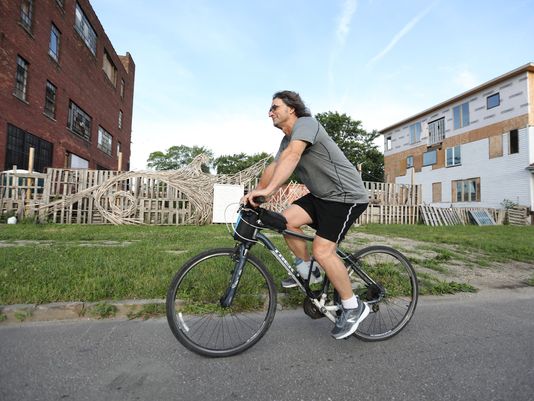
Detroit is one of those places and Thomas Leeper is one of those cyclists.  Except that he claims he's "not really a bicyclist."  Whatever he chooses to call himself, he's ridden 2200 miles of The Motor City's streets during the past sixteen months for his passion project, Every Linear Mile.  


He's been photographing graffiti, murals and other kinds of art, including found-object-art, he's seen along the way.  His goal, he says, is to "give kudos" to folks who are "helping to beautify the city" with their work.  "Ninety-nine percent of it was created with no financial incentive in mind," he explains, so their efforts don't cost anything to the financially-strapped city.


Since he began the project, he's had 11 flat tires, stepped on seven nails, has had nine verbal offers of drugs and been chased by eight dogs.  "I've learned how to ride fast when I need to," he says, and keeps pepper spray on him, but "has never really felt unsafe."  


05 July 2018

When I Couldn't Look Out

The other morning, I woke up early and wasted little time in getting in the saddle.  I figured that if I got home by noon--which I did--I could beat the worst of the heat and humidity predicted for the day.

The weather reports also said there could be heavy fog and mist in coastal areas--where, of course, I planned to ride.  Specifically, I headed for Point Lookout because I enjoy the ride and because it's 125 kilometers:  not a bad before-lunch total.

I knew about the construction at PL, but I didn't mind:  I knew that, as the name implied, there would still be something worth looking out at.  And I figured the mist and fog would make it seem even more littoral.


That they did.  But the only problem was that I couldn't see anything at all, besides machinery, at Point Lookout.


Should it have been renamed, if only for the day?

04 July 2018

The Fourth

In France, they have le quatorzeHere in the US of A, we have The Fourth.

It's what we call our Independence Day.  Today, though, when I hear "the Fourth", I can't help but to think of the Amendment--which, like so much else in the Constitution, is in peril.

But The Fourth is also my birthday.  And this year it just happens to be a round-number year for me.  I'll let you guess which one! 


For the occasion, I gave myself a gift--which actually came to me all the way back in March.  I am referring, of course, to Dee-Lilah, my new Mercian Vincitore Special.


You could say, though, that I got an unexpected gift when the bike I mentioned yesterday--a 1973 Mercian King of Mercia--showed up on eBay.  In my size.  And the seller dropped the price.


And I'm going to meet friends.  I am lucky indeed.  Now, to do something about my country!

03 July 2018

I Could Blame Them....For This!

Blame Phillip Cowan.  And Coline.  And Leo.

I swear, they nudged me into it.  Yes, even though Phillip is in another part of my country--and Coline and Leo are in faraway foreign lands--they completely short-circuited my self-discipline.  Really, they did.  You know, they used powers that, in most circumstances, I deny believing in (sort of like a lot of conspiracy theories).  In the end, I simply couldn't stick to a promise I made myself.

And I've waited a couple of weeks to tell you about it, dear readers, because, well, I don't want to show how weak and vulnerable and suggestible I am.  I know, I don't have to pretend to be a Gary Cooper-type macho-guy anymore. (As if I ever did!)  Even when I end up loving what I'm pushed or cajoled into doing, it pains me to admit it!

So what am I talking about?  First, I'll mention the promise I made:  After Dee-Lilah, my new Mercian Vincitore Special came into my life, I swore I wasn't going to buy another bike.  Of course, we all know that such a pledge from a bike enthusiast is about as credible as anything a politician says when running for office.

And into what trepidation and turpitude did this ruptured oath lead me?  Well, instead of describing it, I'll show you the evidence of it:

Yes, I bought the Mercian-painted-like-a-Motobecane I sort of mocked in a post last month.  Really, if Phillip, Coline and Leo hadn't egged me on in their comments, I never, ever would have done such a thing.

Riiiiight, you say.  You believe that like you believe a single bullet killed JFK--or anything in the 9/11 Commission Report.

All right, I'll admit it:  I wanted that bike.  These days, I shy away from bikes in any combination of black and red because it's so common on new bikes--and done with none of the style of those old Motobecanes. Or this Mercian.


I finally bought the bike two weeks after that post, after the price dropped a couple of times. So what did I get?


Well, it's a King of Mercia built with Reynolds 531 throughout (of course) in 1973.  Somewhere along the way, it was repainted (originally, it was all red), which is why the Reynolds 531 decals aren't from that period.


But almost everything else on the bike is:  Check out the 1973 Campagnolo Nuovo Record gruppo.  I love the crank and large flange hubs--with the old-style flat-lever skewers.  And the shifters--with Campy lever covers!


Then there's--what else?--a Brooks Professional saddle.  And the Cinelli bars and stem.  The only non-period parts are the rims, spokes, tires, freewheel and chain.  


I am guessing that the bike originally had sew-up tires and rims, and someone rebuilt those wheels with Mavic Open Pro rims and DT spokes.  Of course, Mavic OP is my go-to rim for high-end wheels, and in silver it looks like a classic rim.  Hey, the wheels even have 36 spokes.  The bike was shipped with cheapo tires, one of which was worn.  I replaced them with Continental Grand Prix 4 Season tires--another favorite.


I also would imagine that the drivetrain originally included a Regina freewheel and chain, which were standard on Campagnolo-equipped machines. (Some Italian bikes came with Caimi/Everest.)  The freewheel I received, however, was a SunTour ProCompe and a chain whose provenance I couldn't determine.  That wasn't a problem:  I replaced them with a SunTour New Winner freewheel (5 speed, 13-26) and a Sedisport chain.  I replaced the two small cogs on the ProCompe and will most likely use it on my Trek.


I've ridden the bike only twice, and am astounded at how similar it is to Dee-Lilah:  very quick, smooth and stable.  The only other change I plan on making is a stem (Cinelli, of course) with a slightly longer extension--and to replace the Cycle Pro toe clips (pockmarked with rust) with a pair of Christophes.  

The bike was shipped to Bicycle Habitat, and Hal assembled it.  Of course, he took it for a ride.  When he called to tell me the bike was ready, he exclaimed, "You're really gonna like it!"  He's right.

I'm so lucky:  Dee-Lilah, and now this bike!  But they are going to have different roles:  Dee-Lilah is a modern/classic or classic/modern bike, depending on how you look at it (Reynolds 853 tubing with fancy lugs, traditionally constructed, kitted with modern components--and a Brooks Pro.)  On the other hand, if I do L'eroica--or any other event for vintage bikes--you know what I'll ride.

(P.S.  I have a handlebar bottle cage which I believe to be a Specialites TA.  If it isn't, it sure looks like one.  I might put it on this bike--if I can find some clamps for it.)

02 July 2018

A Mission To Be Seen

Bicycles with integrated lighting systems are usually associated with touring bikes and randonneuses from the constructeurs and, to a lesser degree, high-end builders in other countries.  A few production bikes have been supplied with generators built into a bike, or more commonly, a hub, and lights built onto racks and fenders, if not the frame itself.  

Such bikes usually have wires routed into the fenders or racks so they are not only not visible, but not vulnerable to being snagged and snapped.  A few bikes have wiring built into the frame itself.


While it's nice to have lights built into a bike that's frequently ridden in the dark, they are vulnerable to theft if the bike is frequently parked on the street, particularly in the same spot.  Also, light technology has improved dramatically (though, I admit, I prefer the styling of old lights) and a built-in system might tie its rider to an inferior technology.

The latest technology in bike lights, and lighting generally, is Light Emitting Diodes (LED).  This makes smaller, sleeker and lighter (in weight as well as luminosity) units that can fit more easily on different parts of the bike.  They are as much an advance as halogen lights were when they appeared about 35 years ago and displaced the incandescent bulbs that had been in use almost since their invention. (A few lights were made with fluorescent bulbs, but the idea never caught on because they're not good at throwing a beam forward, even through a lens with the best of optics.)


Apparently, someone out in San Francisco wanted a built-in lighting system with the advantages of LEDs.  The result is that Misssion Bicycles, a local company, has just introduced a bike with LEDs built into the inside each fork blade and on the rear of the seatpost.  They are powered by a rechargable battery inside the headset that can be turned on by a cap on the stem.  Thus, the bike shares one characteristic of those custom bikes with integral lights:  wires that run through the frame.


Such a system, to me, makes sense on a bike used for commuting in an urban area.  The lights wouldn't do much to help a rider see the roadway ahead, but they will help him or her be seen in traffic--which I know, from experience, is far more useful for night riding on city streets.  And they would be more difficult to steal than other kinds of lights when the bike is parked.  The one downside I can see is that if the lights need to be replaced and a new technology displaces LEDs.


01 July 2018

An Egg-Strodinary Ride!

Back in the day, I rode with the Central Jersey Bicycle Club.  During the winter, one of CJBC's Sunday rides involved pedaling about 20 miles to a rural fire station and joining the firefighters, as well as what seemed to be everybody in the village, for an "all you can eat" breakfast.

A popular platter was the "Fireman's Special", which included a couple of pancakes; a couple of pieces of bacon, sausage or some other unhealthy meat; a couple of eggs in whatever style you prefer; and, it seemed, whatever else would fit on that plate.

The food wasn't the greatest, but when you're riding on a cold morning, you tend not to be picky. (Also, it was dirt-cheap:  no small consideration when you're a poor college student, as I was!) Besides, the point of the ride seemed to be, more than anything, camaraderie, with CJBC riders, the people of that village, the firefighters and anyone else who got up early on a cold Sunday morning.

Since then, I've gone on other rides that have included breakfasts, weekend brunches, lunches or other meals.  Sometimes, I'm sure, the food actually was good; other times, I was hungry or simply enjoying my time riding and the company of others.  I can guarantee you, though, that no ride of mine ever included food like this:


30 June 2018

A Contest After My Own Heart: Bicycles And Art

I'll admit:  This post is little more than an excuse to display an image I like.

Is this how Van Gogh would have painted a bicycle?


Whatever the intent of the artist, it's great for promoting a bicycle-themed art contest.  (Well, it got my attention, anyway!)  "The Bicycle:  Art Meets Form" is an invitational juried show sponsored by the Theatre Art Galleries in conjunction with the High Point Cycling Classic.  Winning works will be exhibited from 30 August until 28 September.


If you're interested in entering, you have until 25 July. 
For more information, go to http://tagart.org/.


Good luck!  


29 June 2018

Off The Island With Them!

Yesterday I wrote about cops who break the law--specifically, one that forbids cycling on the sidewalks of Denver.  I also mentioned that those same officers routinely overlook violations of said statute.

Now, to balance things out, I'm going to write about two constables who broke a law pertaining to cycling--with less reason than their peers in the Mile High City--and were arrested for it.

Actually, the law isn't about bicycles specifically.  But, given its locale, it has special resonance for cyclists and makes the policemen's offence all the more egregious.

Lt. Andrew Longuski and Detective Sgt. Derrick Jordan work in the Polygraph Section of of the Michigan State Police's Biometrics and Identification Division.  Now, if any two officers know about your chances of getting busted if you commit a crime, I would expect them to be the ones.


They were attending a training conference on the Great Lake State's Upper Peninsula when they decided to go for a joyride on Mackinac Island.  As I mentioned in an earlier post, motorized vehicles are not allowed on the island, so people usually get around on foot or by bicycle.  And some of those bikes are tandems.  Thus, two guys on a bike built for one would--and, in their case, did--attract attention.

That, and the fact that the bike had a pink seat.  Longuski pulled up to Jordan and offered to let him ride with him to a watering hole. 

Now, even though a couple of cops on a bike built for one raised a few eyebrows, it probably wouldn't have gotten them in trouble had the bike not belonged to either Longuski or Jordan.  


Apparently, the cops-turned-perps didn't realize that the offenses for which officers of the law cannot be indicted do not include taking a bike that is not one's own--especially in a place like Mackinac Island.  Oh, and immunity doesn't extend to Disorderly Conduct, a charge that most likely stemmed from their heated exchange between them and the Island's law enforcement officers.  

Both officers pleaded "not guilty" at their arraignments on 30 May and were released on bond.  They are due back in court in July and face up to 93 days in jail in addition to fines.

Hmm...This is an interesting "not guilty" plea from a couple of polygraph experts.  Perhaps the truth is subjective, after all.


28 June 2018

Fighting For Scraps At The Edge In The Mile High City

When I was writing for a local newspaper, a kinda-sorta-somewhat high-ranking (Is that vague, or what?) police officer admitted that  he didn't make arrests or even give summonses for some low-level offenses.  "Is it because you want to spend your time and energy on more important things?"

He shook his head.  When I reassured him that our conversation was off-the-record, he admitted that he doesn't give tickets or arrest people for some of those minor infractions because, well, he has committed "most of them" himself at some point or another in his life.  

Now, as I understand, here in New York, as in many other places, police officers are exempt from some of those charges.  The same holds true in Denver, where they cannot be charged with an offense they rarely ticket:  riding a bicycle on a sidewalk.

The Mile High City's statutes on this matter are similar to those in many other places:  The rule doesn't apply if the sidewalk is part of a designated bike route. Also, police who are riding their bikes as part of their uniformed duties, as well as other uniformed city, state and federal employees are exempt.  So are newspaper deliverers.

Denver police officers on the 16th Street Mall during the 2008 Democratic National Convention.


Oh, one other group of cyclists is allowed to ride on the sidewalk:  Those within one block of preparing to dismount their bikes.  That alone is probably a reason why cops don't enforce the policy:  How are they supposed to know that a cyclist is going to dismount on the next block?

But the vagueness of that part of the law is not the only reason why it's infrequently enforced in Colorado's capital. According to a recent report, the officers themselves admit that cycling on some of the city's streets is simply unsafe, and the sidewalk is the only viable alternative.  

One officer added that his exemption from the law is not the only reason he violates it.  "I'm not going to get hit," he explained.  He, perhaps not surprisingly, admitted that he has never ticketed anyone for the violation.

Jill Lancatore, Executive Director of the nonprofit advocacy group WalkDenver, says that officer's perception hit the nail on the head.  Though she acknowledges pedestrians are frustrated, she cautions against making the issue one of pedestrians vs. cyclists because "So much of our public right of way are dedicated to cars that everybody else is pushed to the fringes and we're fighting for scraps at the edge of the roadway."

I have not cycled in Denver but, based on what I saw in other parts of Colorado, I imagine it's more spread-out and car-centric than my hometown or places like San Francisco or Portland. From reports I've read, streets are particularly narrow, probably as a result of constraints of construction in the mountains.  That, in and of itself, is a reason to make cycling safer and thus more enticing to more people.  

But there is another reason:  In part because of its altitude, Denver has some of the worst air quality among major American cities.  So, working to make cycling safer can only help to improve residents' health as well as safety.

Until then, cyclists, pedestrians and other non-motorists will "fight for scraps at the edge," as Lancatore says.  And cops like the one I mentioned will look the other way.